EU Rail Booking Rules: One Ticket Across Europe
Europe has been very good at selling the idea of seamless travel. The reality, as anyone who has tried to book a cross-border train journey knows, has often been much less elegant.
You want to travel from Zagreb to Vienna, Paris to Milan, Amsterdam to Zurich, or Brussels to Barcelona. In theory, rail should be the obvious choice: cleaner than flying, more comfortable than a coach, and often city-centre to city-centre. In practice, the booking process can still feel like a puzzle. One operator here, another platform there, separate tickets, unclear transfer protection, different refund rules, and too many browser tabs open at once.
That is exactly the problem the European Commission is now trying to fix.
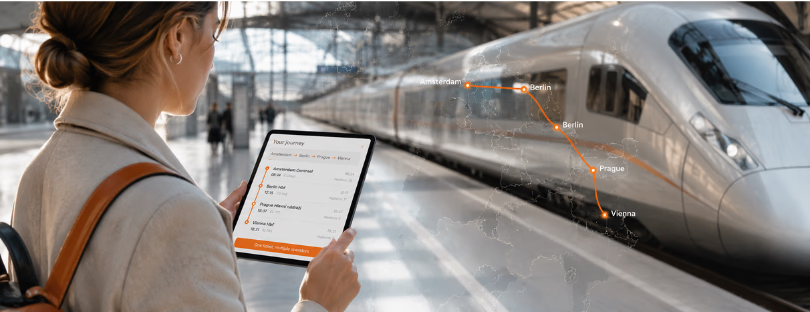
On 13 May 2026, the Commission proposed a new passenger package designed to make regional, long-distance and cross-border travel easier to plan and book, with a strong focus on rail journeys involving multiple operators. The headline idea is simple: one journey, one ticket, and passenger rights that cover the whole trip.
The single-ticket promise
The most important part of the proposal is the push for single-ticket bookings across multiple rail operators. Instead of passengers having to stitch together separate tickets from different national rail companies, platforms would be able to offer combined rail services in one transaction.
That matters more than it sounds.
A single ticket is not just about convenience. It changes the risk for the passenger. Today, if your first train is delayed and you miss the second leg, your protection often depends on how the tickets were sold, whether they count as a through-ticket, and whether the operators are covered by specific agreements. For many travellers, it is impossible to understand before booking.
Under the Commission’s proposal, passengers travelling on a single ticket across multiple operators would get stronger protection if something goes wrong, including assistance, rerouting, reimbursement and compensation. In plain English: if the rail system sells you the journey as one trip, it should take responsibility for the journey as one trip.
This is the kind of rule that sounds obvious only because passengers assumed it already existed.

A fight over who controls the rail customer
The proposal is not only about passengers. It is also about power.
European rail is still shaped heavily by large national incumbents: Deutsche Bahn in Germany, SNCF in France, Renfe in Spain, Trenitalia in Italy, and others. These companies do not just operate trains. They often control powerful booking channels, customer relationships, timetable visibility and distribution access.
The Commission wants ticketing platforms and rail operators to work under fair, reasonable and non-discriminatory conditions. Platforms should be able to access and sell tickets more fairly, while travel options must be displayed neutrally. The proposal also says platforms should sort by greenhouse gas emissions where feasible, which could make rail’s climate advantage more visible at the moment of booking.
This is where the policy becomes commercially sensitive. Independent platforms such as Trainline, Omio and other digital travel sellers have long argued that rail is too fragmented and too difficult to compare. Large rail operators, meanwhile, worry that mandatory access rules could shift too much value toward digital intermediaries.
READ MORE: Italo Brings Starlink to High-Speed Rail
Reuters reported criticism from the Community of European Railway and Infrastructure Companies, whose director Alberto Mazzola argued that the EU should focus more on infrastructure than ticket sales. The Guardian also reported industry concerns that stronger platform access could increase the influence of tech intermediaries and potentially affect prices.
Both sides have a point. Europe does need better rail infrastructure, more capacity, better night trains, smoother border operations and faster connections. But pretending ticketing is a minor issue misses the obvious: if people cannot easily find and book the train, the train loses before the journey even begins.
Why this matters for travellers
For passengers, the current system creates friction at exactly the wrong moment. Cross-border rail should feel like booking a flight or a hotel: compare, choose, pay, travel. Instead, too many journeys still require insider knowledge.
The Commission’s own framing reflects a strong public demand for seamless travel solutions and reliable online booking systems. That is not surprising. Travellers are already used to digital ecosystems that hide complexity. They do not care which airline settlement system, hotel channel manager or payment processor sits behind the transaction. They care that the booking works.
Rail has been slower to reach that level of digital simplicity. And that matters for climate policy. If the EU wants more travellers to choose trains over short-haul flights, the journey has to be competitive before departure, not only onboard. Price, duration and convenience matter, but so does confidence.
A family planning a summer route through three countries should not have to become experts in rail passenger rights. A business traveller should not need to gamble on separate tickets. A tourist should not have to know which national operator owns which booking system.
The proposal is trying to turn cross-border rail from a specialist hobby into a mainstream travel product.

The bigger travel tech signal
This is also part of a wider shift in travel technology: distribution is becoming infrastructure.
The same thing is happening in aviation, hotels, mobility apps and even travel connectivity. The customer does not want to understand the back-end system. They want the offer presented clearly, fairly and reliably. Whoever controls the booking layer often controls the customer relationship.
That is why this rail package is bigger than rail. It is about whether Europe can make public-interest mobility work in a platform economy without handing everything to either national monopolies or global tech platforms.
READ MORE: The New Battlefield of European Rail Luxury: SNCF Optimum vs. Trenitalia Executive
There are useful comparisons here. Airlines have spent years moving toward more integrated digital retailing, even if the process is messy. Hotel booking platforms made comparison easy, but also created dependency problems for hotels. Travel eSIM marketplaces did something similar: they simplified choice for consumers, while forcing providers to compete on visibility, price and trust.
Rail is now facing its own version of that battle. More openness could unlock demand, but it needs careful rules so the market does not simply move from operator fragmentation to platform dependency.
Final take
This proposal is a necessary correction, but not a magic fix.
Europe cannot build a truly competitive rail alternative to flying if booking a multi-country journey still feels harder than buying a low-cost airline ticket. Single-ticket protection, neutral comparison and fair platform access are practical steps in the right direction.
But the bigger challenge is coordination. Rail operators need to stop treating ticketing data and customer access as defensive territory. Platforms need rules that prevent them from becoming the new gatekeepers. And policymakers need to understand that digital simplicity and physical infrastructure are not separate priorities. They are part of the same travel experience.
If Europe gets this right, rail becomes more than a sustainable option. It becomes the obvious option. And that is the real test.