Travelport, Cognizant and Anthropic Bet on AI Travel Tech
Travelport, Cognizant and Anthropic are not simply adding another AI layer to travel technology. They are going after something less glamorous, and more important: the old plumbing behind travel retailing.
According to the announcement, Cognizant will work with Travelport on a strategic AI transformation using Anthropic’s Claude to modernize how Travelport builds, tests and maintains software across its travel retailing and distribution platforms. The aim is to speed up AI-led innovation for airlines, hotels, travel management companies and online travel agencies, while also embedding AI capabilities into Travelport’s own platform.
That sounds technical. It is. But the commercial point is simple: travel is becoming conversational on the front end, while many booking and servicing systems still behave like they were built for another era.
The gap to close
Travelers now ask AI tools for flexible routes, cheaper dates, complex business trips, family-friendly stays and backup options when disruption hits. The problem is that a good travel answer is not the same as a confirmed booking.
Behind every booking sits live availability, fare rules, refund logic, exchanges, servicing flows, traveler data and supplier systems. This is where many AI travel ideas start to look thin. They can inspire a trip, but they cannot always complete the work.
READ MORE: Travelport Expands NDC Reach with 4 Leading European Travel Tech Partners
Travelport’s bet is that AI needs to sit closer to the infrastructure layer. The company says the collaboration will help close the gap between AI-driven travel intent and a confirmed booking. That is the real story here: not AI as a glossy search box, but AI as a layer that helps interpret, execute and service travel properly.


Agents need fewer tabs
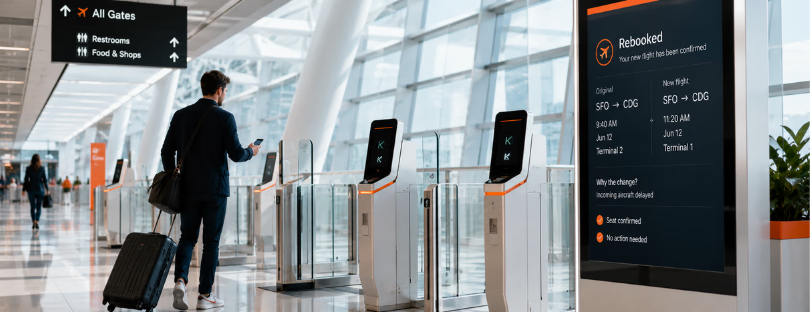
For travel agencies and TMCs, the promise is practical. Travelport says its platform will absorb more of the cognitive work agents currently do manually, from surfacing relevant options faster to automating exchanges and rebooking.
One example stands out: an agent managing a business traveler could surface routes with statistically lower disruption risk. That is not flashy, but it is exactly the kind of operational intelligence business travel needs.
Travelport’s customers indicate that saving even one hour per agent per day can translate into millions of dollars in annual productivity improvement.
The quotes matter
“The travel industry runs on some of the most complex technology infrastructure in the world, and the companies that will lead it forward are the ones investing now in how that infrastructure gets built,” said Ravi Kumar S, CEO of Cognizant. “This collaboration is about giving Travelport the tools to move faster and deliver higher quality at scale to meet the challenge of a changing travel distribution landscape. That’s what the AI Builder model is designed to do.”
Travelport CEO John Mangelaars was more direct about the timing.
“AI is not a future consideration, it is happening now, and the companies that move fastest and most intelligently will define the next era of travel technology,” he said. “Collaborating with Cognizant and Anthropic gives us a genuine AI superpower. Anthropic brings the most capable AI models and tools; Cognizant adds engineering talent and development capability to deploy them at scale; and Travelport brings the travel infrastructure and the partner network that connects it all to the real world of distribution and bookings.
“Anthropic also developed MCP, the protocol that lets AI agents interact directly with external systems and data,” Mangelaars added. “Choosing the organization that invented that protocol was a straightforward decision. Their approach to safety, reliability and controllability matters as much: travel is a high-trust environment where data is sensitive and the consequences of errors are real.”
That final point is crucial. Travel is not a low-risk AI playground. A wrong answer can mean a missed flight, a broken refund, a bad rebooking or exposed customer data. In this market, trust is not decoration. It is infrastructure.
Where the market is moving
Travelport is not alone. Amadeus, Sabre, large OTAs, airline retailing platforms and hotel tech companies are all trying to make travel selling smarter and more automated. The difference is that Travelport is putting visible emphasis on the engineering layer, not just the customer-facing AI experience.
The initial focus is Travelport Trip Services, which handles bookings, exchanges, refunds and servicing. That choice makes sense. Selling a trip is only the first step. The real test comes when the traveler changes plans, the airline cancels a flight or the corporate policy says no.
READ MORE: Cognizant and Rubrik Introduce Business Resilience-as-a-Service for the AI Era
Claude will support AI-assisted code development, test creation and pull-request review, while Cognizant will use its engineering platforms, including Neuro-san, the open-source library behind its Neuro AI multi-agent accelerator.
The real signal
The Travelport, Cognizant and Anthropic collaboration matters because it targets the part of travel AI that does not usually make pretty demos: servicing, exchanges, refunds, workflows and old business logic buried inside large platforms.
That is where the next advantage may be won. AI travel planners will keep getting attention, but infrastructure will decide who can actually fulfill the promise. The winners will not be the companies with the loudest chatbots. They will be the ones that can connect intent to execution without breaking reliability, compliance or trust.
For Alertify readers, this is the wider signal: travel technology is moving from search and display toward interpretation and action. In that shift, the companies modernizing their core systems now may be the ones that make AI useful when the traveler actually needs something fixed.