O2 Satellite for iPhone Expands UK Mobile Coverage
Virgin Media O2 is switching on O2 Satellite for iPhone from Thursday, 28 May, bringing direct-to-device satellite connectivity to a much wider slice of its customer base. On paper, that sounds like another network coverage upgrade. In reality, it is a clear signal of where mobile connectivity is heading.
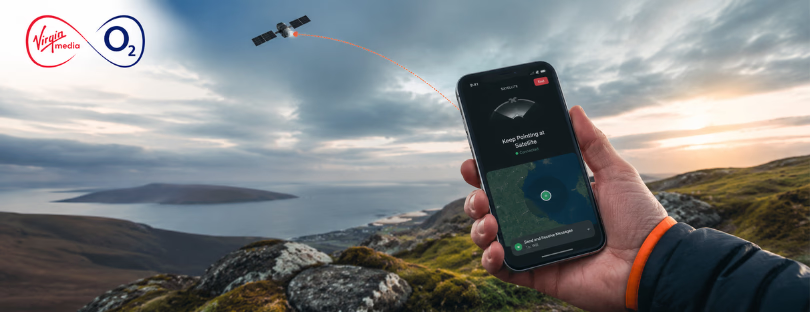
For O2 customers with compatible iPhones, the promise is simple: when there is no traditional mobile coverage at all, the phone can connect to the O2 network via satellite instead. No specialist handset. No separate device. No dramatic “off-grid” setup. Just a phone trying to stay useful when the mobile network disappears.
That matters in a country where coverage conversations often get stuck on population percentages. The UK can look well covered where people live, but rural roads, coastal paths, mountains, farms, rail routes and tourist areas still expose the limits of terrestrial networks. O2 Satellite is not about replacing 4G or 5G. It is about filling the awkward spaces where mobile networks have always struggled to justify traditional infrastructure.
Why iPhone support changes the story
O2 Satellite launched earlier this year as the first direct-to-device satellite mobile service in Europe, powered by Starlink Direct to Cell. The iPhone update is the bigger consumer moment because it puts the service in reach of millions more potential users.
Virgin Media O2 says the service automatically connects compatible smartphones to satellite when cellular coverage is unavailable. It supports messaging and data across selected apps, including Messages, Apple Maps, WhatsApp, Messenger and location services. The value is not only “can I send a text?” It is “can I message someone, share where I am, check a map, or keep a basic data session alive when normal coverage has vanished?”
Chris Bournes, Commercial Director at Virgin Media O2, put it clearly:
“Earlier this year, we made history with the switch on of O2 Satellite. Expanding the service to iPhone users is a major step forward in making this new, groundbreaking technology accessible to more customers. Whether you’re hiking, travelling or in a remote part of the UK, O2 Satellite helps ensure you can stay connected when you need it most.”
The service is available as a £3-per-month Bolt On and is included at no extra cost for O2 Ultimate Plan customers. Satellite connectivity is being introduced not as a luxury expedition product, but as a mainstream mobile add-on.

Coverage is becoming layered
The most interesting number is not the price. It is the coverage uplift. Virgin Media O2 says O2 Satellite has increased O2’s UK landmass coverage to 95 percent, adding an area equivalent to around two-thirds the size of Wales.
That does not mean the satellite suddenly turns every remote valley into a full-speed 5G zone. Direct-to-device satellite is still an early-stage layer with practical limits around capacity, app support, latency, indoor use and emergency calling. O2 itself says the service is designed to complement its mobile network, not replace it.
READ MORE: Virgin Media O2 Secures UK’s First Satellite-to-Smartphone Licence
But that is exactly why the move matters. The future of connectivity is not one network doing everything. It is a stack: terrestrial mobile networks for everyday capacity, Wi-Fi for indoor density, satellite for resilience and remote coverage, and software deciding which layer the user needs at that moment.
For travellers, hikers, rural businesses and remote workers, this is the part that will feel new. Connectivity is starting to follow the user rather than the mast.
The wider market signal
Virgin Media O2 is not moving in isolation. The direct-to-device race is heating up quickly. In the US, T-Mobile has worked with Starlink on satellite messaging and data ambitions. Vodafone has been testing satellite connectivity with AST SpaceMobile, including a satellite video call demonstration. Apple already offers Emergency SOS via satellite on compatible iPhones, but that is a different model: emergency-focused, device-led and not the same as a mobile operator extending its own network experience.
That distinction matters. O2 Satellite is an operator-led service, tied into a mobile plan and positioned as part of the O2 network. If this model scales, mobile coverage will no longer be judged only by mast density. It will also be judged by how intelligently operators combine terrestrial and non-terrestrial networks.
READ MORE: Virgin Media O2 Partners with Starlink to Launch Satellite-to-Mobile Coverage Across the UK
There is a strategic risk here too. Starlink is becoming a powerful infrastructure partner for mobile operators. That can accelerate coverage, but it also raises uncomfortable questions about dependency, spectrum, regulation and who controls the next layer of mobile access. Vodafone’s warning that satellite technology could become a regulatory “Wild West” should not be dismissed as competitor noise.
The real takeaway
O2 Satellite for iPhone is not the end of mobile not-spots. It is too early, too limited and too dependent on compatible devices to claim that. But it does mark a shift in how operators talk about coverage.
For years, the mobile industry sold better connectivity through faster speeds and bigger 5G claims. This story is different. It is about usefulness when the network is absent. That is a more human promise, and probably a more powerful one.
For Virgin Media O2, the iPhone switch-on gives O2 Satellite a much larger addressable audience. For the wider market, it shows that satellite-to-phone connectivity is moving from the demo stage into the mobile tariff. And for customers, the real win is simple: the best network may soon be the one that still gives you something when there is supposed to be nothing.