Global eSIM Readiness: Winners, Gaps and Friction
The Holafly Global eSIM Index 2026 lands at a very interesting moment for the connectivity industry. For years, eSIM was treated like a technical upgrade. Smaller SIM, cleaner activation, no plastic card, better for travel, easier for wearables. Fine. All true.
But this report makes a sharper point: eSIM is no longer just about whether operators have the technology. In many markets, they do. The real question is whether people can actually use it without friction.
That is the story sitting underneath the index. The eSIM market is mature enough, the operator systems are increasingly in place, and device manufacturers are pushing the technology deeper into premium and mid-range smartphones. Yet adoption is still uneven because the blockers are not only technical. They are regulatory, political, economic, and, very often, painfully practical. The report describes this as a gap between technological availability and effective adoption across 50 markets and 171 mobile operators.
Simply put, eSIM may be ready, but many markets are still making users behave as if they were buying a physical SIM in 2014.
Who is leading
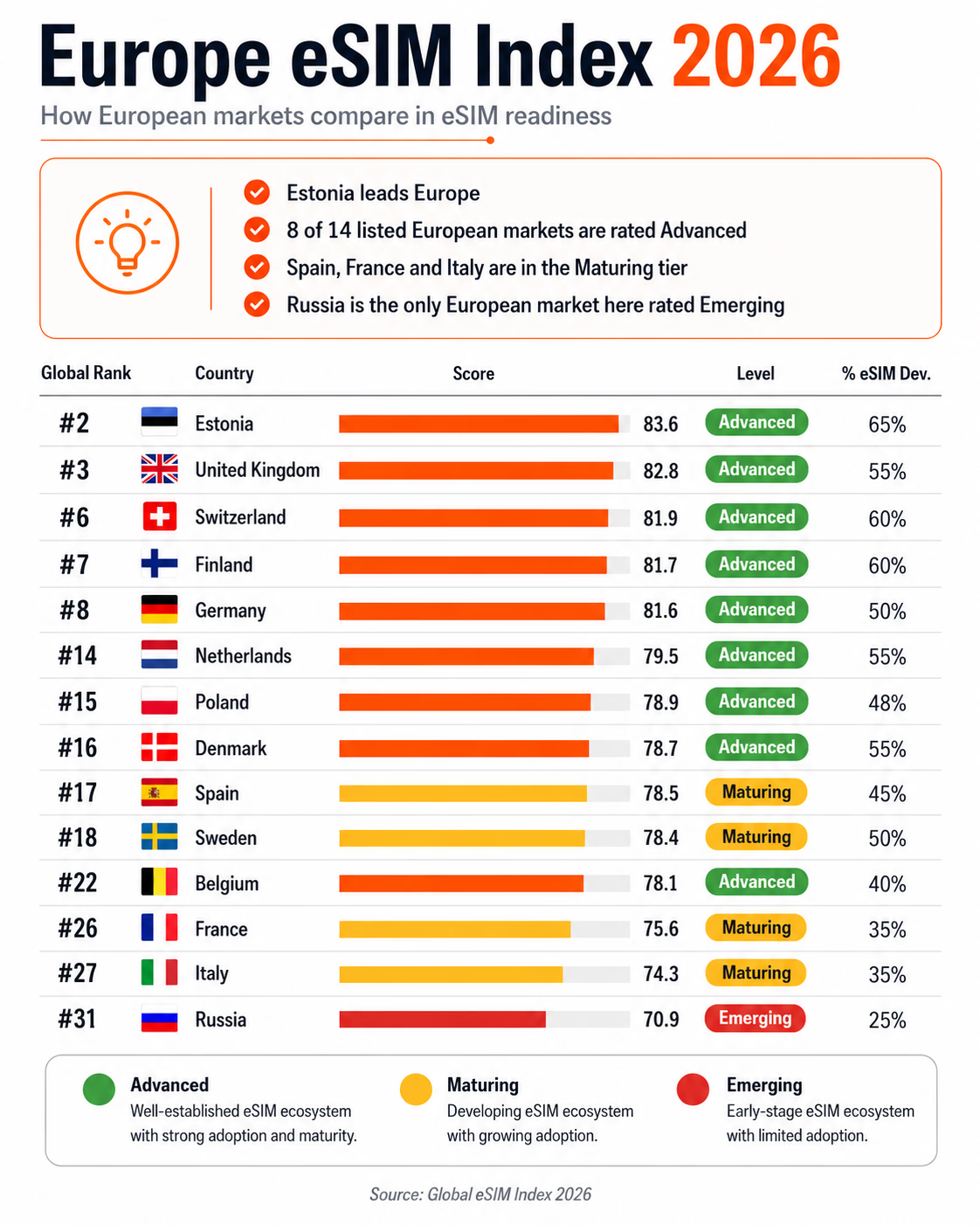
The United States leads the ranking with a score of 90.2, followed by Estonia at 83.6 and the United Kingdom at 82.8. Thailand and Canada follow closely, both scoring 82.7. That top five is important because it shows eSIM leadership is not only a Western European story or a North American story. Thailand’s position is especially interesting because it confirms that tourism, digital onboarding, and user demand can push a market forward very quickly when the experience is easy enough.
The U.S. result is not surprising. Apple’s decision to remove the physical SIM tray from iPhone 14 models sold in the United States was a major market catalyst, and Apple still states that iPhone 14 models or later purchased in the U.S. can only be activated with eSIM. Once that happened, operators had no real choice but to make eSIM work at scale.
READ MORE: iPhone 17 Pro: Apple May Push eSIM-Only Design Beyond the U.S.
But the U.S. is also a useful warning. Even in the most advanced market, the index notes that some users still struggle with QR codes, manual configuration, and device locking linked to financed phones. So yes, the U.S. is ahead. But “ahead” does not mean friction-free.
Canada is another strong example. The report highlights push provisioning, where the profile downloads automatically after an in-app purchase, removing the need to scan a QR code. That matters more than people think. QR codes were useful as a bridge technology, but they are not the final user experience. The final experience is: buy, confirm, activate. No little square. No second device. No panic at the airport.
Regulation is the quiet gatekeeper
The most valuable insight in the index is not the ranking itself. It is the reason behind the ranking.
Markets do not fall behind only because operators are lazy or consumers are unaware. Many fall behind because regulation is built around identity control, anti-fraud measures, and national security. That is understandable. SIM swap fraud is real. Anonymous mobile lines are politically sensitive. Governments want control over who is connected to local networks.
The problem is that eSIM’s main promise is instant remote activation. So when a market requires in-person registration, biometric checks, passport validation, or waiting periods, it weakens the very thing that makes eSIM attractive.
Brazil is a good example. The index places Brazil 24th with a score of 77.6, but it also points to biometric validation and user registration rules as barriers that can force users back into physical stores when remote checks fail. Brazil has strong operators, tourism demand, and a serious digital market. But activation friction still slows the experience.
READ MORE: Why Some eSIMs Feel Premium and Others Feel Broken?
India shows the tension even more clearly. The report says India ranks 49th, with strict identity requirements and a 24-hour SMS suspension after eSIM activation or migration. That may reduce fraud risk, but from a user perspective, it turns a supposedly instant technology into something awkward and inconvenient. For travelers, the gap is even bigger because a data-only travel eSIM may help with maps and messaging, but it does not always solve access to local services that require a verified local number.
This is where operators, regulators, and travel eSIM providers are now colliding.

Travel eSIMs are exploiting the friction
Travel eSIM providers are growing because they sell what local telecom systems often fail to deliver: simplicity.
The index repeatedly points to players such as Holafly, Airalo, Saily, Nomad eSIM, Ubigi, Jetpac, and others, finding space in markets where local onboarding is too slow, too bureaucratic, or too confusing. That does not mean travel eSIM providers replace mobile operators. They do not own the full relationship in the same way. Most are data-first, many rely on roaming agreements, and they often lack local numbers. But they do solve a very specific problem: “I need data now, and I do not want to deal with paperwork.”
READ MORE: Who Controls eSIM? The Entitlement Battle Begins
That is why this segment is becoming strategically important. Juniper Research estimated travel eSIM package revenue would reach $1.8 billion by the end of 2025, up 85% from 2024, driven by the appeal of cheaper alternatives to traditional roaming. That growth is not just about price. It is about timing and convenience. The customer is not shopping like a telecom customer. They are shopping like a traveler with a boarding pass, a hotel booking, and 14 tabs open.
GSMA’s own framing of eSIM also supports the bigger industry shift: eSIM enables remote SIM provisioning and allows users to store multiple operator profiles on one device. That sounds technical, but commercially it means something simple: the operator relationship is becoming more flexible, more portable, and easier to challenge.
OEMs now shape the adoption curve
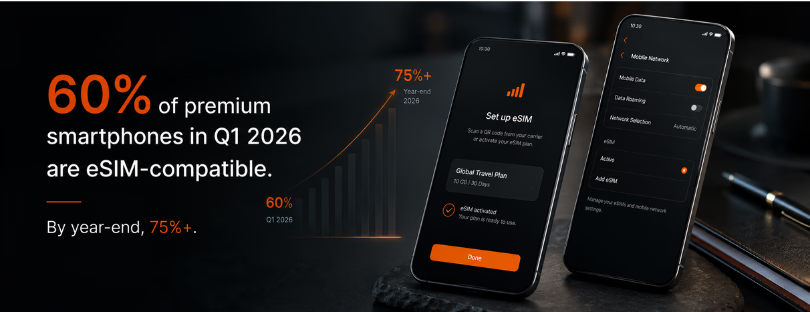
One of the smartest points in the report is that eSIM adoption increasingly depends on OEM strategy, not only operator strategy. If the installed base is still dominated by low and mid-range smartphones without eSIM support, operator readiness can only go so far.
This is the quiet reason why some markets look promising on paper but move slowly in practice. Mexico, for example, ranks 43rd. The index notes that more than 70% of smartphones in the country still lack eSIM support. Bolivia is even more constrained, with only around 10% of smartphones supporting eSIM.
That creates a two-speed market. Premium users get digital connectivity, dual profiles, smartwatch plans, travel eSIMs, and app-based switching. Budget users continue with physical SIMs, retail stores, and slower processes. If eSIM becomes the default only for people who can afford newer phones, the industry risks creating a digital access gap inside mobile connectivity itself.
That should worry regulators and operators. eSIM is often presented as a modernization story, but modernization that excludes lower-income users is not really mass adoption. It is a premium adoption with better branding.
Operators face a strategic contradiction
For mobile operators, eSIM is both an opportunity and a threat.
On one side, it reduces logistics, cuts SIM distribution costs, supports wearables and IoT, enables multi-device services, and gives operators a cleaner digital relationship with customers. On the other side, it makes switching easier. And when switching becomes easier, churn becomes more dangerous.
READ MORE: Who Will Control the Future of Connectivity: Telecoms, Tech Giants, or eSIM Upstarts?
That explains why some operators still move carefully. They like eSIM when it supports retention, premium bundles, smartwatches, enterprise use cases, or IoT. They are less enthusiastic when it makes prepaid users more mobile or helps travelers bypass expensive roaming.
This is why the next phase will not be about “does the operator support eSIM?” That question is already too basic. The better question is: how much control does the operator want to give the user?
Final thoughts
The Holafly GlobaI eSIM Index 2026 is useful because it moves the conversation away from the lazy idea that eSIM adoption is simply a technology rollout. It is not. It is a power shift.
Compared with similar market signals from GSMA, Juniper Research, Apple’s eSIM-only push in the U.S., and the rise of travel eSIM players, the direction is clear: connectivity is becoming more digital, more modular, and more user-controlled. But the speed depends on who controls activation. In Estonia, Canada, the U.S., and the UK, eSIM is becoming infrastructure. In markets with strict identity rules, low device compatibility, or operator hesitation, it is still a feature waiting for permission.
The winners will not be the markets that simply “have eSIM.” Almost everyone will have an eSIM. The winners will be the ones who make it boringly easy.
And that may be the biggest compliment in telecom. When eSIM becomes invisible, trusted, and instant, it stops being a product feature and becomes the default layer of modern connectivity. That is when the real competition begins.