Why Some eSIMs Feel Premium and Others Feel Broken?
Two travellers can buy an eSIM for the same destination, on the same phone, in the same airport, and have completely different experiences.
One installs in a minute, connects before the baggage carousel starts moving, switches networks quietly when coverage drops, and gives the traveller enough confidence to forget about it. The other gets stuck on activation, shows “no service”, needs manual APN settings, loses data after crossing a border, or turns customer support into part of the trip.
That difference is not just branding. It is not only about the app design either. It usually comes down to how much of the connectivity stack the provider actually controls.
In travel eSIM, “premium” is often mistaken for nice visuals, a clean checkout and a modern app. Those things matter, but they are only the surface. The deeper question is more technical: what happens after the user taps install?
That is where the market starts to separate.
The stack decides the experience
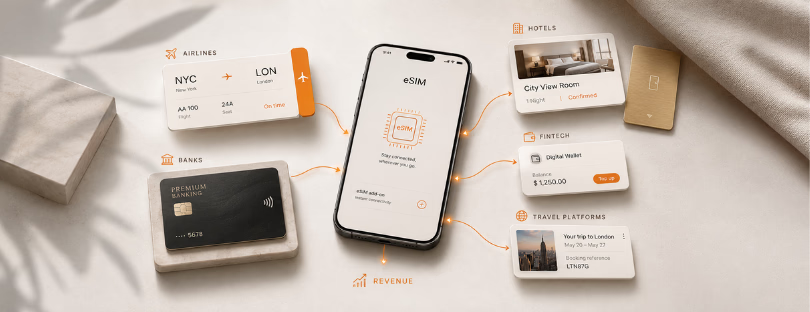
An eSIM product looks simple to the traveller. Choose a destination, pay, install, connect. Behind that small journey sits a chain of systems: eSIM provisioning, remote SIM profile delivery, network partnerships, roaming agreements, routing, app logic, customer support, payment systems, device compatibility and recovery flows.
The GSMA’s consumer eSIM framework, including specifications such as SGP.22, exists because remote SIM provisioning needs secure, interoperable processes between devices, service providers and mobile networks. Newer GSMA work around SGP.32 also shows how important remote provisioning has become as connectivity moves into more devices and more automated environments.
For travellers, this technical plumbing becomes very practical very quickly.
READ MORE: Delay eSIM Activation? Yesim Lets You Decide
A strong provider can usually make activation feel boring. That is a compliment. The profile installs, the phone recognizes it, the plan is visible, the network attaches, and the user can get on with the trip. A weaker provider may still sell a valid data plan, but the experience feels fragile because too many pieces depend on someone else’s infrastructure, manual fixes, or delayed support.
This is why some eSIMs feel premium and others feel broken, even before speed tests enter the conversation.
Activation is the first trust test
The first emotional moment in an eSIM journey is activation. People do not install travel eSIMs while sitting calmly at home with unlimited patience. They install them at airports, in taxis, hotel lobbies, train stations and queues.
That means activation is not a small technical detail. It is the moment when the customer decides whether the provider feels trustworthy.
Apple’s own support documentation shows how much activation depends on device, carrier support, transfer method and QR or carrier activation flows. Even in mature ecosystems, eSIM setup still involves several possible paths depending on the user’s device and provider support.
Premium eSIM providers reduce the number of things the traveller needs to understand. They do not force users to become telecom technicians. They simplify installation, guide users clearly and handle more of the complexity behind the scenes.
READ MORE: What Frequent Travelers Notice Immediately When Switching to Yesim
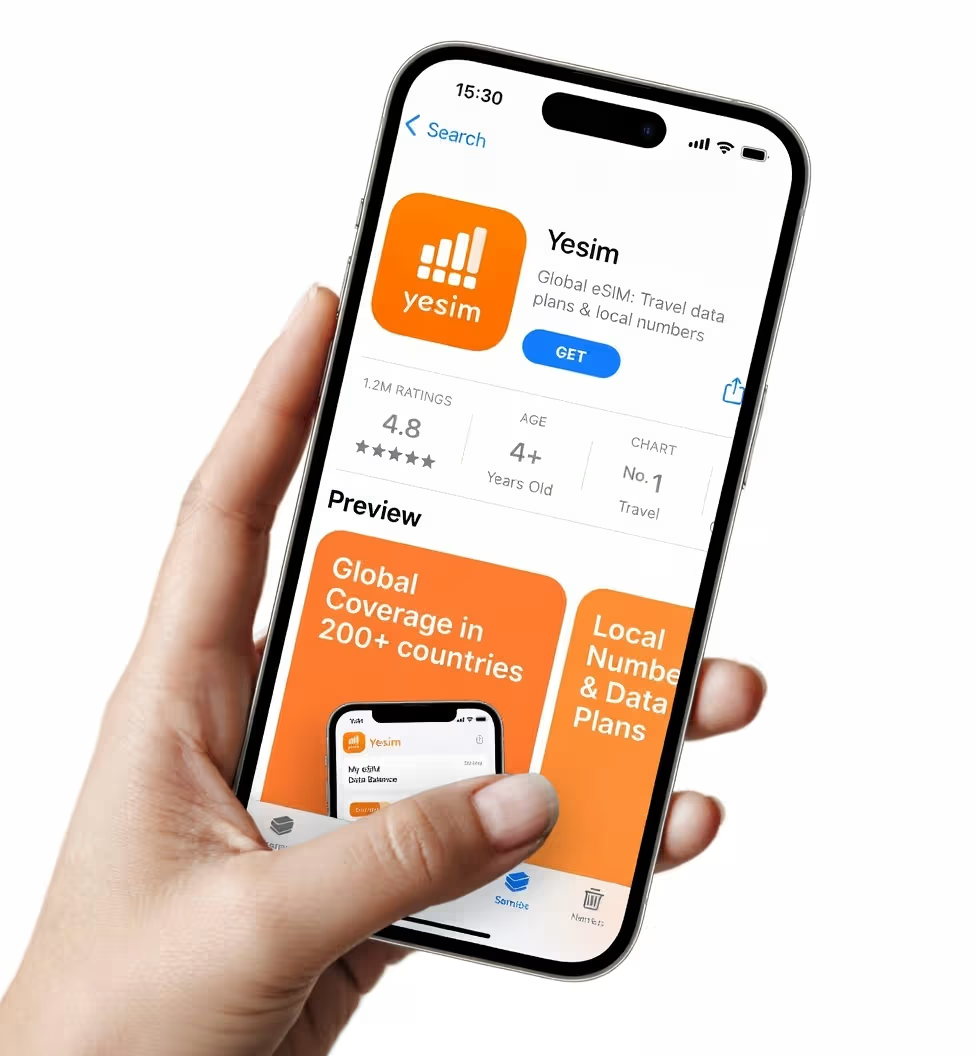
Yesim is a strong example of this direction. Its positioning is not only about selling destination plans. It is about making connectivity feel more controlled. The company promotes one eSIM for 200+ destinations, one-click installation, 24/7 support, a refund guarantee and network switching features designed to reduce friction when travellers move between locations or coverage conditions.
That matters because the traveller does not care which part of the stack failed. They only know the internet works, or it does not.
 Switching is where the premium becomes visible

The best eSIM experience is not always the one with the flashiest plan page. It is the one that behaves well when travel becomes messy.
A traveller lands in Istanbul, takes a domestic flight, moves to a coastal town, enters a basement restaurant, joins a video call from a hotel, then crosses into another country two days later. A cheap-looking plan may work fine in one central location, then fall apart when the device needs to attach to another network or recover after signal loss.
This is where infrastructure depth matters.
Yesim highlights automatic connection to the best available network and says it works with 800+ operators worldwide. Its SmartSwitch-style network experience is important because the modern traveller does not want to manually test operators, toggle airplane mode five times, or guess which local network is less congested.
READ MORE: 3 Million Travelers Choose Yesim for Global eSIM Connectivity
For users, this feels like quality. Not because they see the wholesale agreements or routing logic, but because the product quietly adapts.
There is a reason premium travel connectivity is moving away from the old idea of “one cheap bundle for one country”. Serious travellers increasingly need flexibility across regions, multi-stop routes and different usage patterns. That is also why Yesim’s product structure is interesting.
Its unlimited day pass model covers 82+ countries and is built around a simple promise: buy several days and use them one at a time, only when you go online. For people who travel irregularly, that removes a common frustration with prepaid plans: paying for a fixed validity window and wasting unused days.
Then there are Global Packages for 80+ countries and Global Plus coverage across 140+ countries, aimed at classic routes, beach escapes, nomads and business travellers. Pay & Fly goes further with pay-as-you-go flexibility across 170+ countries, provider-level rates, no hidden fees and payment only for actual usage. Yesim’s help center describes Pay & Fly as a plan built around actual consumption, online top-ups, easy activation and no upfront commitment.
Flexible eSIM plans built for real travel
Unlimited days, prepaid global packages, or pay-as-you-go connectivity across multiple destinations.
Flexible
Unlim Day Pass
Countries
- ✓ Pay only for the days you go online
- ✓ Use days one at a time
- ✓ Recharge anytime
Prepaid
Global Package
Countries
- ✓ Classic routes and beach escapes
- ✓ Clear pricing
- ✓ Frequent travellers
Prepaid
Global Plus Package
Countries
- ✓ Nomads and business travel
- ✓ Multi-stop destinations
- ✓ Ready for any trip
Flexible
Pay & Fly
Countries
- ✓ Global features included
- ✓ Provider-level rates
- ✓ Pay only for what you use
Smart network switching
If one available operator has 5G, your eSIM can switch to it instantly. Yesim partners with 800+ operators worldwide.
That range matters because premium is not always “more data”. Sometimes, premium means the plan model matches real travel behaviour.
Broken often means outsourced too thinly
The difficult truth in travel eSIM is that many providers do not control enough of the experience they sell.
Some are mostly storefronts. Some rely heavily on third-party aggregators. Some have limited visibility into network behaviour. Some depend on support scripts because they cannot actually fix the underlying issue quickly. The product can still function, especially in easy destinations, but it starts to feel thin when something goes wrong.
This is why two providers can both claim “global coverage” while delivering very different experiences.
Coverage is not the same as control. A provider may list many countries, but the real test is how it handles network selection, failed activation, reinstallation, balance recovery, unexpected throttling, support escalation, and multi-country travel. Premium eSIM providers design for failure. Weaker ones hope the user never reaches it.
The market is starting to understand this. Travellers are no longer impressed by a long list alone. They want products that behave predictably. Business travellers want fewer surprises. Digital nomads want continuity. Families want something that works without turning one person into the trip’s IT department.
 The new premium is invisible
The next phase of eSIM competition will not be won only on price per gigabyte. That race is already crowded and, honestly, not very interesting anymore.
The more important competition is around invisible reliability.
Can the provider activate quickly? Can it recover cleanly? Can it switch networks without drama? Can it support users in real time? Can it offer flexible models for different travel patterns? Can it make global connectivity feel less like roaming and more like a normal digital service?
This is where Yesim’s model feels aligned with the direction of the market. The combination of unlimited day-based access, prepaid global packages, Global Plus coverage, Pay & Fly usage-based pricing, automatic best-network connection, 800+ operator partnerships and one eSIM across many destinations gives the experience a more complete feel. It is not just “buy data for Spain” or “buy data for Thailand”. It is a layered travel connectivity product.
And that is the difference.
A basic eSIM sells access. A premium eSIM sells confidence.
The real conclusion
The travel eSIM market is entering a more mature phase. The first wave was about proving that travellers could avoid roaming bills without buying plastic SIM cards at airports. That job is mostly done. The next wave is about quality, control and trust.
This is uncomfortable for providers who built their businesses mainly on cheap data and broad destination claims. The user experience is becoming harder to fake. If activation is slow, if recovery is poor, if network switching is unreliable, if support cannot solve problems, travellers notice. They may not know the words “provisioning”, “routing” or “operator stack”, but they feel the difference immediately.
Yesim stands out because it is building the experience around flexibility and reliability rather than only around a headline price. Its Day Pass logic fits occasional travellers. Its prepaid global packages fit frequent routes. Global Plus fits complex trips. Pay & Fly fits people who hate waste and want usage-based control. Automatic best-network connection and a large operator footprint address the part of eSIM that really matters once the traveller leaves the app and enters the real world.
That is where premium lives now.
Not in the banner. Not in the discount code. Not even in the gigabytes.
Premium is when the traveller stops thinking about the eSIM because it simply works.