T-Mobile Launches U.S. Travel eSIM for Visitors
T-Mobile has made a move that should make travel eSIM providers pay attention.
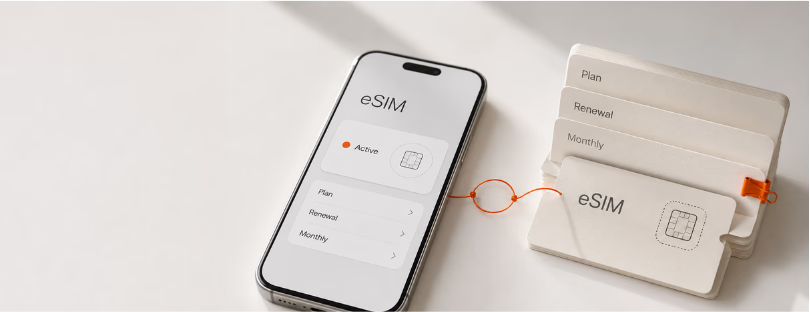
The company has launched T-Mobile Prepaid U.S. Pass eSIM, a short-term prepaid eSIM product aimed at international visitors coming to the United States. It goes live on May 18, 2026, and the basic idea is simple: land in the U.S., buy or activate digitally, and connect to T-Mobile’s network without paperwork, store visits, or the old tourist SIM routine.
At first glance, this looks like another visitor SIM offer. But it is a little more interesting than that. For years, the U.S. has been a strong market for travel eSIM apps because buying mobile data as a foreign visitor could be confusing, fragmented, or simply expensive. Airalo, Nomad eSIM, Ubigi, Holafly and others built a neat business around solving that pain point before the big operators treated it seriously.
Now one of those operators is walking directly into the same space.
What T-Mobile Is Offering
The new U.S. Pass eSIM comes in four short-term versions: 7 days for $25, 10 days for $30, 14 days for $35, and 30 days for $50. Each plan includes unlimited talk and text in the U.S., Mexico, and Canada, unlimited 5G data with 50GB of premium 5G data in the U.S., plus a hotspot allowance that scales with the plan length. The 7-day pass includes 14GB of high-speed hotspot data, while the 30-day pass includes 50GB.
|
T-Mobile U.S. Pass
7-Day Pass$25
• Unlimited talk and text in the U.S., Mexico, and Canada • Unlimited 5G data with 50GB of premium 5G data in the U.S. • 14GB of high-speed mobile hotspot data in the U.S. • 5GB of high-speed data in Mexico and Canada, including hotspot where available |
T-Mobile U.S. Pass
10-Day Pass$30
• Unlimited talk and text in the U.S., Mexico, and Canada • Unlimited 5G data with 50GB of premium 5G data in the U.S. • 20GB of high-speed mobile hotspot data in the U.S. • 5GB of high-speed data in Mexico and Canada, including hotspot where available |
T-Mobile U.S. Pass
14-Day Pass$35
• Unlimited talk and text in the U.S., Mexico, and Canada • Unlimited 5G data with 50GB of premium 5G data in the U.S. • 28GB of high-speed mobile hotspot data in the U.S. • 5GB of high-speed data in Mexico and Canada, including hotspot where available |
T-Mobile U.S. Pass
30-Day Pass$50
• Unlimited talk and text in the U.S., Mexico, and Canada • Unlimited 5G data with 50GB of premium 5G data in the U.S. • 50GB of high-speed mobile hotspot data in the U.S. • 5GB of high-speed data in Mexico and Canada, including hotspot where available |
That hotspot detail matters.
Many travel eSIMs are fine for maps, WhatsApp, browsing and light social use. But the moment a visitor wants to work from a laptop, upload files, take video calls, or share a connection with family members, hotspot rules become important very quickly. T-Mobile appears to understand that U.S. visitors are not all casual tourists checking restaurant reviews. Some are business travellers, students, conference attendees, road-trippers, creators, and families managing multiple devices.
READ MORE: Visible Launches World Cup 2026 eSIM Travel Pass
The pass also includes 5GB of high-speed data in Mexico and Canada, which gives it a North American travel angle rather than a purely U.S. domestic one. T-Mobile is positioning this as “one pass that works across three countries,” which is smart because a lot of U.S. travel does not stop neatly at one border.
Why This Is Different From a Normal Travel eSIM
The obvious difference is that this is not a reseller-led product. It comes directly from a major U.S. mobile network operator.
That gives T-Mobile a useful advantage. It can sell the comfort of a direct network relationship rather than access through an intermediary. For travellers who do not want to compare ten apps, install profiles from unknown providers, or wonder which underlying network they are actually using, that directness has value.
GeekSpin framed the move as T-Mobile entering a crowded prepaid eSIM traveller market, noting that third-party apps such as Airalo and Nomad eSIM have owned this niche for years while major carriers were slower to respond. That is the bigger story here. The travel eSIM category was built partly because operators left room for it. Now operators are starting to notice the money, the user experience, and the arrival moment.
Still, this is not automatically a win against eSIM-first players. Travel eSIM apps usually compete on global coverage, multi-country plans, local flexibility, app experience, and fast comparison. A traveller visiting five countries across Europe or Asia will still probably look at global or regional eSIM platforms. T-Mobile’s offer is stronger for a specific use case: visitors coming to the U.S., especially those who care about voice, text, hotspot, and a known American network.
That is a narrower lane, but it is a valuable one.

The Real Signal for the eSIM Market
This launch shows where the travel eSIM market is heading: less novelty, more segmentation.
In the early phase, the pitch was easy: avoid roaming charges. Download an eSIM. Save money. That message still works, but the category is maturing. Travellers now compare more specific things: hotspot data, fair usage policies, local numbers, 5G access, regional coverage, app reliability, refund rules, and whether the eSIM works well at the exact moment they land.
T-Mobile’s U.S. Pass is not trying to be everything for everyone. It is trying to win one highly valuable moment: the international traveller arriving in North America who wants a simple, trusted, high-capacity connection.
READ MORE: Yesim Unveils 2026 Fan eSIM Plan and 2,500 Free Data Giveaway
That puts pressure on travel eSIM providers in two ways.
First, they need to explain why their experience is still better than buying directly from the operator. That may be price, flexibility, app simplicity, wider global coverage, or the ability to compare multiple destinations in one place.
Second, they need to think beyond data-only plans. T-Mobile includes talk and text across the U.S., Mexico and Canada. Many travel eSIMs are still data-only, which is fine for plenty of users, but not all. The more operators package voice, SMS, hotspot, rewards, and local-style benefits into visitor eSIMs, the more third-party providers will need to sharpen their own value proposition.
What Travellers Should Watch
The offer looks strong, especially for U.S.-bound visitors who need real hotspot capacity. But travellers should still read the details. T-Mobile notes that heavy users above 50GB during the plan period may notice lower speeds during congestion due to prioritization, and video streams are in SD. Taxes, fees, and exclusions may also apply.
That does not make it a bad product. It just means “unlimited” still needs context, as it almost always does in mobile.
READ MORE: FIFA World Cup 2026 Travel Risks: What You Need to Know
For many travellers, 50GB of premium 5G data is generous. For heavy remote workers, livestreamers, or families sharing one connection, the hotspot allowance may be the real deciding factor. For a short U.S. business trip, $25 to $50 for direct network access, voice, text, and hotspot could be attractive. For a multi-country global trip, an eSIM marketplace may still make more sense.
Where This Leaves the Market
T-Mobile’s U.S. Pass eSIM is not the end of the travel eSIM app market. But it is a warning that the easiest part of the market is getting more crowded.
When operators ignored travellers, eSIM specialists could win with convenience. When operators begin offering digital-first visitor products with strong hotspot allowances and recognizable network branding, convenience alone is no longer enough.
The next phase will be about sharper positioning. Airalo, Nomad, Ubigi, Holafly and similar players can still win by being global, flexible, app-native and comparison-friendly. Operators like T-Mobile can win by being local, trusted and network-direct. The interesting fight is no longer “who sells cheap data?” It is who owns the travel moment with the clearest promise.
And for international visitors heading to the U.S., that fight just became more useful.