

FIFA World Cup 2026 Travel Risks: What You Need to Know
The FIFA World Cup 2026 is shaping up to be the most ambitious tournament the sport has ever seen. Not just because of the expanded format or the expected millions of fans, but because of the geography.
For the first time, the World Cup will be hosted across three countries: the United States, Canada, and Mexico. Sixteen host cities. Vast distances. Different regulatory systems. Different risk profiles.
From a travel and connectivity perspective, this is not just a sports event. It’s a large-scale mobility challenge.
That’s exactly where Safeture and Riskline are positioning themselves, with the launch of the FIFA World Cup 2026 Informer — a guide designed to help both travelers and organizations navigate the complexity behind the spectacle.
Beyond Tickets: Planning for a Moving Tournament
The traditional World Cup mindset is simple: pick a host city, book a hotel, attend matches.
That doesn’t apply here.
With matches spread across North America, many fans will move between cities or even countries during the tournament. A group-stage match in Los Angeles could easily be followed by a knockout game in Dallas or Mexico City.
That changes everything.
Safeture’s approach reflects this shift. The Informer focuses less on the event itself and more on the logistics around it: how people actually move, stay, and stay safe.
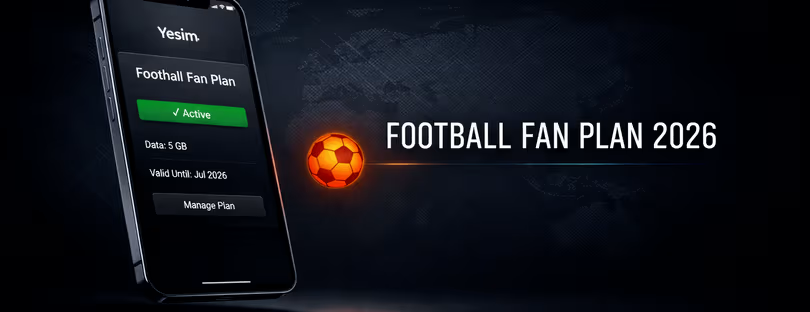
READ MORE: Yesim Unveils 2026 Fan eSIM Plan and 2,500 Free Data Giveaway
As Marcel Brandt, Chief Sales Officer at Safeture, puts it, this tournament introduces “a new level of global mobility.” And that’s not just a nice phrase. It’s a real operational challenge.
Travelers now need to think about:
- Cross-border entry requirements
- Multi-city transport planning
- Infrastructure bottlenecks
- Local risk differences
This is no longer passive travel. It’s active coordination.
What the Informer Actually Covers
Instead of generic travel advice, the guide leans into structured, actionable planning. That’s where it stands out.
What the Guide Covers
A premium overview of the key areas travelers and organizations need to think about before FIFA World Cup 2026 begins.
This last part matters more than most guides admit. Large events don’t fail at the stadium level. They fail in transit.
Congestion, overwhelmed public transport, and last-minute changes are where most friction happens.
Three Countries, Three Risk Profiles
One of the more useful aspects of Riskline’s analysis is its honesty. The three host countries are not treated as a single, unified environment.
They’re not.
Canada is generally positioned as a low-risk destination with stable infrastructure and predictable travel conditions.
The United States sits somewhere in the middle, but with strong regional variation. Safety, infrastructure quality, and congestion risks differ significantly from city to city.
Mexico introduces a different layer of complexity. While major tourist and event areas are typically well-managed, certain regions carry elevated risks related to organized crime and security conditions.
On top of that, there are external variables that could impact all three countries:
- Protests and political gatherings
- Extreme weather events
- Wildfires and earthquakes
This isn’t about fear. It’s about awareness.
|
HOTEL
Hotels worldwide, best prices.
Top-rated stays · flexible booking
|
EXPERIENCES
Skip the tourist traps
Guided tours · skip-the-line tickets
|
GETTING AROUND
Don’t figure out transport on arrival
Book trains, buses & flights in advance
|
CONNECTIVITY
Get eSIM before landing
Avoid roaming · instant data · no SIM swaps
|
The Scam Economy Around Mega Events
Every global event creates its own shadow market. The World Cup is no exception.
The Informer calls out a familiar pattern:
- Fake ticket platforms
- Unofficial accommodation sites
- Fraudulent “visa” services linked to the event
These scams aren’t new, but they’re evolving. They’re becoming more polished, more localized, and harder to detect.
The advice is simple but still often ignored: stick to official channels and verify everything twice.
For a tournament of this scale, that’s not optional. It’s basic risk management.
Why This Matters for Businesses Too
This isn’t just a fan story.
For companies sending employees, partners, or media teams to the World Cup, the stakes are higher.
Managing travel across three countries introduces:
- Compliance challenges
- Duty-of-care responsibilities
- Real-time risk monitoring needs
This is where platforms like Safeture position their value. Not as travel tools, but as operational infrastructure for mobility.
Real-time alerts, location awareness, and centralized communication aren’t “nice to have” anymore. They’re becoming standard expectations for organizations operating globally.

The Bigger Shift: Travel Is Becoming Risk-Aware by Default
What Safeture and Riskline are doing here reflects a broader industry trend.
Travel is no longer just about booking and moving. It’s about managing uncertainty.
Players like International SOS, Healix, and Anvil Group have been building this space for years. But what’s changing is the context.
Mega-events like the World Cup accelerate adoption.
They expose the gaps in traditional travel planning and force both individuals and organizations to think differently.
At the same time, real-time intelligence providers like Riskline are becoming more critical. Static guides don’t work anymore. Situations change too quickly.
Conclusion: The World Cup Is Becoming a Connectivity Event
Here’s the real shift.
The FIFA World Cup 2026 isn’t just the biggest football tournament ever organized. It’s a live test of how well global travel systems can handle complexity at scale.
And that includes everything:
- Physical mobility
- Digital connectivity
- Risk awareness
- Infrastructure resilience
What Safeture and Riskline are doing with this Informer is part of a larger movement. Travel is becoming structured, data-driven, and increasingly proactive.
Compared to traditional travel advice platforms or even some risk providers, the difference here is integration. It’s not just about identifying risks. It’s about embedding that intelligence into the planning process itself.
That aligns with what we’re seeing across the travel tech ecosystem. Whether it’s connectivity platforms, eSIM providers, or mobility tools, the direction is the same.
Less friction. More control. Real-time awareness.
For travelers, that means better decisions.
For companies, it means fewer surprises.
And for the industry, it signals something bigger: global events are no longer just about where you go. They’re about how well you can navigate everything around it.