melita.io Launches IoT eSIM Profile for Global Scale
melita.io has launched its own eSlM profile for IoT devices, and while that might sound like a technical update, it actually reflects something much bigger happening in the connectivity space.
Until now, melita.io has offered traditional SIM formats like 2FF, 3FF, 4FF, and MFF2. With this move, they are stepping into eSIM, built on the GSMA SGP.22 standard, bringing remote provisioning and lifecycle management into their IoT offering.
At a time when IoT deployments are scaling fast across industries, this is less about adding another SIM type and more about removing friction from how devices are deployed and managed globally.
From physical SIMs to remote control
If you’ve ever worked on IoT deployments, you know where things get messy. It’s not the device. It’s the connectivity.
Physical SIMs create constraints. Devices need to be pre-configured, shipped, and sometimes even recalled if something changes. That becomes a serious limitation when you’re dealing with thousands of devices across multiple regions.
This is where eSIM changes the equation.
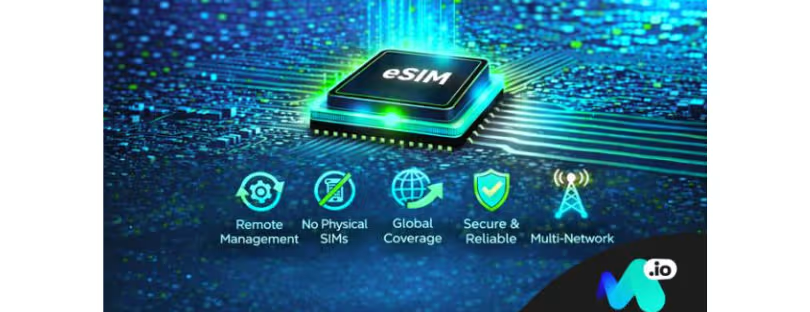
With melita.io’s eSIM profile, connectivity can be provisioned remotely. No physical access needed. No swapping SIMs. No logistical delays.
Malcolm Briffa, Chief Officer Business and IoT at Melita, highlighted this clearly: eSIM enables faster deployment, remote management, and more efficient scaling. And in IoT, that combination is critical.
The platform is the real story
What matters here is not just the eSIM itself, but how it’s integrated.
melita.io has upgraded its Connectivity Management Platform to support both eSIM and physical SIMs in a single environment. That’s important because most companies are not operating in a clean, eSIM-only setup. They are managing mixed fleets.
Having everything in one place reduces complexity immediately.

What the platform enables
- Unified SIM inventory across physical and eSIM
- Access to QR codes and LPA links at SIM level
- API capabilities for automation and bulk provisioning
This is where the value actually sits. Not in the SIM format, but in the ability to control and scale it.
Where this has a real impact?
The use cases mentioned are exactly where eSIM makes the biggest difference: logistics, utilities, smart cities, asset tracking, and industrial automation.
These are environments where devices are widely distributed and often difficult to access once deployed.
Take logistics. Devices move across borders constantly. Networks change. Costs fluctuate. Regulations differ. With traditional SIMs, adapting to that is slow and operationally heavy.
With eSIM, you can adjust connectivity remotely and in real time.
That’s not just efficiency. That’s control.
Timing and commercial push
The launch aligns with International IoT Day, which positions melita.io within a broader industry narrative around connected infrastructure and scalability.
They’re also pushing adoption with a clear commercial incentive. Orders of 100 or more eSIM profiles placed during April 2026 come with a 50 percent discount on initial fees.
It’s a smart move. For existing customers, it lowers the barrier to testing. For new ones, it creates an easy entry point into the platform.
And in IoT, once you’re in, switching is not trivial.
What comes next
melita.io has also confirmed it is preparing to introduce SGP.32 later this year.
This is worth paying attention to.
While SGP.22 enables remote provisioning, SGP.32 is designed to simplify it further, especially for large-scale deployments. It reduces operational complexity and improves interoperability across devices and networks.
In other words, this launch is not the end point. It’s part of a broader transition toward more software-driven connectivity models.
Where melita.io stands in the market
melita.io is not the first to move in this direction.
Major players like Vodafone IoT, Telefónica Tech, and 1NCE have already invested heavily in eSIM capabilities and IoT platforms. At the same time, a growing number of MVNEs and connectivity providers are shifting toward full-stack solutions that combine connectivity, management, and APIs.
What’s interesting about melita.io is the positioning.
They are not trying to compete purely on infrastructure. And they are not treating connectivity as a commodity product either.
Instead, they are focusing on a combined model:
- Flexible SIM formats
- Centralized platform control
- API-driven scalability
That aligns closely with how the market is evolving.
According to GSMA Intelligence, eSIM adoption in IoT is accelerating as enterprises look for more flexible and remotely manageable connectivity solutions. At the same time, businesses are moving away from single-operator setups toward more dynamic, multi-network strategies.
That shift favors platforms that reduce complexity rather than add to it.
Conclusion
This launch confirms something that is becoming increasingly clear: in IoT, eSIM is no longer a differentiator. It is becoming a baseline requirement.
The real competition is shifting elsewhere.
It is no longer about who offers connectivity, but who makes it easiest to deploy, manage, and scale across global operations.
Compared to larger players, melita.io’s move is more incremental. But that may actually be its strength. Instead of pushing a radical shift, it offers a practical path for businesses to transition from physical SIMs to eSIM without disrupting existing operations.
And that is exactly what many companies need right now.
The next phase of the market will not be defined by SIM types, but by control layers, automation, and how invisible connectivity becomes to the end user.
That is where the real battle is already happening.