


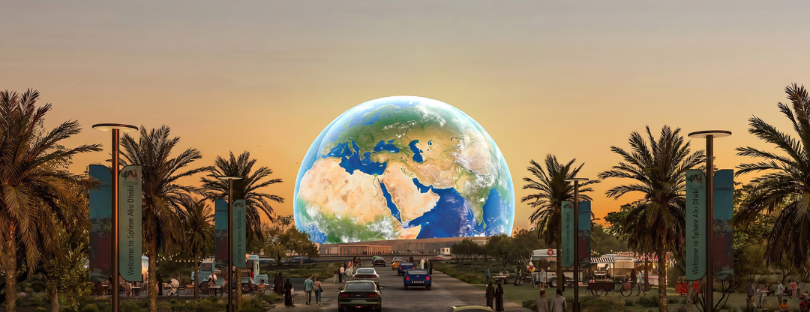
Sphere Abu Dhabi: Yas Island’s Next Tourism Icon
Abu Dhabi is not exactly short of big-ticket attractions, but Sphere Abu Dhabi feels different. The Department of Culture and Tourism Abu Dhabi and Sphere Entertainment Co. have confirmed that Yas Island will host the first Sphere venue outside the United States, with the construction phase valued at USD 1.7 billion and completion expected by the end of 2029. The venue will sit between Yas Mall and SeaWorld Abu Dhabi, placing it right inside one of the region’s most concentrated entertainment districts.
That location matters. This is not being built as a standalone spectacle dropped into the desert. It is being plugged into an existing tourism machine: Ferrari World, Warner Bros. World, Yas Waterworld, SeaWorld Abu Dhabi, Etihad Arena, Yas Marina Circuit, hotels, retail, restaurants, and soon Disney Abu Dhabi. In other words, Sphere Abu Dhabi is not just another venue. It is another layer in Yas Island’s push to become one of the world’s most complete entertainment destinations.
More than a concert venue
Like the Las Vegas Sphere, which opened in September 2023, Sphere Abu Dhabi is expected to combine concerts, immersive productions, brand events, sports, conferences, and large-scale cultural experiences. The Abu Dhabi venue is also expected to echo the Las Vegas scale, with a capacity of up to 20,000 depending on the event configuration.
That is where the project becomes interesting for travel and hospitality. Traditional arenas are places people visit for a specific event. Sphere is trying to become something broader: a content platform, a tourism icon, a broadcast backdrop, a brand stage, and a city symbol all at once.
HE Mohamed Khalifa Al Mubarak, Chairman of DCT Abu Dhabi, framed the project as a long-term statement:
“Abu Dhabi has always built for the long term, and Sphere Abu Dhabi is a powerful demonstration of that commitment. In a region where the appetite for world-class experiences continues to grow, our USD 1.7 billion investment in its construction phase sends a clear signal: Abu Dhabi is open, ambitious, and unwavering in its direction.”
That line is important because Abu Dhabi is not simply buying attention. It is building destination infrastructure. The goal is not one viral opening weekend. It is decades of events, visitors, media coverage, hotel nights, cultural showcases, and international partnerships.
Emirati culture on a global screen
The most compelling part of the announcement is not only the architecture. It is the cultural positioning. Sphere Abu Dhabi is expected to host signature immersive experiences similar to those in Las Vegas, but also new Sphere Experiences built around Emirati culture, heritage, and storytelling.
That could be a real differentiator. The risk with mega-venues is that they become impressive but interchangeable. A global artist can perform in Las Vegas, London, Riyadh, Singapore, or Abu Dhabi. The venue itself needs a local reason to matter.
Al Mubarak made that point clearly, saying:
“At its heart, Sphere Abu Dhabi will be a platform for Emirati culture, Emirati talent and Emirati storytelling, shared with the world on the grandest stage ever built.”
That is where Abu Dhabi has a chance to do something smarter than copy Las Vegas. If the exterior Exosphere becomes a canvas for Emirati artists, if immersive shows genuinely tell local stories, and if Arabic music and regional creative talent are built into the programming from the beginning, this could become more than an imported entertainment format.


Why Abu Dhabi makes sense
James L. Dolan, Executive Chairman and CEO of Sphere Entertainment, described Abu Dhabi as
“a premier international capital city” and said its “ambition, infrastructure, and position as a cultural crossroads make it a natural home for Sphere.”
That is not just diplomatic wording. Abu Dhabi sits within one of the world’s most powerful travel corridors, with strong access from Europe, Asia, Africa, and the wider Middle East. Yas Island already benefits from major event traffic, especially around the Formula 1 Etihad Airways Abu Dhabi Grand Prix. Sphere adds another globally recognizable asset that can be photographed, streamed, shared, and broadcast.
It also arrives at a moment when destination competition is shifting. Cities are no longer competing only on hotels, museums, beaches, and shopping. They are competing on “reasons to travel now.” Immersive venues, branded entertainment districts, sports calendars, and cultural mega-projects are becoming part of the same tourism strategy.
Disney’s planned theme park resort on Yas Island strengthens that direction. Disney and Miral announced the Abu Dhabi resort in 2025, with Disney responsible for creative design and Miral financing, building, and operating the project. Reuters reported that the park will be Disney’s first in the Middle East and part of a wider push to tap fast-growing regional tourism demand.
The bigger destination trend
Sphere Abu Dhabi also fits a wider Gulf trend: entertainment as economic diversification. Saudi Arabia is investing heavily in sports, gaming, events, and giga-projects. Dubai continues to dominate international tourism through hospitality, retail, and aviation. Abu Dhabi is taking a slightly different route, building a layered destination around culture, family entertainment, live events, museums, sports, and premium infrastructure.
Compared with Las Vegas, Abu Dhabi’s Sphere will likely have a different job. Las Vegas Sphere is part of a city already built around spectacle. Abu Dhabi’s Sphere will help define the next phase of Yas Island itself. It is less about adding another show to an entertainment strip and more about building a global events ecosystem.
That makes the infrastructure behind the project just as important as the screen. DCT Abu Dhabi said it will coordinate with local entities on roads, access, energy, transport, and site-wide infrastructure. That sounds boring, but it is what separates a tourist landmark from a functioning destination asset.
Conclusion
Sphere Abu Dhabi is not just a USD 1.7 billion venue announcement. It is a signal about where premium tourism is going.
The next generation of destination development is not about one attraction, one hotel, or one event. It is about building ecosystems where culture, entertainment, mobility, hospitality, retail, and media visibility reinforce each other. Las Vegas proved that Sphere can become a global visual icon. Abu Dhabi now has the harder and more interesting task: making Sphere feel local, useful, and strategically connected to a much bigger destination story.
If it works, Yas Island will not simply have another attraction by 2029. It will have a new anchor for global attention. And in modern tourism, attention is no longer a soft metric. It is infrastructure.


