Why Enterprise eSIM Management Is Moving Beyond SIMs
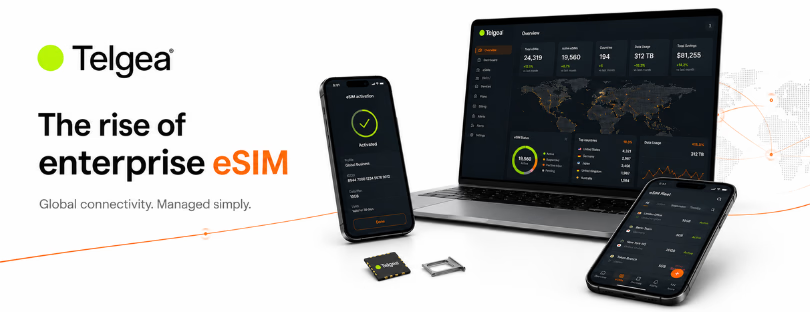
Enterprise eSIM management is starting to look less like a telecom feature and more like a control layer for modern business connectivity.
That may sound like industry language, but the shift is very practical. Companies are no longer just asking, “Can this device connect?” They are asking: Can we activate thousands of devices remotely? Can we switch networks without touching hardware? Can we control roaming costs before finance gets a nasty surprise? Can we keep connected vehicles, field teams, payment terminals, tablets, sensors, and industrial equipment online across borders?
That is why the enterprise eSIM management market is attracting serious attention. According to The Business Research Company, the market is projected to reach $8.63 billion by 2030, growing at a 31.3% CAGR. The drivers are familiar but powerful: industrial IoT adoption, private 5G, remote provisioning, security requirements, connected vehicle ecosystems, and better analytics for managing connectivity at scale.
In other words, this is not just about replacing a plastic SIM card. The real value is in orchestration.
The market is growing because devices are getting harder to manage
For years, enterprise connectivity was built around contracts, SIM cards, roaming agreements, and manual processes. That worked when companies managed phones and laptops. It becomes painful when the estate includes vehicles, smart meters, payment devices, industrial machines, healthcare equipment, and mobile workforces across multiple countries.
Enterprise eSIM management solves a specific problem: how to manage connectivity after deployment.
READ MORE: Enterprise eSIM Is Becoming a Corporate Standard — Here’s Why
That “after” matters. A physical SIM card can be inserted once. But enterprise connectivity needs to change constantly. Devices move across networks. Regulations change. Usage patterns shift. A connected car sold in one country may operate in another. A logistics device may cross borders weekly. A company may need to suspend, reactivate, switch, audit, or localize connectivity without asking someone to physically touch the device.
This is where remote SIM provisioning, multi-operator connectivity, and lifecycle management become more important than the SIM itself.
The strongest players in this space are not simply selling data. They are selling control.
The big names are positioning early
The competitive landscape is already crowded with telecom, security, IoT, and connectivity specialists. The Business Research Company lists major players including Thales, Giesecke+Devrient, IDEMIA, KORE, Tata Communications, Vodafone, Telefónica, Deutsche Telekom, AT&T, Orange, Redtea Mobile, 1oT, Telna, Ericsson, Airalo, Apple, Samsung SDS, Eseye, and eSIM Go.
That list tells us something important. Enterprise eSIM management is not owned by one category.
Traditional telcos bring network assets and enterprise relationships. SIM technology companies bring security and provisioning expertise. IoT connectivity providers bring fleet management and multi-network experience. Newer eSIM platforms bring APIs, automation, and faster deployment models.
READ MORE: MSP Opportunity: How to Package Enterprise eSIM Management as a Service
This is exactly why the market is interesting. Everyone sees the same direction, but they are entering from different angles.
Tata Communications is a good example of the consolidation logic. The company acquired a majority stake in Oasis Smart SIM Europe in 2020 and later completed the full acquisition in July 2023, strengthening its eSIM and global mobility capabilities. That matters because enterprise buyers increasingly want connectivity, provisioning, security, and management in one stack, not a patchwork of suppliers.
The original article mentioned February 2025 for this acquisition, but the public acquisition timeline points to 2020 for the majority stake and 2023 for full ownership. That is worth correcting before publication.
Connected cars show where this is heading
One of the clearest use cases is the connected vehicle.
In February 2025, Thales and Cubic announced a partnership to bring Thales’s GSMA SGP.32-compliant eSIM management platform into Cubic’s global multi-network connectivity ecosystem. The goal is to simplify subscription activation and remote updates across Cubic’s footprint of more than 200 countries.
This is not a small technical update. It shows how automotive connectivity is moving from static SIM profiles to software-managed connectivity. Cars are becoming connected platforms. They need telematics, infotainment, diagnostics, emergency services, navigation, software updates, payments, and sometimes in-car commerce. That requires reliable connectivity across markets and over a long device lifecycle.
READ MORE: Enterprise eSIM Global Coverage That Actually Works
For automakers, the old model is too rigid. A vehicle may remain active for ten or fifteen years. Connectivity agreements, networks, roaming rules, and customer expectations will change many times during that period. eSIM management gives manufacturers more flexibility to adapt without recalling vehicles, replacing SIMs, or rebuilding connectivity arrangements country by country.
This same logic applies to industrial IoT, logistics, smart infrastructure, healthcare devices, energy assets, and enterprise mobility.

Why is this not the same as consumer travel eSIM?
It is tempting to compare enterprise eSIM management with the travel eSIM market because both use the same basic technology. But the buyer’s logic is completely different.
A consumer travel eSIM is usually judged on price, coverage, activation, app experience, and whether the plan works when someone lands in Japan, Turkey, Spain, or the US.
Enterprise eSIM management is judged on governance.
Can IT see every active device? Can finance predict spend? Can operations manage connectivity across regions? Can policies be applied automatically? Can profiles be updated remotely? Can the company reduce dependency on one operator? Can the solution support compliance and security requirements?
READ MORE: Enterprise eSIM 101: What IT Teams Really Need
That is why companies like Thales, G+D, IDEMIA, Tata Communications, KORE, Vodafone Business, Orange Business, 1GLOBAL, Eseye, Telna, and 1oT are not playing the same game as consumer-first eSIM brands. The enterprise market is less about the cheapest gigabyte and more about resilience, control, integration, and accountability.
This is also where private 5G and IoT make the story bigger. A factory, port, airport, hospital, logistics hub, or connected fleet does not just need connectivity. It needs managed connectivity that fits into operational systems.
The real trend is orchestration
The most important trend in enterprise eSIM is not simply remote provisioning. That is becoming the baseline.
The next layer is orchestration.
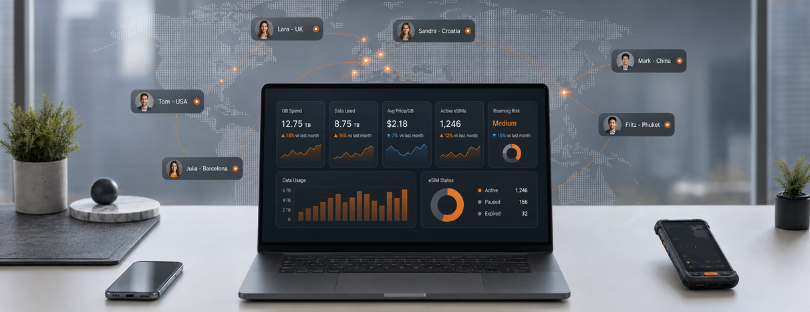
Enterprises want the ability to manage multiple operators, regions, device groups, policies, security rules, roaming behavior, and usage thresholds from one place. They want connectivity decisions to become smarter and more automated. They want analytics that show which devices are underperforming, which regions are expensive, which networks are unreliable, and where policy changes could reduce costs.
This is where AI-powered connectivity optimization may become useful, but only if it solves real operational problems. Nobody needs “AI” as a label on a dashboard. Enterprises need systems that can detect abnormal usage, recommend network changes, prevent bill shock, and help teams manage thousands or millions of connected endpoints without drowning in manual work.
That is the market opportunity.
Not eSIM as a product.
eSIM as infrastructure intelligence.
Conclusion
Enterprise eSIM management is entering the phase where the winners will not be the companies shouting the loudest about coverage. Coverage is necessary, but it is no longer enough.
The market is moving toward platforms that can manage connectivity like software: programmable, secure, policy-based, measurable, and adaptable. That favors players with deep telecom relationships, strong provisioning technology, enterprise-grade security, and the ability to support complex deployments over many years.
Thales and Cubic show the automotive direction. Tata Communications and Oasis show the consolidation direction. IoT specialists show the operational direction. Traditional telcos show the enterprise relationship advantage. Meanwhile, travel eSIM brands may borrow some language from enterprise connectivity, but most are still built around short-term usage, not full lifecycle control.
For Alertify readers, the bigger signal is clear: eSIM is no longer just a travel convenience. In the enterprise world, it is becoming part of the operating system for connected business. And once companies start managing connectivity this way, going back to static SIM cards and manual operator contracts will feel increasingly outdated.