Enterprise eSIM Is Becoming a Corporate Standard — Here’s Why
There’s a particular kind of frustration that every frequent business traveler knows intimately. You land in a new country, your roaming either doesn’t kick in or costs a small fortune, you spend the first twenty minutes of a client trip hunting for Wi-Fi, and by the time you’re connected, you’ve already missed something. A message, a briefing update, a security check-in, your company didn’t even know it needed from you.
This has been the background noise of corporate travel for years. Everyone tolerated it because that’s just how travel worked.
Except it doesn’t have to. And quietly, almost without announcement, the enterprise world is starting to figure that out.
The Consumer eSIM Moment That Changed Expectations
The mass-market eSIM boom, driven by a few well-known eSIM players and a wave of challenger providers, did something unexpected for the enterprise sector. It educated the traveler. Suddenly, employees knew that seamless international connectivity was possible. They had used it on their personal phones during the holidays. They came back to the office and, reasonably, asked why their company-issued devices were still fumbling through roaming agreements from 2015.
That gap between consumer experience and corporate reality created pressure. Not dramatic pressure. Nobody was writing op-eds about it. But procurement teams started getting questions. IT helpdesks started logging roaming complaints differently. And somewhere in the background, a more serious conversation began.
Why This Is No Longer Just an IT Problem
Here’s where it shifts.
Enterprise eSIM adoption isn’t being driven purely by IT departments looking to cut roaming costs, though that’s still part of the story. The conversation has expanded well beyond the network team.
Travel risk managers are at the table now. So are corporate security officers. In some organizations, even ESG teams are weighing in, framing reliable traveler connectivity as a duty of care obligation rather than a convenience perk.
This convergence matters because it changes the nature of what’s being bought.
When IT was the only buyer, the decision was largely technical and cost-focused. Now, procurement is looking at governance and vendor reliability, security is looking at visibility and control, and TRM teams are looking at connectivity through the lens of ISO 31030 — the international standard that explicitly addresses communication protocols and incident response.
When a traveler goes unreachable in a high-risk market, that’s no longer an inconvenience. It’s a compliance gap.

The Geopolitical Layer Nobody Planned For
The other accelerant is harder to package, but impossible to ignore: the world has become less predictable.
Corporate travel has been disrupted by political instability, regional conflicts, infrastructure failures, and public health events in ways that have forced companies to rethink what “connected” actually means. A dominant local carrier goes down during a civil disturbance. Roaming agreements get suspended due to sanctions. Conference venues in major cities become so congested that standard roaming simply fails.
These are no longer edge cases. They are scenarios that TRM teams actively plan for.
And the realization creeping into these conversations is simple: most corporate connectivity setups have no fallback. A SIM from the home carrier with a roaming add-on offers zero redundancy. If the network fails, the traveler is dark.
Multi-network failover changes that completely.
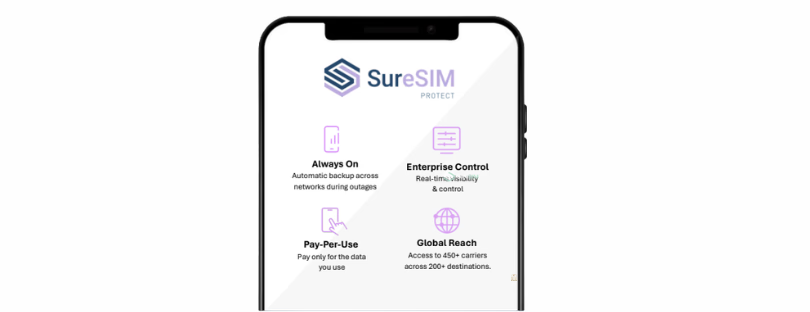
The ability to switch automatically across hundreds of networks in over 200 destinations is no longer a premium feature. For organizations with real duty of care obligations, it’s starting to look like baseline infrastructure.
Remote Work Normalized the Distributed Workforce — And Exposed the Gap
The normalization of remote and hybrid work didn’t reduce corporate travel. It made it more complex.
Teams are now geographically distributed. The traveling employee is not always moving between offices with local support. They are operating independently across time zones, often without a safety net.
That independence is valuable. It’s also risky.
The assumption that the traveler will figure connectivity out, find Wi-Fi, buy a SIM, and expense it later, doesn’t hold when the stakes are higher than a delayed email.
IT and security teams are increasingly aware that employees are operating in conditions where a consumer eSIM from an app store is not a strategy. It’s a workaround.
What Enterprise Actually Needs That Consumer Can’t Provide
The distinction isn’t just about network quality or price. It’s about visibility and control.
Consumer eSIM gives access. Enterprise eSIM givesis.
An IT or security team managing a traveling workforce needs to know, at a policy level, who is connected, where, and on which network. They need cost governance that doesn’t rely on chasing expense reports. They need the ability to enforce data policies, not just recommend them. And in an incident, they need to act in real time, not discover hours later that roaming failed silently.
This is the architecture enterprise eSIM platforms are built around.
It’s also why providers like SureSIM sit in a fundamentally different category than consumer travel connectivity products, even when they rely on similar underlying infrastructure. This isn’t a better roaming solution. It’s a different layer entirely.
The Moment Has Arrived — And It’s Structural
What’s happening right now isn’t a product trend. It’s a structural shift.
The fact that procurement, IT, security, and TRM teams are now sitting in the same room asking the same questions signals a level of maturity that simply didn’t exist five years ago.
SureSIM is positioned at that intersection — not by chance, but by design. Automatic failover, centralized visibility, policy control, global reach. These are not features layered on top. They are responses to problems the enterprise world has only recently started to define clearly.
The road warrior’s connectivity infrastructure has always existed.
It just wasn’t managed.
Now it is.
Conclusion
This is where the market quietly splits.
On one side, consumer eSIM providers continue to optimize for simplicity, price, and user experience. Fast activation, clean apps, aggressive bundles. That layer isn’t going away.
On the other hand, enterprise connectivity is evolving into something closer to infrastructure. Programmable, governed, and tied directly to risk management, compliance, and operational continuity.
That’s a different category.
Compared to traditional roaming solutions or even advanced consumer providers, the difference is no longer about coverage or pricing. It’s about philosophy. Access versus control. Convenience versus accountability.
Industry signals support this direction. Organizations like the GSMA continue to highlight enterprise eSIM and IoT connectivity as major growth drivers, while travel risk frameworks and corporate IT strategies increasingly prioritize visibility and resilience across distributed environments.
SureSIM’s positioning aligns with where that demand is heading, not where it has been.
And that’s the real shift.
Connectivity is no longer a background utility. It’s becoming an operational layer that companies are expected to own.
The road warrior may never think about it.
But the companies responsible for them don’t have that luxury anymore.
Ready to explore how SureSIM Protect fits into your organization’s travel risk framework? Get in touch.