
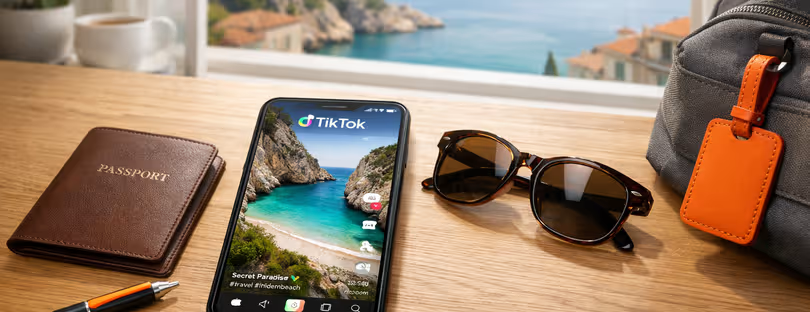
TikTok Travel Ads Are Changing How Trips Get Booked
Something fundamental has shifted in how people plan trips. It is no longer search-first. It is scroll-first. And right now, TikTok sits at the center of that shift.
Travel discovery used to begin with Google queries, blog posts, and carefully planned itineraries. Today, it often starts with a 15-second video. A beach clip. A hidden café. A real moment that feels spontaneous and unfiltered. That moment does not just inspire. It drives action.
TikTok is not just influencing where people go. It is shaping how they decide, how quickly they book, and even how they experience destinations once they arrive.
TikTok in the Travel Journey
Travelers are not passively consuming content anymore. They are actively building trips from it.
According to TikTok Marketing Science’s 2025 research, the numbers tell a clear story:
- 70% of users report booking a trip or activity after seeing TikTok content.
- 52% complete their booking within the following week.
- 72% consult the platform specifically when choosing accommodation.
- 28% are more likely to take action after encountering authentic content rather than traditional advertising.
That is not just influence. That is conversion.
What makes this powerful is the speed. A traveler can go from casual scrolling to confirmed booking in a matter of days. Inspiration, validation, and decision-making all happen inside the same platform.
And it does not feel like advertising. It feels like discovery.
From Inspiration to Transaction
What TikTok has done better than most platforms is collapse the traditional funnel.
There used to be clear stages. Awareness. Research. Comparison. Booking. Each step is owned by different platforms.
Now, those stages blur together.
A single video can introduce a destination, show real experiences, build trust, and trigger action. Comments act as reviews. Creators act as travel advisors. The platform itself becomes the planning tool.
This is why authenticity matters more than ever. Travelers are not responding to polished campaigns. They are reacting to real people, real experiences, and content that feels immediate.
That shift is forcing the entire travel industry to rethink how it shows up.
TikTok Travel Ads Enter the Game
Recognizing this behavior, TikTok has introduced Travel Ads, a format built specifically for tourism brands.
These are not traditional ads. They are dynamic, behavior-driven experiences that live inside the feed.
They appear as swipeable video stacks, adapting based on what users have searched, saved, or interacted with. Instead of targeting based on assumptions, the system responds to real-time intent.
If someone casually explores destinations, they are shown inspiration. If they focus on a specific location, the content evolves. Hotels, activities, and transport options start appearing. The journey becomes personalized without feeling intrusive.
This is powered by TikTok’s Smart+ automation, which optimizes delivery based on engagement signals. Timing matters. Relevance matters even more.
What stands out is how seamlessly this fits into user behavior. Travelers are not leaving the platform to plan. They are doing it inside the experience.
A Different Kind of Discovery Engine
TikTok is not just another marketing channel. It is becoming a discovery engine.
Unlike search platforms, where intent already exists, TikTok creates intent. It introduces places travelers did not know they wanted to visit.
That is a major difference.
On platforms like Google or even Instagram, users often start with a goal. On TikTok, the goal emerges from the content itself.
This is why lesser-known destinations are gaining visibility faster than ever. A single viral video can put a hidden location on the global map overnight.
For tourism boards and travel brands, this is both an opportunity and a risk. Visibility is no longer controlled. It is earned through relevance and storytelling.
Why Authenticity Wins
One insight stands out from TikTok’s data: 28% of users are more likely to act after seeing authentic content compared to traditional ads.
That gap is growing.
Travelers are increasingly skeptical of polished campaigns. They want real perspectives. Real experiences. Content that feels human.
This is where creators outperform brands.
The most effective travel content today does not look like marketing. It looks like someone is sharing a moment worth experiencing.
For brands, the implication is clear. Control less. Collaborate more. Enable storytelling instead of dictating it.

The Bigger Shift Across the Industry
TikTok is not operating in isolation. It is part of a broader shift toward visual-first, experience-driven discovery.
Platforms like YouTube have long influenced travel decisions through long-form content. Google still dominates intent-based search and booking pathways. But TikTok is redefining the starting point.
It captures attention earlier. It accelerates decision-making. And it blends entertainment with utility in a way few platforms manage.
This creates a new competitive dynamic.
Travel brands are no longer just competing on price or product. They are competing for attention in a feed where relevance is decided in seconds.
Conclusion
TikTok is not replacing traditional travel planning channels. But it is reshaping the front end of the journey in a way the industry cannot ignore.
Search platforms still dominate when travelers know what they want. Booking engines still matter for transactions. But TikTok is increasingly where desire is created.
And that changes everything.
The brands that will win are not the ones with the biggest budgets. They are the ones who understand how to show up authentically, at the right moment, in the right format.
Because in this new model, attention is not bought. It is earned.
And once you earn it, bookings follow.