SureSIM: Enterprise Connectivity Without Weak Points
Enterprise mobility has quietly become one of the most fragile layers in corporate infrastructure.
Not because networks are unreliable by design. And not because mobile technology hasn’t advanced. The problem is structural. Enterprises are still managing global mobility with tools and contracts that were never designed for today’s operating reality.
International travel has intensified. Hybrid work is permanent. Field engineers operate in remote and high-risk regions. Fleet operators rely on continuous telematics. IoT deployments span multiple borders. Yet many organisations still rely on fragmented roaming agreements, single-network SIM contracts, and consumer-grade travel eSIMs to keep their people connected.
That mismatch creates operational exposure.
SureSIM was built to close that gap.
The Connectivity Gap Enterprises Don’t Talk About
Enterprise mobile data is often treated as an operational afterthought until something breaks.
A device fails to connect during a business-critical trip. A fleet vehicle drops offline while crossing a border. A roaming bill arrives that no one forecasted. An employee lands in a region where coverage is technically available but practically unusable.
For IT leaders, this creates an administrative burden and risk exposure. For finance teams, it creates unpredictable spend. For travel risk managers working within ISO 31030 frameworks, it introduces duty-of-care vulnerabilities. For operations teams, it results in downtime and inefficiency.
What enterprises need is not more data bundles.
They need control.
SureSIM Protect: Resilience When Networks Fail
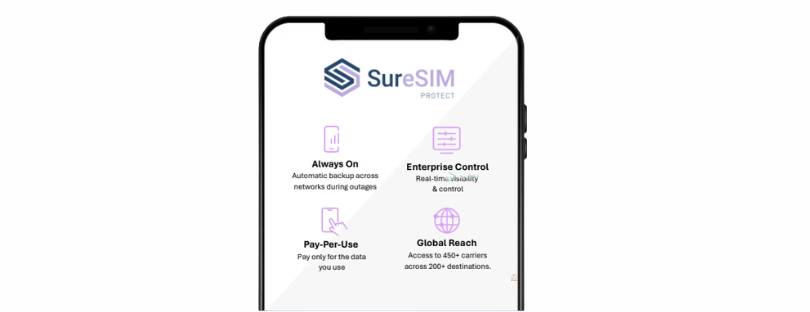
One of the strongest structural advantages in the SureSIM portfolio is SureSIM Protect, positioned as always-on backup connectivity for enterprise mobility.
This is not a standard roaming solution. It is a resilience layer.
When primary networks experience outages, congestion, or coverage gaps, devices automatically switch across available carriers. That capability becomes critical for corporate travel teams, field workers operating in challenging regions, and organisations managing BYOD environments.
In practice, this means business continuity is not dependent on a single network agreement. It means employees remain connected when it matters most. It means downtime becomes the exception rather than the default response to network instability.
For enterprises managing risk at scale, that shift is significant.

SureSIM Global: Travel Connectivity With Governance
International travel continues to grow, but enterprise control over mobile data abroad remains inconsistent.
Consumer eSIM providers have simplified access to data in 200+ destinations, but they were never designed to provide policy-based governance, cost controls, or compliance visibility.
It combines multi-network coverage with pay-as-you-go billing, real-time visibility, reusable licences, and policy-based profiles. Enterprises can assign different connectivity rules depending on user type, enforce cost thresholds, and validate coverage before travel begins.
That last capability is particularly valuable. Pre-travel testing ensures mobile service is available on arrival, reducing exposure during high-risk or high-priority trips.
For finance teams, usage-based billing eliminates bill shock. For IT teams, centralised visibility across devices simplifies management. For travel risk managers, connectivity becomes part of compliance rather than an uncontrolled variable.
This is enterprise mobility designed around governance rather than convenience.
SureSIM IoT: Cross-Border Fleet Intelligence
Connected vehicles and IoT deployments introduce another layer of complexity.
Single-network IoT SIMs often struggle across regions and borders. Roaming structures can inflate costs rapidly. Coverage inconsistencies disrupt tracking, analytics, and operational dashboards.
SureSIM IoT addresses these issues with multi-network capability across 200+ destinations, combined with lifecycle management and policy-based controls.
Fleet operators can activate, suspend, or reassign eSIMs remotely. IT teams can set thresholds and alerts at the vehicle or fleet level. Usage-based billing ensures organisations pay for consumption rather than static allocations.
In a logistics environment where real-time tracking drives operational efficiency, connectivity reliability is not optional. It is core infrastructure.
SureSIM treats it accordingly.
The SureSIM Platform: A Single Pane of Glass
The most important element in the SureSIM architecture is not a single product. It is the platform that unifies them.
This platform provides near real-time visibility into usage, network health, and spend across devices worldwide. IT teams can manage the entire eSIM lifecycle over the air, from activation to suspension to reassignment. Policy-based controls can be applied by team, device, or fleet.
This eliminates the need to manage multiple providers, portals, and billing frameworks. It replaces fragmentation with centralised governance.
In an enterprise environment where complexity compounds quickly, that simplification is strategic.
Built for Compliance, Not Marketing
In regulated industries and multinational corporations, connectivity is directly linked to employee safety and corporate responsibility. If employees cannot connect, organisations lose visibility. If roaming structures are opaque, financial governance weakens. If networks fail during critical travel, risk exposure increases.
SureSIM’s approach integrates connectivity into the broader enterprise risk framework.
That is a very different narrative from consumer travel eSIM marketing.
 Recognition and Validation
The award recognition as Best Enterprise eSIM Product reinforces SureSIM’s enterprise credibility. The testimonial from Mitsubishi Corporation referencing over-the-air deployment
Enterprise buyers prioritise proven infrastructure over promotional messaging. SureSIM positions itself accordingly.
Why This Matters in 2026
Enterprise mobility is no longer a side consideration. It is a core operational layer.
As organisations expand globally, deploy IoT at scale, and adopt hybrid work structures, connectivity must become programmable, visible, and cost-controlled. Multi-network resilience, lifecycle management, and policy enforcement will increasingly define procurement decisions.
SureSIM aligns with that trajectory.
It does not attempt to compete in the consumer travel eSIM market. It does not position itself around the cheapest data. Instead, it focuses on enterprise-grade visibility, control, and resilience across international travel, backup connectivity, and IoT fleets.
That focus gives it strategic clarity.
Conclusion
SureSIM is not selling data. It is delivering governance.
In a market crowded with consumer-first eSIM brands, SureSIM occupies a different category entirely. It functions as a control layer for enterprise mobility, integrating backup connectivity, international travel data, and IoT deployments into a unified platform.
For IT leaders, that means fewer blind spots. For finance teams, predictable spend. For travel risk managers, stronger duty-of-care alignment. For fleet operators, consistent operational visibility.
Enterprise mobility will continue to grow in complexity. Providers that merely offer coverage will struggle to differentiate. Providers that deliver centralised governance, policy control, and resilience at scale will define the next phase of enterprise connectivity.
SureSIM is clearly positioning itself in that second category.