Virgin Media O2 Satellite Expands to Google Pixel Phones in the UK
Virgin Media O2 has expanded O2 Satellite to compatible Google Pixel devices, giving more UK customers access to direct-to-device satellite connectivity when a normal mobile signal disappears.
It sounds like a small device update. It is not. This is another sign that satellite connectivity is moving out of the “emergency tech” corner and into the everyday mobile experience.
O2 Satellite, launched earlier this year, lets customers connect directly to satellites using standard smartphones, without a separate satellite phone or specialist hardware. The service was first limited to selected devices, then expanded to Apple compatibility last month. Now, compatible Google Pixel devices are being added too.
For customers, the promise is simple: when the mobile network cannot reach you, your phone may still have a way to send a message, use maps, check the weather, or share location. That matters in rural areas, on hiking routes, during road trips, and in those awkward coverage gaps where “99% population coverage” does not feel very useful.
More than a coverage claim
Virgin Media O2 says O2 Satellite has lifted its UK landmass coverage to 95%, adding an area equivalent to around two thirds the size of Wales.
That is the interesting part. Mobile coverage has traditionally been discussed in terms of population, which makes sense commercially because networks are built where people live and move most. But travelers, rural workers, outdoor users, logistics teams, and anyone crossing remote areas care about landmass too.
This is where satellite-to-phone services become strategically important. They are not designed to replace 4G or 5G networks in cities. They are designed to fill the gaps that are expensive, difficult, or environmentally impractical to cover with towers.
Available as a £3-per-month Bolt On for standard pay monthly customers and included at no extra cost for Ultimate Plan customers, O2 Satellite is already being used by tens of thousands of customers, according to Virgin Media O2.
READ MORE: 14 new things you can do with Google Pixel thanks to AI
Chris Bournes, Commercial Director at Virgin Media O2, said: “When we launched O2 Satellite, we wanted to make satellite connectivity available on the devices our customers already use every day.
“The addition of Google Pixel devices is another important step forward and means even more customers can benefit from the reassurance of staying connected in places where traditional mobile coverage isn’t available.
“As satellite technology continues to evolve, we’re excited to keep expanding access and bringing the benefits to more people.”
 Why Pixel matters
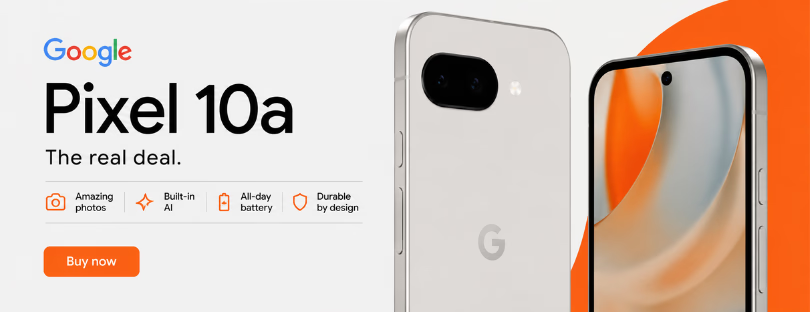
Adding Google Pixel support is more than a compatibility update. It makes O2 Satellite feel less like a niche feature for one handset ecosystem and more like a direction of travel for mainstream mobile.
Francois Mahieu, UK and Ireland General Manager for Devices and Services at Google, said:
“We are delighted to partner with Virgin Media O2 to bring O2 Satellite to Google Pixel users. Pixel phones are designed to be helpful and reliable devices and those using 02 Satellite have the reassurance of staying connected, even in the most remote parts of the UK. It’s a fantastic step forward in making next-generation connectivity truly accessible.”
That word, accessible, is important. Direct-to-device satellite only becomes useful at scale when it works with phones people already own. Nobody wants to pack a second device just in case a hiking route, rural cottage, festival field, or coastal road has poor signal.
This is also where the market is starting to split. Some satellite connectivity is built around specialist hardware. Some is built around emergency SOS. O2 is trying to position satellite as an extension of a normal mobile plan.
That is a much more powerful consumer proposition.
The bigger race
Virgin Media O2 is not operating in a quiet market. Direct-to-device satellite is becoming one of the most-watched connectivity battlegrounds in telecom.
VodafoneThree is preparing customer trials in the UK using AST SpaceMobile technology, with ambitions around data, voice, and SMS. Vodafone has also been active in Europe through its AST SpaceMobile partnership. Internationally, operators such as AT&T, Verizon, T-Mobile, Orange, and others are exploring satellite-to-phone models through different partners.
The wider trend is clear: mobile operators know that “no signal” is becoming less acceptable. Travelers expect connectivity everywhere. Businesses expect workers to stay reachable. Consumers expect maps, messaging, and location sharing to work even when they leave the city.
READ MORE: UK First in Europe to Approve Direct-to-Device Satellite Services for Smartphones
That does not mean satellite services are perfect yet. Today’s direct-to-device experience is still limited compared with terrestrial mobile networks. App support, speed, device compatibility, indoor reliability, and service availability all matter. O2’s own guidance also makes clear that emergency calls are not supported over O2 Satellite, so it should not be treated as a full safety replacement.
That nuance matters. Satellite connectivity is a major step forward, but it is not magic coverage.
Who benefits most
For frequent travelers inside the UK, rural residents, hikers, drivers, delivery workers, field teams, and anyone who regularly moves through patchy coverage areas, O2 Satellite could become a genuinely useful add-on.
For people who mainly stay in cities, rarely lose signal, or expect full broadband-style mobile performance everywhere, it may feel less essential for now. The early value is not streaming or heavy browsing. It is continuity. A message gets through. A map loads. A location can be shared. That is enough to change the experience in a not-spot.
READ MORE: O2 Satellite for iPhone Expands UK Mobile Coverage
What could improve next is obvious: more devices, more apps, clearer roaming possibilities, stronger emergency-service integration, and broader performance transparency. Customers will want to know not just whether satellite is available, but what it can realistically do in the moment.
Conclusion
The Google Pixel expansion makes O2 Satellite feel less experimental and more like the beginning of a new mobile layer.
This is not the end of coverage gaps. It is the start of operators admitting that traditional networks alone will not solve every coverage problem, especially across remote landmasses. The winning model will probably not be satellite versus mobile. It will be a satellite quietly supporting mobile when the normal network disappears.
For travelers, that is the real shift. Connectivity is no longer just about the cheapest data plan or the fastest 5G headline. It is about whether your phone still works when the journey becomes less predictable. Virgin Media O2 has moved early in the UK. Now the real question is how quickly the rest of the market turns satellite from a premium reassurance feature into something customers simply expect.