T-Mobile Dynamic CX Targets Stadium Network Congestion
T-Mobile has introduced Dynamic CX, a new AI-powered network optimization capability designed for one of the hardest problems in mobile: what happens when tens of thousands of people all try to use the network in the same place, at the same time.
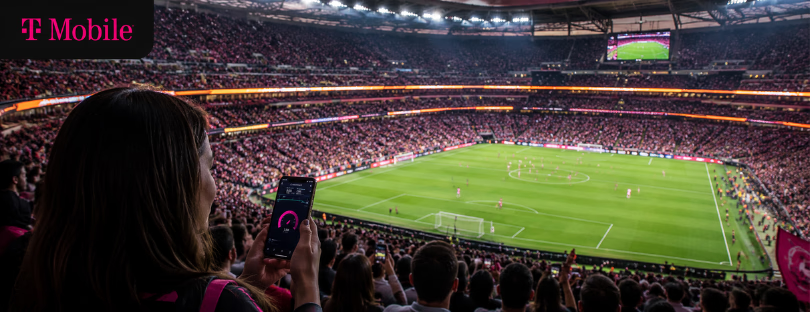
Anyone who has left a stadium, festival or sold-out concert knows the moment. You try to message friends, upload a clip, open maps or order a rideshare, and suddenly the phone feels much less smart. The network is still there, but demand has changed faster than the experience can keep up.
Dynamic CX is T-Mobile’s answer to that pressure point. Built for major live events and high-density environments, it helps the network prepare before large gatherings and adapt as crowds move, stream, share and connect.
How Dynamic CX works
The capability builds on T-Mobile’s intelligent Self-Organizing Network technology, known as SON, which continuously monitors and optimizes network performance. Dynamic CX adds a more predictive layer. According to T-Mobile, the system can help identify potential mass gatherings by analyzing publicly available event information, schedules and online activity.
That matters because event connectivity is no longer just about adding capacity and hoping it is enough. Crowd behavior changes throughout the day. Demand looks different before kickoff, during halftime, after the final whistle, at train stations, in fan zones and around rideshare pickup points. Dynamic CX is designed to read those shifts and help the network respond as they happen.
“T-Mobile has decades of experience supporting America’s connectivity during some of the world’s largest events, and we’re constantly evolving how the network responds to moments of high demand,” said John Saw, Chief Technology Officer, T-Mobile. “With Dynamic CX, we’re using AI to help the network prepare ahead of large-scale events and adapt in real time as crowds move and demand changes — helping deliver a stronger, more resilient experience for customers.”
Why this summer matters
The timing is not accidental. Dynamic CX is launching as T-Mobile prepares for one of the world’s largest global soccer tournaments, hosted across the United States this summer, with host cities including Atlanta, Boston, Dallas, Houston, Kansas City, Los Angeles, Miami, New York/New Jersey, Philadelphia, the San Francisco Bay Area and Seattle.
READ MORE: Best USA eSIM 2026: Congestion & Latency Tested
T-Mobile says its teams have expanded capacity and operational support across stadiums, fan zones, airports, transit hubs and surrounding infrastructure. That matters because event connectivity does not stop at the venue gate. For international visitors, the journey may involve airport arrivals, hotel check-ins, ticketing apps, maps, mobile payments and eSIM activation before they even reach the stadium.
“This summer’s event season will bring millions of people together across America for some of the year’s biggest cultural and sporting moments,” said Ankur Kapoor, Chief Network Officer, T-Mobile. “From network readiness and public safety coordination to new technologies like Dynamic CX, our teams are focused on helping people stay connected when it matters most.”
The company also points to public safety coordination, priority communications through T-Priority, deployable network assets in several host markets and heightened cybersecurity monitoring across critical infrastructure and event-related operations.

The bigger network race
What makes Dynamic CX interesting is not only the AI label. Every major operator is now talking about smarter, more resilient networks. Verizon has been preparing venue connectivity with stadium capacity upgrades, 5G, C-band and mmWave. AT&T, through FirstNet, continues to emphasize public safety readiness and deployable assets for planned events and emergencies. Ericsson has also reported live-network AI-RAN trial results with T-Mobile showing efficiency and throughput gains compared with legacy rule-based methods.
So T-Mobile is not alone in treating AI as part of the network operations layer. The difference is the way Dynamic CX is being positioned: less as a lab trial and more as a practical event-season tool for real crowds, real movement and real traffic spikes.
READ MORE: T-Mobile Launches U.S. Travel eSIM for Visitors
Independent measurement gives T-Mobile useful momentum. Opensignal’s recent analysis of North American host cities found T-Mobile leading across several U.S. mobile experience categories, including download speed performance in the U.S. host markets. That does not guarantee every fan will get a flawless connection, but it gives the announcement more weight.
There are still limits. Dynamic CX will matter most for T-Mobile customers and compatible devices. International visitors may still compare roaming, local prepaid options and travel eSIM plans depending on price, phone compatibility and length of stay. And as with any AI-powered network promise, users will judge it by one simple test: does the message send when the stadium empties?
Final thoughts
Dynamic CX shows where mobile networks are heading. The next battle is not just who has the biggest 5G footprint, but who can make connectivity feel stable when demand becomes chaotic.
For travelers, this is part of a wider shift. Operators are trying to make roaming and event connectivity less visible, while travel eSIM providers are winning attention by making access easier before departure. Telcos have the network depth. eSIM platforms often have a smoother purchase journey. The winners will be the companies that combine both: strong infrastructure, simple activation and fewer dead moments when people actually need their phones.
T-Mobile’s Dynamic CX is a serious move in that direction. It will not remove every pain point at massive events, but it does signal a more realistic future for mobile networks: less manual reaction, more predictive intelligence and a customer experience built around the messy way people actually move.