Why Airport Arrivals Fall Apart Without Data
This is the first story in Alertify’s new series, 15 Problems Every Traveler Knows Too Well, where we look at the small but very real connectivity problems that can make a trip feel harder than it should.
We are starting with the one almost every traveler recognizes: the airport arrival panic. It is not dramatic. It will not ruin the whole trip. But it appears at exactly the wrong moment, when you are tired, moving through arrivals, and suddenly need your phone to do everything at once.
The airport arrival panic
There is a very specific kind of silence after landing. The plane door opens, everyone stands too early, bags start hitting shoulders, and half the cabin turns off airplane mode. Not because people are desperate to scroll. Because the trip has already moved onto the phone. Airport connectivity
You need the hotel address. Your transfer driver has messaged. Uber or Bolt wants the pickup point. WhatsApp is full of “landed?” messages. Google Maps is supposed to tell you which exit to take. Maybe your booking confirmation is buried in an app that has logged you out.
And then nothing loads.
That is the airport arrival panic. Small, familiar, and deeply annoying.
The first ten minutes
Travelers used to think about mobile data later. After baggage. After check-in. Maybe after finding a café with Wi-Fi. That rhythm does not match how travel works anymore.
The first ten minutes after landing are often the most data-dependent part of the trip. You are tired, moving through a place you do not fully know, and making quick decisions. Which terminal exit? Where is the rideshare zone? Has the driver cancelled?
READ MORE: Delay eSIM Activation? Yesim Lets You Decide
This is why “I’ll just use airport Wi-Fi” is not really a plan. Airport Wi-Fi can work when you are sitting at the gate with time to spare. It is less useful when it asks for SMS verification, opens a broken login page, drops after three minutes, or refuses to load the ride app near the taxi rank.
The problem is not a lack of technology. The problem is timing.

Roaming is the lazy fix
Of course, one option is to switch on roaming and hope for the best. Many travelers still do this because it is easy. The phone connects. The bill arrives later.
But that convenience has a psychological cost. Nobody likes paying premium rates for basic travel behavior: maps, messages, email, payments, and a few app refreshes. Roaming is not always wrong. For a short business trip, an included roaming package, or a corporate plan, it can be acceptable. But for many travelers, especially those crossing borders often, it feels like using the most expensive tool for the most ordinary job.
This is where travel eSIMs became interesting. They moved the decision earlier: before departure, before the airport Wi-Fi gamble, before the first “why is nothing loading?” moment.
Where Yesim fits
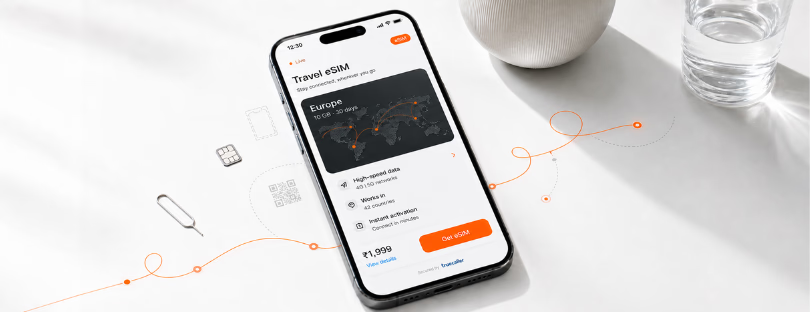
eSIM solutions like Yesim make sense in this arrival moment because it treats mobile data as preparation, not damage control.
With Yesim, travelers can install an eSIM digitally before the trip, choose a destination or international plan, keep their physical SIM in place, and arrive with mobile data ready to use.
No kiosk. No passport queue. No SIM swapping. No awkward comparison of local plans while half-asleep after a flight. And no, depending on public Wi-Fi for the most practical part of arrival.
READ MORE: What Frequent Travelers Notice Immediately When Switching to Yesim
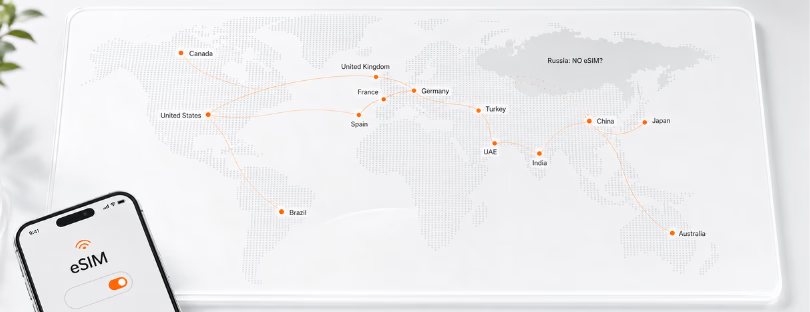
Yesim also fits the way many people now travel: not always one country, one hotel, one simple route. Regional and broader international plans matter when a trip moves across borders, or when someone wants one app-based setup instead of rebuilding connectivity each time.
It will not be perfect for everyone. Some travelers already have generous roaming included. Others may prefer a local SIM for long stays, local calls, or very specific domestic bundles. And like every eSIM provider, Yesim could make the experience better by being brutally clear on network partners, speed expectations, hotspot rules, and fair-use conditions before purchase.
Still, for the arrival panic, the case is strong: the best connectivity solution is the one that works before the problem starts.
The market is changing
This shift is bigger than Yesim. GSMA describes eSIM as a technology that lets consumers store multiple operator profiles on a device and switch remotely without replacing a removable SIM. GSMA Intelligence has also described travel eSIM as one of the clearest consumer benefits of eSIM adoption. People may not care about remote SIM provisioning. They care about landing and being online.
At the same time, IATA’s passenger research keeps pointing in the same direction: travelers want smoother, faster, more digital journeys. Airlines, airports, hotels, payment apps, ride platforms, and border systems are pushing more of the journey into mobile-first flows.
Traditional operators still have advantages, especially trust, voice services, bundles, and existing customer relationships. Travel eSIM brands have helped normalize the idea that mobile data can be bought before the trip. But the brands that will win trust are not just the ones with the most countries on a coverage map. They are the ones that make the first hour abroad feel less messy.
Final thoughts about airport connectivity
The airport arrival panic is not dramatic enough to become a travel story, but it is common enough to deserve attention.
It is the moment when travel stops being theoretical and becomes practical. You need directions, transport, messages, payment access, and reassurance. You need your phone to behave like the travel tool it has become.
That is why eSIMs are no longer just a cheaper roaming alternative. They are part of arrival planning.
Yesim’s strongest role here is not to promise magic. It is to remove a very specific piece of friction: the uncertainty between landing and getting properly connected. For frequent travelers, that small difference matters. The trip feels different when the first thing your phone says is “connected.”