Russia Weighs Tighter Rules for M2M SIMs and eSIMs
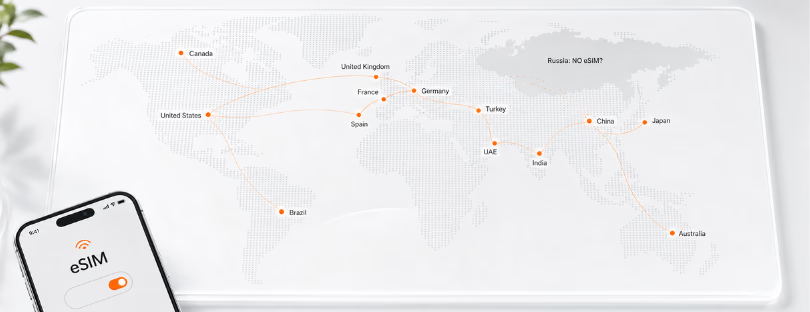
Russia is considering tighter controls on M2M SIM cards and eSIMs, in a move that would push telecom regulation deeper into the Internet of Things. Kommersant reported on June 23 that officials are discussing a separate legal category for M2M SIMs, additional user identification, a ban on voice and SMS services from those cards, and a possible prohibition on Russian citizens registering eSIMs while abroad.
The measures could be added to a third package of anti-fraud amendments, although no final decision has been made. Still, the direction is clear. Russia is not only looking at how people connect. It is looking at how machines connect, too.
That matters because M2M SIM cards sit inside ATMs, sensors, vehicles and meters. They are supposed to transmit data quietly in the background. But if Russia had just over 300 million SIM cards as of August 2025, and roughly 20% were M2M cards, the policy could touch around 60 million connections.
Why M2M now
The official argument is anti-fraud. According to the reports, the IoT SIM market still operates partly in a grey zone, and some cards are allegedly being used for spam calling. Russia’s Digital Development Ministry said it continues to fight internet fraud but did not discuss details. Vimpelcom, MegaFon and T2 declined to comment, while MTS did not respond.
From a telecom perspective, the concern is understandable. A data SIM placed in a machine should not behave like an ordinary consumer phone line. If it can make calls or send SMS, it becomes harder to separate legitimate fleet connectivity from abuse. Removing voice and SMS from M2M cards would make the product cleaner and easier to supervise.
The uncomfortable part is where the anti-fraud policy starts to overlap with the control of digital access. Russia has already moved against foreign connectivity routes. Reports in 2025 described a 24-hour “cooling-off” period or mobile internet block for foreign SIMs and eSIMs entering the country. A ban on registering eSIMs from abroad would fit the same direction: fewer unmanaged access points, more domestic identity checks, and less room for connectivity outside the national perimeter.

What eSIM changes
eSIM makes this debate sharper because it removes the physical chokepoint. A plastic SIM can be handed over, counted, blocked at the retail level and tied to a registration process. An eSIM profile can be provisioned remotely, sometimes before the user enters the country. For travelers and businesses, that is the whole point. For regulators, it is the part that feels difficult to control.
READ MORE: Global eSIM Readiness: Winners, Gaps and Friction
This is especially true in IoT. The GSMA’s newer eSIM IoT specifications, including SGP.32, are designed to make remote provisioning work better for devices with limited screens, limited power and long deployment cycles. In plain English, the industry is moving toward connected devices that can be activated and managed at scale without someone standing in a shop with ID.
That is useful for logistics, smart meters, healthcare devices and vehicle fleets. It is less comfortable for governments that want every connectivity layer to be locally registered, visible and interruptible.
The wider market signal
Russia’s approach is unusually restrictive, but the question is global: who is responsible for identity when connectivity is embedded inside a device, sold through an API, or installed before the user arrives?
In Europe, the debate is usually framed around cybersecurity and resilience. ENISA has examined eSIM ecosystem risks, including profile misuse and service disruption, while also noting that major technical compromises have been limited. The difference is tone. In many markets, the goal is to secure IoT without killing flexibility. In Russia, the direction appears more closely tied to surveillance, fraud control and national internet sovereignty.
READ MORE: Blocked in Turkey: VPNs Down, eSIM Access Restricted
For ordinary travelers, this is not a convenience story. If implemented, the rules could make Russian eSIM use more awkward, especially for citizens abroad and for international services serving Russian users. For companies managing IoT fleets, the impact depends on how narrow the rules become. A clean data-only M2M category is not automatically bad. Many enterprise buyers would welcome clearer rules, fewer grey-market SIMs and less spam abuse. The problem starts when compliance becomes so heavy that legitimate devices are harder to deploy.
What should improve is transparency. Operators, IoT providers and businesses need clear timelines, definitions and migration paths. “M2M SIM” cannot be a vague bucket covering everything from a smart meter to a backup router. The market needs to know which services lose SMS, how identity will be verified, and whether existing fleets will be grandfathered or forced through re-registration.
Conclusion
The important part of Russia’s proposed SIM rules is not the SIM card itself. It is the power shift. Connectivity used to be regulated mostly at the consumer subscription level. Now the target is moving into machines, APIs, remote provisioning platforms and cross-border eSIM activation.
The smarter path is to separate fraud prevention from blanket control: keep M2M products data-only where appropriate, verify enterprise ownership properly, and secure remote provisioning without treating every international eSIM activation as suspicious by default. Russia seems to be choosing a harder line. For the rest of the market, the lesson is simple: as eSIM becomes infrastructure, identity rules will become just as important as coverage, price and speed.