povo Brings Data eSIM Top-Ups to Yahoo! Shopping Japan
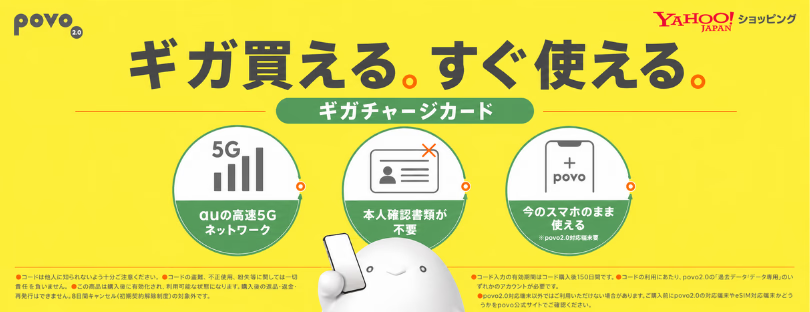
KDDI, Okinawa Cellular and KDDI Digital Life have started selling povo’s data eSIM “Giga Charge Card” through Yahoo! Shopping in Japan from June 23, 2026. Customers can buy a data top-up outside the povo app, pay with Yahoo! Shopping-supported methods such as credit cards or PayPay, then receive a PIN code and activation link by email.
But the more interesting story is not the card itself. It is where the card is being sold.
For years, mobile data has mostly lived inside operator apps, carrier shops, prepaid shelves, airport counters or travel eSIM marketplaces. povo is nudging it into a more ordinary e-commerce habit. You shop, you pay, you receive a code, you activate. That sounds almost too simple, which is exactly why it matters.
What Customers Can Buy
The Yahoo! Shopping lineup is deliberately small: unlimited data for 24 hours at 330 yen, 3GB for 30 days at 990 yen, or 30GB for 30 days at 2,780 yen. The products are tax-exempt, according to the company announcement.
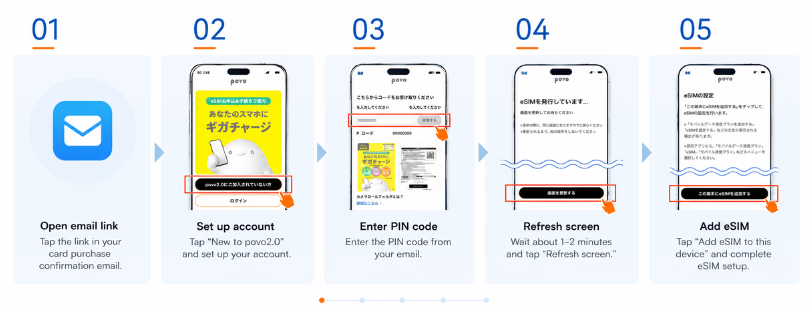
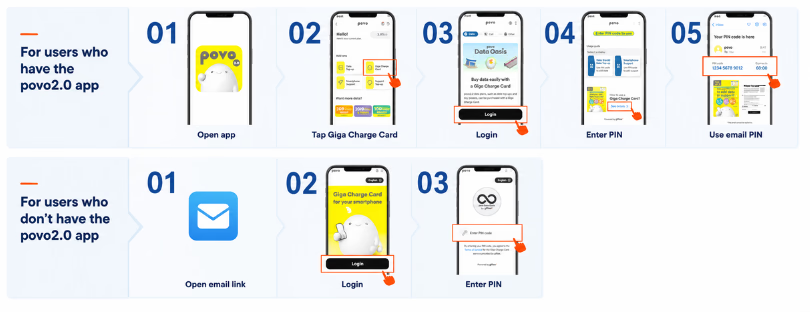
After purchase, the customer receives a PIN code and dedicated URL at the email address registered with Yahoo! Shopping, or another specified email address. Existing povo2.0 users can enter the PIN through the povo2.0 app under “Giga Charge Card.” New users are directed to a dedicated page where they can continue with the povo2.0 contract flow.
 This is not a full mobile plan in the old sense. povo2.0 is built around “Toppings,” where users add data capacity or calling options when needed instead of committing to a standard monthly bundle. povo’s official site describes the service as starting from a 0 yen basic fee, with data capacity purchasable when needed, and the service runs on au’s network.
That flexibility is the whole point. The user does not have to think in monthly contracts. They think in situations: today I need unlimited data, this month I need 3GB, or I need a larger 30GB allowance.
Why Yahoo! Shopping Matters
The move is practical, but also psychological. Buying connectivity through Yahoo! Shopping makes data feel less like a telecom product and more like a digital consumable.
That could help several types of users. Some people prefer familiar payment environments. Some may already have PayPay behavior built into daily life. Some may want to buy data for another person and pass along the code. Others simply do not want every mobile purchase to happen inside one carrier app.
 It also gives povo another touchpoint beyond its own ecosystem. That matters in Japan, where convenience-led mobile behavior is already normal. povo has previously used physical retail routes such as Lawson for Giga Charge Card-style access, including the 30GB option. Yahoo! Shopping adds a digital retail layer to that same idea: make mobile data easy to buy where people already shop.
There is a useful lesson here for the broader eSIM market. The strongest eSIM experience may not always be the one with the most plans. It may be the one that removes the least friction at the moment of need.
The Market Context
Globally, consumer eSIM is moving from early-adopter behavior into mainstream infrastructure. GSMA Intelligence has projected that global eSIM smartphone penetration would reach 10% by the end of 2026 and continue accelerating in 2027. That does not mean every user understands eSIM yet. It means operators, retailers and platforms are all trying to make eSIM less technical and more familiar.
Travel eSIM companies such as Airalo, Holafly, Ubigi and Nomad eSIM helped popularize app-based data buying for international trips. Operators are now learning from that playbook, but with a local-network advantage. Orange Travel, Vodafone travel offers, and Japan-focused products such as povo show that carriers are no longer treating eSIM only as a provisioning format. They are turning it into a retail product.
READ MORE: KDDI starts selling data eSIM ‘Giga Charge Cards’ at Lawson stores
povo’s approach is different from a typical travel eSIM marketplace. It is domestic, tied to KDDI’s au network, and shaped around modular top-ups rather than country-by-country roaming bundles. That makes it useful for people already in Japan or using povo2.0, and less relevant for someone who wants one app to cover a multi-country trip.
There are also limits. The 24-hour unlimited option may be restricted during network congestion or for high-load services such as video streaming or cloud gaming, according to the release. The activation flow still requires users to follow the correct path depending on whether they already use povo2.0. And for complete newcomers, the word “Topping” may still need a moment of explanation.
Conclusion
The Giga Charge Card launch on Yahoo! Shopping is not dramatic in the usual telecom-news way. There is no giant roaming promise, no global bundle, no flashy unlimited-everywhere claim. That is why it is interesting.
povo is showing a quieter direction for eSIM: make data purchasable in the same places people already buy ordinary digital goods. For existing povo users, this is simply another convenient recharge route. For the wider market, it is a sign that eSIM distribution is becoming less about the SIM and more about the shopping journey around it.
The next competitive edge may not be who has the longest destination list. It may be who makes connectivity feel the least like telecom admin.