
ISO 31030 in Practice: Why Connectivity Matters
If you have ever sat in a travel risk meeting, you know the awkward truth nobody wants to say out loud: most “traveller support” plans assume the traveller can actually get online when it matters.
Not when everything is fine. When the airport Wi-Fi is a lie, the local SIM does not activate, roaming is blocked by policy, or the device is stuck on a network that is technically available but practically unusable. In other words, the exact moments that trigger duty of care stress.
ISO 31030 was built for that reality. It is guidance for organisations on how to manage travel risks to both the organisation and its travellers, with a structured approach spanning policy, programme design, risk assessment, prevention, incident response, and continuous review.
The mistake is reading it like a “standard to comply with” instead of a playbook for how risk teams actually think.
So let’s translate ISO 31030 into something practical, and talk about the unglamorous infrastructure layer that keeps the whole traveller support machine working: reliable connectivity.
Why ISO 31030 feels familiar to risk people
ISO 31030 sits in the ISO 31000 family of risk management guidance, so it follows the logic risk professionals already use: identify hazards, assess risk, put controls in place, test them, and keep improving.
It is not trying to be a travel policy template. It is trying to make travel risk management auditable and repeatable, which is why it pushes you toward clarity on roles, escalation, communication, and post-incident learning.
And here is the key: almost every one of those elements has an invisible dependency on connectivity.
If you cannot reach the traveller, you cannot support them.
If you cannot see what is happening, you cannot make decisions.
If you cannot document actions and outcomes, you cannot prove governance.
ISO 31030 does not say “thou shalt buy an enterprise eSIM”. But it does describe an operating model where connectivity stops being a convenience and starts being a control.
Where connectivity shows up in real ISO 31030 workflows
Let’s map the standard to the moments risk and security teams actually care about.
Trip planning and approvals
Before the trip, ISO 31030 pushes organisations to assess threats and hazards, and apply prevention and mitigation strategies that match the trip profile.
In practice, this is where you decide things like:
- Do we need mandatory check-ins?
- Do we require a second device?
- Do we need geofencing alerts?
- Do we need secure comms channels?
- Do we need a “known-good” connectivity fallback?
Risk teams already understand redundancy in everything else. Connectivity redundancy is the same idea, just often forgotten.
Monitoring and traveller support
A lot of travel risk programmes look great on paper until you reach the part where someone has to monitor, communicate, and escalate during disruption.
That is why many TRM tools emphasise monitoring and support, location awareness, disruption alerts, and two-way communication as core operational capabilities.
Connectivity is what makes those capabilities real, not aspirational. If your traveller cannot receive alerts, cannot respond, or cannot access guidance in the moment, you have a programme that works only in PowerPoint.
Incident response and escalation
ISO 31030 explicitly includes guidance on what organisations can do should an incident occur.
This is where latency and network reliability become risk variables. The escalation tree is only useful if the traveller’s device is reachable. Your “call tree” is only useful if calls can be completed. Your crisis app is only useful if it can sync.
In high-friction environments, the practical control is not just “have a number to call”. It ensures the traveller has a stable data path, with visibility for the people supporting them.
Post-trip review and continuous improvement
ISO 31030 also pushes organisations to evaluate and review their programme, which is where data matters.
And data is not only incident logs. It is:
- Where did connectivity fail?
- Which locations created repeated support tickets?
- Which roles had to override policy to get someone online?
- Which trips caused unplanned spend?
If you cannot measure the operational reality, improvement becomes guesswork.

The connectivity gap risk teams keep inheriting
Here is the pattern I keep seeing inside large organisations.
Travel risk and security teams are expected to deliver a strong duty of care posture. Meanwhile, connectivity is often treated as either:
- A roaming bundle problem (procurement)
- A device problem (IT)
- A traveller problem (give them a checklist)
So the traveller lands, connectivity fails, and the “support” programme starts with a first step that is basically: “Please connect to the internet so we can support you.”
That gap is why enterprise connectivity is becoming part of the traveller support stack, not a separate telecom conversation.
This is where SureSIM fits, and why it reads well to risk professionals
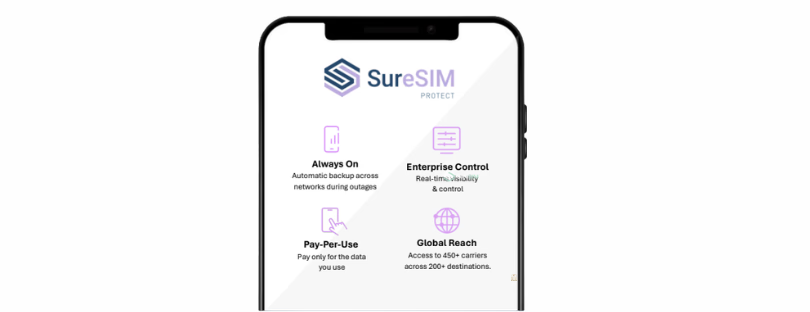
SureSIM is positioning itself as an enterprise-grade eSIM management platform built for corporate IT teams and MSPs, with near real-time visibility and control over business mobile data connections across hundreds of networks.
That matters in an ISO 31030 context because it shifts connectivity from “best effort” to something closer to a managed control.
What that looks like in practice:
SureSIM describes near real-time visibility into SIM activity, data usage, and network status, plus policy-based controls and usage alerts.
It also leans into multi-network access and “control centre” language for enterprise connectivity, which aligns with how risk teams think about oversight during disruption.
This is not about selling another travel eSIM. It is about reducing the probability that traveller support fails at the first dependency.
Practical controls that map cleanly to ISO 31030
- Pre-trip readiness: provision the eSIM before travel, validate activation, and avoid last-minute local SIM chaos.
- In-trip oversight: see who is online, where issues are occurring, and whether the device is burning data unexpectedly.
- Policy enforcement: define what “good” looks like (alerts, caps, access controls) and apply it consistently.
- Incident resilience: reduce single-network dependence, especially in locations where coverage quality varies street by street.
- Audit trail: retain usage and event signals that help demonstrate governance and inform post-trip review.
If you are a risk professional, this will sound less like “telecom features” and more like basic operational controls.
How does this compare with other market approaches?
The market is splitting into two layers.
Convenience-layer travel eSIMs optimise for individual purchase journeys: quick install, broad coverage marketing, and consumer-friendly bundles. They have their place, but they are not designed for enterprise oversight, policy control, or auditability.
Control-layer enterprise connectivity solutions optimise for fleet-level management: lifecycle provisioning, visibility, governance, and integration with how IT and risk teams operate. SureSIM is clearly aiming to sit in this second category, alongside the broader enterprise mobility and managed connectivity trend.
At the same time, travel risk management itself is maturing. Organisations are aligning policies to ISO 31030 frameworks to make programmes consistent, testable, and defensible, especially as disruptions and duty of care expectations keep rising.
In that environment, “reliable connectivity” stops being an IT nice-to-have and becomes part of the risk control set.
Where this is going
ISO 31030 is not asking you to become a telecom expert. It is asking you to remove brittle dependencies from traveller support.
If your support model depends on travellers improvising connectivity in unfamiliar places, your programme is fragile by design. The standard nudges you toward prevention, mitigation, and incident readiness. Connectivity is one of the simplest places to make that real, because it underpins communication, monitoring, escalation, and documentation.
The organisations that will look “most ISO 31030 mature” over the next year will not be the ones with the longest policies. They will be the ones who quietly harden the basics: reachability, visibility, and control.
And that is why enterprise eSIM platforms like SureSIM are starting to show up in conversations that used to be owned by travel teams alone. When connectivity becomes infrastructure, traveller support stops being a promise and starts being a capability.