World Cup eSIM Offers Rise Ahead of FIFA 2026
The World Cup is approaching, and travel eSIM offers are becoming more numerous. That is not surprising. FIFA 2026 will not be a simple “fly in, watch a match, fly home” tournament for many supporters. It will be spread across the United States, Canada, and Mexico, with 16 host cities and a much larger fan journey than previous editions.
That is exactly the kind of travel moment where connectivity stops being a nice extra and becomes part of the trip infrastructure. Tickets, maps, ride-hailing, hotel check-ins, messaging, translation, public transport, restaurant bookings, stadium updates: almost everything a football fan needs now sits inside the phone.
Jetpac is positioning itself directly around that reality. The global travel eSIM provider says it wants to help fans prepare before landing, especially those moving between countries and host cities during the tournament.
“The FIFA 2026 fan journey will be more mobile and more cross-border than a typical tournament trip,” said Vineet Singh, Business Head at Jetpac. “Fans will be using their phones throughout the day, from airport arrivals and stadium navigation to transport, messaging, and post-match plans. Connectivity needs to be planned before the trip, not solved in panic after landing.”
Why FIFA 2026 is different
The 2026 tournament is bigger in almost every practical sense. FIFA has confirmed a 48-team World Cup with 104 matches across three host countries. For fans, that creates a more fragmented travel pattern. Someone may arrive in Toronto, follow their team to New York, then head to Mexico City or Dallas, depending on the draw.
That sounds exciting, but it also exposes one of the least glamorous parts of modern travel: roaming confusion.
Many travellers still assume their home plan will “just work” abroad. Technically, it often does. Financially, it can become ugly very quickly. A few days of maps, video calls, ride-hailing, social media uploads, ticket apps, and messaging can turn into a surprisingly expensive aftertaste.
This is where event-led eSIM marketing makes sense. World Cup fans are not buying data because they love telecom products. They are buying certainty. They want the phone to work when the Uber driver is waiting, when the stadium gate app will not load, or when the group chat is deciding where to meet after the match.
Jetpac’s angle
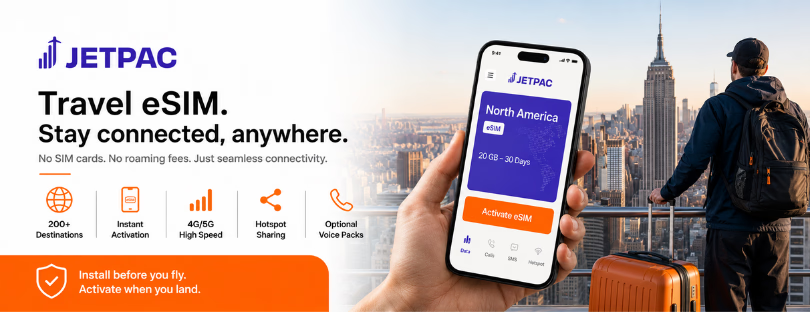
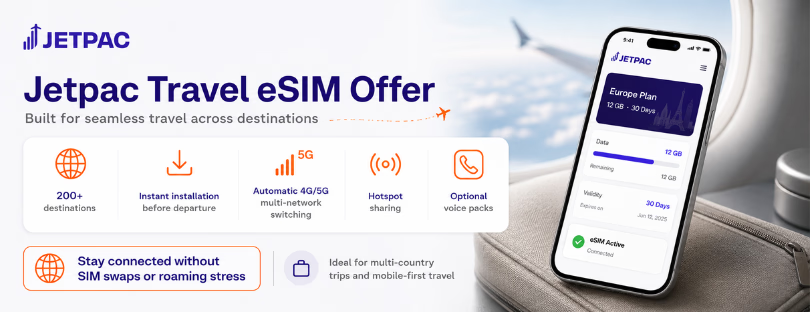
Jetpac’s pitch is built around pre-trip simplicity: install before departure, activate when needed, and avoid physical SIM swaps or airport counter panic. Its offer includes prepaid data packs, upfront pricing, coverage in 200+ destinations, hotspot sharing, optional voice calling packs, and automatic multi-network switching with 4G/5G connectivity where supported.
One feature that stands out is continued access to essential apps such as WhatsApp, Google Maps, and Uber even after data runs out. For football travel, that is not a gimmick. It is exactly the kind of “last mile” safety net people remember when a trip gets messy.
“Major events put pressure on every part of the travel experience,” added Singh. “Fans do not want to spend their first hour after landing comparing SIM options or worrying about roaming charges. They want to get to their hotel, meet friends, find transport, and focus on the match. Jetpac is built to make these travel moments easier.”
That message is smart because it does not sell eSIM as a technical upgrade. It sells it as friction removal.
The wider eSIM playbook
Jetpac is not alone here. Airalo, Holafly, Ubigi, Nomad eSIM, Yesim, GigSky, and others are all fighting for the same travel behaviour: buy connectivity before you travel, not after you land. The difference is increasingly in packaging, trust, app experience, fair usage clarity, refund policies, hotspot rules, and whether the offer feels built for a specific trip rather than dumped into a giant country list.
For the World Cup, that difference matters. A fan visiting one city for three days may want unlimited data. A fan crossing borders for two weeks may care more about regional coverage, hotspot access, and predictable pricing. Families and friend groups may need sharing. Business travellers attending matches may need voice options and reliable tethering.
This is why the best World Cup eSIM offers will not simply shout “200 countries” or “cheap data.” They will explain what happens across the U.S., Canada, and Mexico, which networks are supported, whether 5G is available, what happens after the allowance is used, and whether hotspot use is restricted.
What this really signals
FIFA 2026 will be a major sporting event, but it will also be a stress test for travel connectivity brands. The winners will not be the providers with the loudest discount banners. They will be the ones who understand the fan journey minute by minute.
Jetpac’s timing is good because the tournament gives travellers a clear reason to plan ahead. But the broader trend is bigger than football. Major events are becoming mobile-first ecosystems, and connectivity is now part of event readiness in the same way as tickets, accommodation, and transport are.
For Alertify readers, the takeaway is simple: the travel eSIM market is moving from destination selling to moment-based selling. World Cup, Olympics, Formula 1, music festivals, business conferences. Each has a different connectivity problem. The brands that explain that problem clearly will earn more trust than those selling data as a generic commodity.