
The Future Is Not Roaming vs eSIM. It Is Friction vs Frictionless
For years, travel connectivity was framed as a fight: roaming on one side, eSIM on the other. roaming vs eSIM for travellers
That framing is getting tired.
Travellers do not wake up thinking, “Should I use a roaming agreement today or a remote SIM profile?” They think: Will my phone work when I land? Will WhatsApp load? Can I open Google Maps? Will my bank app send the verification code? Will this cost me €4 or €40?
That is the real market now. Not roaming versus eSIM. Friction versus frictionless.
The old roaming story
Roaming used to be the default because there was no realistic alternative. You landed, your phone connected to a partner network, and the price was whatever your operator decided. Sometimes fair. Sometimes painful. Sometimes the bill arrived later and ruined the memory of the trip.
The EU changed part of that story with Roam like at Home, which removed retail roaming surcharges across the EU and keeps the framework in place until 2032. That matters. It made travel inside Europe easier and gave consumers a rare telecom experience that felt almost invisible.
But the world is not one EU zone. Switzerland, Turkey, the Balkans, the UAE, cruise ships, long-haul trips and fair-use rules still create traps. Roaming became better. It did not become universally simple.
That gap gave travel eSIMs their opening.
What eSIM really changed
The biggest eSIM disruption was not the plastic SIM disappearing. It was the buying moment.
Before eSIM, connectivity was tied to your home operator, airport kiosks, or local SIM hunting. With eSIM, the traveller could buy a plan before departure, scan or tap, and land with data ready. No queue. No trying to explain “data only” while your taxi driver waits outside.
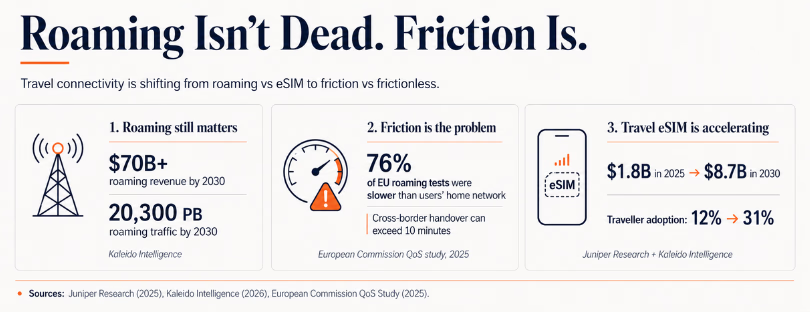
That is why travel eSIM brands grew so quickly. Juniper Research estimated travel eSIM revenue at $1.8 billion in 2025 and projected $8.7 billion by 2030. GSMA Intelligence has also been tracking wider consumer eSIM adoption, including acceleration created by eSIM-only devices and operator deployments.
Still, eSIM is not perfect. Some travellers find installation stressful. Some plans are data-only, so normal voice calls and SMS are not included. Some “unlimited” offers are not as unlimited as the headline suggests.
So eSIM did not win because it is always technically superior. It won because it often feels more controllable.
The real product is certainty
The travel connectivity product is not gigabytes. It is certainty.
A family landing in Istanbul does not want to compare network routing. A consultant flying to Dubai does not want to test three profiles before a meeting. A digital nomad in Mexico does not want to discover that hotspot use is blocked after paying for a large plan.
This is where both roaming and eSIM providers are judged now. Can the user understand the price before travel? Can they see the destinations included? Can they trust the speed? Can they avoid bill shock? Can they get support when the line fails?
Roaming still has strengths. It keeps the customer on their main number. It is often automatic. It can support calls and SMS without explaining workarounds.
eSIM has different strengths. It is searchable, comparable, often cheaper, and increasingly embedded into travel journeys. It can sit inside airline apps, banking apps, booking platforms, or travel wallets. That is dangerous for operators, because the point of sale is moving closer to travel.
Where roaming may still win
A travel eSIM is not always the best answer for someone who barely uses data abroad, needs traditional voice calling, or wants everything handled through one monthly bill.
Roaming is not always best for heavy users, frequent cross-border travellers, families with several devices, or anyone travelling outside included zones where daily charges stack up.
A weekend in Paris from another EU country? Roaming may be fine. Two weeks across Japan, Korea and Thailand? A regional eSIM might be cleaner. A business traveller who needs their main number, SMS authentication and policy control? A managed roaming or enterprise eSIM solution may be smarter. A cruise passenger? Read everything twice.

What needs work
Roaming needs better transparency. The industry should stop assuming an SMS alert is enough. Travellers need clear plan labels: countries included, fair-use limits, 5G access, speed restrictions, hotspot rules, maritime exclusions and what happens after the allowance is used.
Travel eSIMs need to mature, too. Too many offers hide real differences in routing, network priority, refund rules, support quality, and throttling. Crowded markets punish vague promises.
There are alternatives worth considering. Operator roaming bundles still make sense for customers who value simplicity and main-number continuity. Travel eSIM providers such as Airalo, Holafly, Ubigi, Yesim, Nomad eSIM, GigSky and Saily compete on destination coverage, unlimited-style plans, app experience or network partnerships. Enterprise-focused options matter for companies that need control, not just cheap data.
These categories are starting to blur. Operators are launching travel eSIMs. eSIM providers are adding more app controls. Banks and airlines are testing connectivity as a travel add-on. The winner may be the company that disappears on the trip most elegantly.
Roaming vs eSIM for travellers – the real shift
The future is not a clean victory for roaming or eSIM.
It is a market where travellers punish friction immediately.
If roaming becomes clear, capped, fast and fairly priced, it will remain powerful because it is already built into the customer relationship. If eSIM becomes easier, more transparent and better integrated into travel apps, it will keep taking moments where operators used to be the only option.
That is why the smartest players are not defending a technology label. They are removing steps.
The next battle will be decided at the airport gate, in the hotel lobby, inside the banking app, at online check-in, and in those first five minutes after landing when the traveller simply needs the phone to work.
The product that wins will not feel like roaming. It will not feel like an eSIM either.
It will feel like nothing went wrong.