Ubigi interview: “The Next eSIM Chapter Is Bigger Than Travel Data”
Ubigi is not the loudest name in the travel eSIM market. That may be exactly why it is worth paying attention to.
In a category where many brands sound increasingly similar, promising cheaper data, fast activation and freedom from roaming shocks, Ubigi comes from a different place. It is the consumer eSIM brand of Transatel, an NTT company, which gives it a much broader story than the usual “buy a data plan before you fly” message.
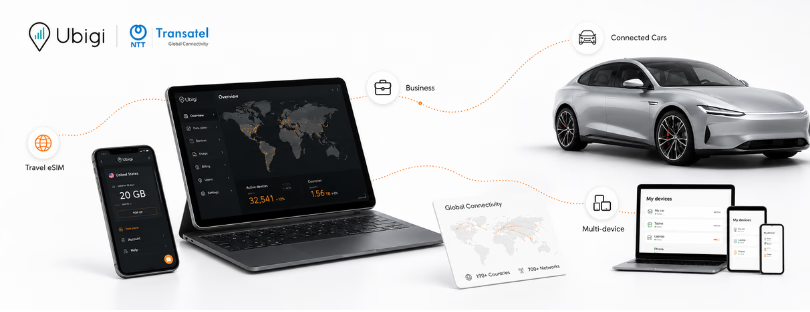
Behind the app, the destination plans and the travel use case sits a deeper connectivity layer. Ubigi is connected to travel, business mobility, laptops, tablets, connected cars and enterprise-grade global access. In other words, it is not only selling data to travelers. It is part of a much bigger shift in how people, companies and devices stay connected across borders.
That makes Ubigi one of the more interesting companies to watch right now. The eSIM market is moving beyond short-term travel data. It is shifting toward reusable profiles, persistent connectivity accounts, monthly and annual plans, secure alternatives to public Wi-Fi, business data control and connected devices that need mobile access wherever they go.
 For travelers, that shift means less friction. One eSIM can be installed once, kept on the device, topped up and reused across destinations. For companies, it means better visibility, simpler mobile data management and lower exposure to unpredictable roaming costs. For the wider travel tech market, it raises a much bigger question: is the future of eSIM still about selling gigabytes, or about becoming the connectivity layer behind modern mobility?
In this interview, we speak with Marie-Julie Le Guen, Ubigi Brand Director at Transatel, about where the market is heading, why persistent connectivity matters, how consumer and business needs are changing, and why the next chapter of eSIM may go far beyond the smartphone.
Q1. Ubigi is often seen by consumers as a travel eSIM brand, but behind it there is Transatel, NTT, automotive connectivity, enterprise mobility and carrier-grade infrastructure. Do you think the market still misunderstands what Ubigi really is?
The answer really depends on what we call “the market.”
If we’re talking about the travel eSIM space and our direct competitors, then there is no misunderstanding at all. They know exactly what Ubigi is, and they have for quite some time. Ubigi has been a pioneer from day one. We launched international eSIM connectivity as early as 2017 on laptops, and we were ready from the moment Apple introduced eSIM on iPhone in 2018. We were also among the first to introduce recurring monthly and annual plans, as well as business-oriented offers.
As a result, Ubigi has often set the direction of the market, rather than followed it. Some players that are now considered leading travel eSIM brands started by building on Ubigi connectivity. So from an industry perspective, our positioning is not misunderstood; it is closely observed.
“Ubigi has often set the direction of the market, rather than followed it.”
The gap is more on the consumer side. Being a pioneer also means we had to build awareness from scratch. But it also reflects a deliberate strategic choice: from the beginning, Transatel has prioritized building a sustainable and profitable business, rather than pursuing rapid growth at any cost. This means we have historically invested less in mass marketing and advertising than some of the newer entrants in the travel eSIM space. Many of these players have grown very quickly thanks to aggressive marketing spend, but often with business models that remain structurally unprofitable and potentially vulnerable to market shifts. At the same time, eSIM adoption has accelerated in recent years, and many users still discover the technology through travel use cases. This naturally positions Ubigi as a “travel eSIM” in their minds.
To make adoption easier, we deliberately structured our communication around clear use cases (travel, business, automotive) even though they are powered by the same global infrastructure and already accessible through one single Ubigi app.
What is changing now is that we are making this unified reality much more visible. Very soon, users will be able to manage, in one place, their personal travel eSIM, those of their family, their business connectivity, their tablets or secondary devices, and even the connectivity of their vehicle.
That’s a big shift, because it reflects what Ubigi truly is becoming: not just a travel eSIM provider, but a global connectivity hub across devices, use cases and everyday mobility.
And if we look at enterprise customers, there is no ambiguity. Large international companies, including major CAC 40 groups, fully understand the value of our carrier-grade infrastructure and our global reach without any doubt.
 Q2. Many travelers still buy a new eSIM for every trip. Ubigi promotes the idea of one reusable eSIM profile for multiple destinations. Do you believe the market is moving from disposable trip-based eSIMs to persistent connectivity accounts?
 Q2.
Q2.Yes, we clearly see the market moving in that direction, but there is a very practical reason behind it that is often overlooked.
Installing an eSIM is not the same as simply buying a new data plan. It requires a few additional steps, and most importantly, downloading an eSIM profile requires an active internet connection. That creates a very typical “chicken and egg” situation for travelers who decide to arrange connectivity once they arrive: they need connectivity to install their eSIM but they need their eSIM to get connectivity.
Once users experience this friction, the value of a reusable eSIM becomes very obvious. You install it once, you keep it, and you simply activate or top up it whenever you need it.
This is where Ubigi has a very strong advantage. As a fully integrated operator controlling both telecom infrastructure and IT platforms, we are able to offer a much more seamless experience. For example, our users can access the Ubigi app to purchase and manage their data plans even without Wi-Fi or available data credits, which removes a major point of friction compared to other solutions when you run out of credits. We receive a lot of feedback from customers who describe this experience as one of the most seamless they’ve encountered.
Q3. The eSIM market is crowded with brands competing on price, GB size and destination lists. Where does Ubigi want to compete: price, performance, trust, simplicity, or infrastructure?
Ubigi’s ambition is to offer the best overall value for money, but it’s important to understand what “value” really means in this market. Not all eSIM offers are comparable.
Behind a price or a data volume, there are key factors that define the real quality of the experience: the number and quality of network partners in each country, the availability of 5G, whether tethering is allowed or limited, as well as performance aspects like speed and latency. These are not always visible to the end user, but they make a fundamental difference in everyday usage and quality of experience.
Backed by Transatel and the greater NTT Group, Ubigi invests heavily in global infrastructure to deliver consistent, high-quality connectivity across markets. Our objective is simple: to provide end users with the same level of reliability and performance that our platform already delivers to large industrial clients such as Airbus or BMW.
Not All eSIM Offers Are Comparable
What this means in practice is that we don’t aim to compete in a race to the bottom on price. We compete on the overall experience: a combination of performance, trust, and consistency that makes connectivity feel seamless and stressless wherever you are.
This approach also reflects how we see the future of the market. Ubigi is not designed to be used only for occasional travel. We are building a solution that can support everyday connectivity needs: whether it’s for a secondary device like a tablet, a child’s plan, complementing a national subscription with low data allowance, or enabling connectivity within a vehicle.
In that sense, infrastructure is at the core of everything we do, because it is what allows us to deliver quality, consistency and scalability across all these use cases.

Q4. Ubigi has monthly and annual-style plans, not only short trip plans. What kind of customer is choosing recurring connectivity instead of a one-off travel package?
Ubigi has been offering recurring monthly and annual plans for several years, and this directly reflects our vision, which has never been limited to connecting travelers for a short period of time.
We aim to support a much broader range of connectivity needs, from frequent travelers returning to the same destinations to global users who want reliable connectivity available wherever they go, thanks to recurring WORLD data plans.
The first group we see adopting these plans are highly mobile users (digital nomads, business travelers, or expats) who need consistent connectivity across borders. For them, the priority is not just price, but convenience, reliability and continuity. They don’t want to think about connectivity every time they travel; they want it to already be there when they need it.
“Around 30% of our annual plans are actually used for local or everyday connectivity.”
What is particularly interesting is that these recurring plans are not only used for travel. Around 30% of our annual plans are actually used for local or everyday connectivity. This shows that for many users, Ubigi is no longer just a travel solution, but part of their regular connectivity setup, whether to complement a national plan (for allowance and/or coverage issue), equip a secondary device (such as tablets and laptops), or provide connectivity to children.
This evolution perfectly illustrates the shift we are seeing in the market: from a one-off, trip-based purchase to a more persistent and integrated connectivity model, where users expect to stay connected seamlessly across countries, devices and moments of life.
Q5. We often talk about eSIMs for smartphones, but Ubigi also supports tablets, Windows PCs, hotspots, routers and connected vehicles. Is the next eSIM growth wave less about phones and more about connected devices?
It’s interesting to remember that laptops were actually the first consumer devices to support eSIM, even before smartphones. In fact, this is where Ubigi started!
From the beginning, we believed that cellular connectivity would gradually complement, and even outperform, traditional Wi-Fi usage. If you think about it, Wi-Fi has been extremely successful, but it remains fundamentally limited: it is location-based, requires logins and passwords, and often comes with performance or security constraints.
Anyone who travels or works on the move has experienced this: losing connectivity in between networks, struggling to access a Wi-Fi network in a taxi or a public space, or relying on unsecured public hotspots.
Cellular connectivity solves this by design. It provides instant, secure and always-on access, without the need for manual authentication or fixed infrastructure. That’s why we believe its role will continue to expand significantly across devices.
“Cellular connectivity will become standard across a wide range of consumer and industrial devices.”
In the short term, smartphones — and especially travel eSIM — will continue to drive adoption, simply because they are the most visible entry point. But over the longer term, we are convinced that cellular connectivity will become standard across a wide range of consumer and industrial devices.
So the next growth wave is not so much about moving away from phones, but about expanding to a multi-device world where connectivity is expected everywhere (including in cars and Internet of Things).
In that sense, the real shift is from single-device connectivity to an ecosystem where every device can be seamlessly connected, wherever you are.

Q6. Public Wi-Fi is still treated as the “free” alternative to roaming, especially by business travelers. From Ubigi’s perspective, how should companies rethink public Wi-Fi risk in 2026?
Public Wi-Fi is often perceived as a convenient and free alternative to roaming. But in reality, it comes with significant risks that are still largely underestimated.
It is technically very easy to set up fake Wi-Fi access points and intercept data traffic, and these situations are more common than people think, whether in airports, hotels or cafés. This creates real exposure, especially for business users handling sensitive information.
More and more organizations are moving toward a Zero Public Wi-Fi strategy.
In today’s geopolitical and cybersecurity context, companies need to be much more cautious about how their employees connect. Rather than relying on unsecured public networks, connectivity should be treated as a strategic asset, with secure and controlled alternatives as the default option.
More and more organizations are moving toward a Zero Public Wi-Fi strategy. The objective is not to police employee behavior, but to provide a secure and seamless alternative by default. When secure cellular connectivity is instantly available on every device, employees naturally make safer choices without compromising productivity.
Q7. Ubigi for Business talks about reducing roaming bills by up to 90%. What usually creates the biggest savings: negotiated carrier agreements, better usage control, smarter plan allocation, or changing employee behavior?
The biggest driver of savings is actually the underlying pricing model, and the difference with traditional roaming is still massive.
In many parts of the world, roaming tariffs can still exceed €5 per megabyte, which means €5,000 per gigabyte, and up to €50,000 for 10GB in extreme cases. These are not theoretical numbers: we still regularly see examples of bill shock affecting both businesses and consumers.
What Ubigi fundamentally changes is how connectivity is sourced. We negotiate directly with local operators in each country to secure pricing that is as close as possible to domestic rates. This is where the largest share of savings comes from.
These are not theoretical numbers: we still regularly see examples of bill shock affecting both businesses and consumers
On top of that, the ability for IT and Procurement teams to regain control. real time visibility, usage alerts, centralized billing, and policy enforcement transform international connectivity from an unpredictable expense into a managed service makes also a important difference.
So while better control and smarter plan allocation do contribute to savings, the real shift comes from combining local pricing with full visibility and control.
Q8. For enterprise clients, is the real problem roaming cost, or is it a lack of visibility and control over mobile data usage?
Roaming cost is often what companies notice first, but in reality, it is only the visible part of the problem.
The deeper issue is the lack of visibility and control over mobile data usage. In a traditional roaming model, companies often don’t know how data is being consumed, who is using what, or at what cost until they receive the bill; which is too late.
This lack of transparency creates uncertainty, makes budgeting difficult, and exposes companies to unexpected overages or bill shocks.
What enterprises are really looking for is control: the ability to monitor usage in real time, define clear limits, and ensure that connectivity stays within a predictable budget.
But control alone is not enough, flexibility is equally important. This is where Ubigi for Business brings a unique approach. Companies can define usage caps per employee to fully protect their budgets, while still allowing users to remain connected when they need to.
Roaming Cost Is Only the Visible Part of the Problem
If an employee reaches their limit, they can purchase additional data themselves, either with their own payment method or, if authorized, through the company account.
This creates a balanced model where companies maintain full control over costs, without restricting employees or disrupting their connectivity.
So while cost reduction is important, the real value comes from combining visibility, control and flexibility, turning connectivity from an unpredictable expense into a fully managed and user-friendly resource.

Q9. Ubigi for Business offers both eSIM and physical SIM options. In a market that talks so much about eSIM, why does physical SIM still matter for some enterprise deployments?
In the enterprise world, device lifecycles are typically longer than in the consumer market. As a result, not all employees are equipped today with eSIM-compatible devices, whether it’s smartphones, laptops or tablets. We believe enterprises should not have to choose between innovation and operational reality.
This means that physical SIM cards are still necessary in some deployments, simply to ensure compatibility across existing fleets.
That said, we are clearly seeing a gradual shift. As devices are renewed, eSIM adoption naturally increases, and the reliance on physical SIM cards decreases over time.
Q10. Which industries are showing the strongest demand for Ubigi for Business today: airlines, consulting, finance, NGOs, industrial companies, automotive, or something less obvious?
Rather than a specific industry, the strongest adoption comes from organizations with international mobility, whether they are consulting firms, industrial groups, legal organizations, NGOs, or multinational corporations.
The common denominator is not the sector. It is the need to connect employees securely and cost-effectively across borders.
That said, if we look at less obvious segments, we do see strong demand from sectors like large law firms. These organizations often have teams traveling frequently across jurisdictions and require highly reliable, secure and predictable connectivity, which makes them particularly sensitive to both roaming costs and data security issues.
Q11. Ubigi has a serious connected-car story, including BMW expansion and automotive partnerships. How different is connectivity inside a car compared with connectivity on a smartphone?
First, from a technical perspective, connectivity in a vehicle is designed to deliver a much more stable and reliable signal. The modem is embedded directly into the car and connected to the vehicle’s external antenna, which significantly improves reception compared to a smartphone, especially when on the move or in challenging environments.
Second, connectivity in a car is shared by design. With a built-in Wi-Fi hotspot, the vehicle becomes a connectivity hub, allowing multiple passengers and devices to connect without impacting a smartphone’s battery or performance.
But beyond that, connectivity in a vehicle is part of the overall driving experience. It enables integrated services such as voice assistants, remote interaction with home devices, real-time navigation, and even in-car entertainment like video streaming. Q12. With Esteban Ocon as Ubigi’s global brand ambassador, Ubigi is clearly connecting travel, performance and mobility. Is motorsport mainly a marketing move, or does it reflect where Ubigi sees its future?
Esteban Ocon as Ubigi’s global brand ambassador reflects how we see the brand and where we are heading.
We took the time to find the right ambassador, because it was important for us to partner with someone who genuinely embodies what Ubigi stands for. We were looking for someone international, performance-driven, but also grounded and authentic.
Esteban Ocon is a very strong fit. He travels constantly across countries, operates in highly demanding environments, and has built his career through merit and discipline, which resonates strongly with our values.
Beyond the individual, motorsport is also about teams. Esteban operates within a global ecosystem of engineers, partners and staff who travel constantly and rely on seamless connectivity, which is very close to what we support with Ubigi for Business.
The fact that he is also a Formula 1 driver creates a natural connection with another key dimension of Ubigi: connected mobility and automotive.
So motorsport is not just about visibility. It brings together travel, performance, teams in motion, and connected vehicles: the pillars that define both our brand and our vision.
13. Ubigi is connected to both consumer travel and B2B distribution. What makes a good Ubigi distributor or travel partner today: audience size, trust, integration capability, regional expertise, or customer support?
We actually offer a wide range of partnership models, because not all partners have the same level of technical capability or the same objectives.
This can range from very simple affiliate programs — which require no technical integration — to advanced white-label solutions, where partners can fully integrate Ubigi connectivity into their own platforms and manage the experience through APIs. In all cases, Ubigi can provide 24/7 customer support.
The Real Success Factor Is the Partner’s Ability to Activate Their Audience
With the recent launch of our UbiClub loyalty program, we are also now able to connect Ubigi plans to a partner’s existing loyalty ecosystem, creating additional value for their end customers and the partners.
But beyond the model itself, the real success factor is not the type of integration; it’s the partner’s ability to activate their audience.
The most effective partners are those who can make connectivity visible and relevant within their customer journey. Whether it’s through trust, strong branding, or a well-integrated user experience, what matters most is how the offer is presented and adopted by end users.
Q14. Many travel brands, airlines and tourism companies are looking at eSIMs as an ancillary revenue product. What do they usually underestimate when adding connectivity to the customer journey?
What many travel brands tend to underestimate is that the value of an eSIM does not stop at the first purchase.
Connectivity is not just a one-time transaction linked to a specific trip; it has the potential to become a long-term relationship with the user. Once a customer has installed an eSIM, it can stay on their device for years and be reused across multiple journeys.
This fundamentally changes the way travel companies should approach it. It’s not only about selling a plan for a trip to Bali — it’s about ensuring that the user can easily come back, reuse the same eSIM, and reconnect with the brand for their next travels.
If done well, this creates recurring revenue opportunities, but also long-term brand visibility. Even if the customer does not travel again with the same airline or operator, the brand can remain present through the connectivity experience.
Q15. Looking ahead, what does Ubigi want to be known for in the eSIM market: the easiest travel eSIM, the most reliable global data layer, the business mobility solution, or the connectivity brand behind tomorrow’s connected devices?
We don’t see these options as mutually exclusive. —They are all part of the same evolution. Simplicity, reliability and performance are essential.
What Ubigi ultimately aims to be known for is not just an easy travel eSIM, but a global and reliable connectivity layer.
For consumers, that means seamless connectivity across trips, countries and devices.
For enterprises, it means secure, controlled and globally managed connectivity that supports productivity while reducing costs and complexity.
Beyond a Product, a True Connectivity Hub
Rather than choosing between these different dimensions, our ambition is to bring them together into a unified experience: one account, one platform, accessible through the same Ubigi app.
In that sense, Ubigi is evolving beyond a product to become a true connectivity hub, designed to support how people and devices move in an increasingly connected world.
Ubigi’s story says a lot about where the eSIM market is heading.
The first phase of travel eSIM was simple: avoid roaming charges, skip the SIM kiosk and get online faster. That still matters, of course. But the next phase looks bigger and more structural. Travelers are no longer carrying just one connected device. Companies are no longer thinking only about occasional roaming bills. Cars, laptops, tablets, hotspots, remote teams and second devices are all becoming part of the same connectivity question.
That is where Ubigi’s position becomes interesting. It sits between the consumer travel eSIM market and the deeper infrastructure world of global mobile connectivity. For travelers, the promise is convenience and continuity. For businesses, it is control, visibility and security. For the wider industry, it is a reminder that eSIM is not just a cheaper way to buy data abroad. It is becoming part of how mobility itself is managed.
The brands that win this next chapter will probably not be the ones shouting only about price. They will be the ones that make connectivity feel stable, reusable and trusted across every trip, device and use case.
And that may be the real question for the eSIM market now: are we still selling temporary travel data, or are we building the always-on connectivity layer people will expect everywhere?