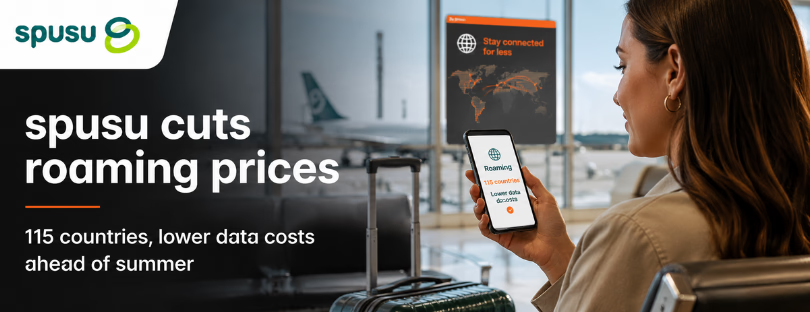
spusu Cuts Roaming Data Prices in 115 Countries
Ahead of the summer travel rush, spusu mobile has cut international roaming data prices across 115 countries, giving UK customers a cheaper way to stay connected beyond the EU without immediately reaching for airport Wi-Fi, a local SIM card, or a separate travel eSIM.
The headline number is simple: roaming data now costs £2 per GB in five destinations, including the United States, Turkey, Bosnia and Herzegovina, North Macedonia and Serbia. For UK travellers, that is a notable move because these are exactly the kinds of destinations where roaming costs can still feel unpredictable. The US and Turkey remain major travel markets, while the Balkans are increasingly relevant for family visits, road trips, remote workers and longer stays.
spusu has also reduced prices in a further 110 countries worldwide. Several destinations that were previously in higher-priced roaming zones now cost £4 per GB, including Armenia, Guernsey, the Channel Islands, Indonesia, the Isle of Man, Israel, Kazakhstan, Kosovo, Madagascar, Senegal, Taiwan and Togo. Montenegro has seen roaming prices cut by 25 per cent, while Georgia and Albania have also received reductions.
For a mobile market where “roaming included” often comes with asterisks, fair usage limits and country-list small print, this matters.
Why this feels timely
Roaming has become one of the most awkward parts of mobile pricing. Inside the EU, many travellers got used to the idea that mobile data simply followed them. For UK customers after Brexit, the picture became messier. Some operators kept EU roaming included. Others brought back daily fees, fair usage caps or paid add-ons. Outside Europe, the difference between checking a map and accidentally burning through an expensive allowance can still be uncomfortable.
That is why spusu’s move is interesting. It is not trying to reinvent global connectivity. It is trying to make traditional mobile roaming look less scary.
“Roaming is one of the areas where customers are most likely to worry about cost, especially when travelling outside the EU,” said Christian Banhans, managing director of spusu UK. “By reducing prices across more than 100 countries and continuing to review our roaming rates, we’re making it easier for people to stay connected wherever they go, without having to second-guess how much it’s going to cost them.”
The phrase “second-guess” is important here. Most travellers do not want a telecom lesson before every trip. They want to know whether they can open Google Maps, message their hotel, check a train app, or upload a photo without later regretting it.
Transparency is the real product
The price cut is only part of the story. spusu has also introduced a roaming lookup tool on its website, allowing customers to check country-by-country roaming prices before they travel.
That may sound like a small website feature, but in roaming, visibility is often the difference between trust and frustration. Ofcom has repeatedly pushed UK providers to give customers clearer information about roaming charges and help protect them from unexpected bills. MoneySavingExpert and similar consumer sources regularly advise travellers to check roaming rules before leaving the UK, precisely because operator policies vary so much.
A lookup tool does not solve everything, but it helps move the customer from guessing to planning. That is where the mobile industry has been weak for years. Operators publish roaming pages, but many still feel like they were built for compliance, not for actual humans standing in an airport queue.
spusu’s approach is more practical: check the country, see the price, decide before you go.
Where spusu fits in the market
This update puts spusu in an interesting middle lane. On one side, you have traditional UK operators, where roaming can depend heavily on plan type, destination, add-ons and fair usage policies. On the other side, you have travel eSIM providers such as Airalo, Holafly, Yesim, Nomad eSIM and Ubigi, which have grown because travellers want clearer, trip-specific data options.
spusu is not necessarily replacing travel eSIMs. For heavier data users, remote workers, families sharing hotspot data, or people visiting several countries on one trip, a dedicated travel eSIM may still be the better fit. Unlimited-style travel eSIM plans, regional bundles, and app-based top-ups can be more flexible when the trip is data-heavy.
But for existing spusu customers who want light-to-moderate data abroad, £2 or £4 per GB is easy to understand. No extra app. No QR code. No switching data lines. No hunting for a local SIM shop after landing.
That simplicity is the advantage.
The weaker point? Per-GB pricing still needs attention. A traveller streaming video, taking video calls, backing up photos, or hotspotting a laptop can move through gigabytes quickly. spusu’s new rates are more transparent, but customers still need to understand their own usage. This is not a blank cheque for unlimited roaming.
Conclusion
spusu’s roaming price cut is a reminder that the next phase of travel connectivity will not be won only by the cheapest provider. It will be won by the provider who removes anxiety.
Travel eSIM brands forced the market to become clearer, faster and more user-friendly. Traditional mobile providers now have to respond, not only with lower prices, but with tools that make roaming understandable before the bill arrives. spusu’s £2 per GB pricing in key destinations and its roaming lookup tool are steps in that direction.
For casual travellers, this could be enough. For power users, travel eSIMs will still have a strong place. But the wider trend is clear: customers are no longer willing to treat roaming as a mystery charge. They want the price before the trip, the rules in plain language, and no unpleasant surprise when they come home.
That is the real story here. Roaming is becoming less about coverage promises and more about customer confidence.