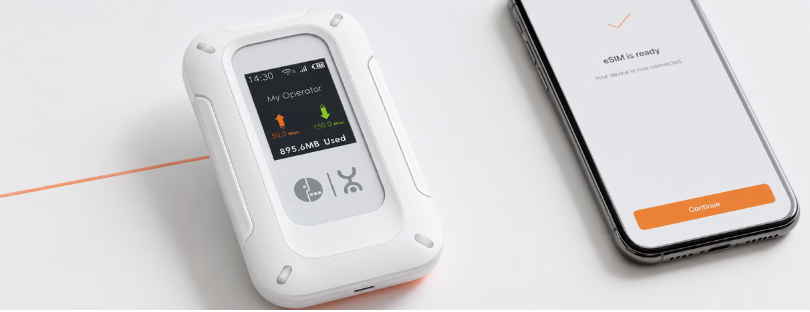
MegaFon eSIM Router Brings eSIM to Portable Wi-Fi
MegaFon has moved eSIM beyond the phone and into a practical piece of travel tech: the portable Wi-Fi router. According to Forbes Russia, the operator has launched its own branded mobile router with built-in eSIM support, developed in a cobranding with Yota and adapted for Russian network frequencies.
That frequency detail matters. Many portable routers sold on marketplaces look similar, but they are not always tuned or tested for local networks. MegaFon is positioning this device as the safer operator-approved alternative: less guesswork, fewer compatibility surprises, and a more controlled activation journey.
MegaFon’s online shop lists the router at 4,499 rubles, while Yota’s cobrand package page shows 4,649 rubles, suggesting a small channel or bundle difference. Either way, this is not being framed as a luxury gadget. It is a mass-market connectivity tool.
Why eSIM changes the router
The headline feature is remote eSIM activation. A user can buy an eSIM online, verify identity through Gosuslugi, then download the digital profile through a web interface or mobile app. No store visit. No plastic SIM hunt. No tiny SIM ejector tool at the worst possible moment.
That is the real story here. The router itself is useful, but the activation flow is the bigger signal. Operators are beginning to treat eSIM as a service layer that can live inside more devices, not just smartphones and smartwatches.
READ MORE: Digi IX25 Launch: 5G Router with eSIM and Edge AI
For families, small offices, dachas, temporary workspaces, or travelers moving inside Russia, the logic is simple. One compact router can connect up to 32 devices over dual-band Wi-Fi, using 2.4 GHz and 5 GHz. It also keeps a physical nano-SIM slot, which is smart. eSIM is convenient, but physical SIM support gives users a fallback when a plan, account, or activation flow does not behave perfectly.
The 4,000 mAh battery is rated for up to 8 hours of LTE operation. That is enough for a train ride, a workday outside the office, or backup connectivity during a broadband outage. It is not a power-user monster, but it does not need to be.

Where it may fall short
This is not the perfect device for everyone. It is still a 4G/LTE router, not 5G. For users who need the fastest possible mobile broadband, especially for heavy video work, cloud backups, or frequent international travel, more advanced hardware may be a better fit.
There is also a question around operator openness. MegaFon’s shop says the router works with MegaFon and Yota SIM cards, while use with other operators requires checking with the store chat. That is not unusual for operator-led hardware, but it does limit the “bring any provider” feeling many eSIM users now expect.
And while remote activation is convenient, it depends on identity verification and a smooth digital onboarding flow. For local users, that may be fine. For visitors, foreign residents, or anyone without easy Gosuslugi access, the experience may feel less frictionless than the product story suggests.
A wider router shift
Globally, portable connectivity is becoming more flexible. Netgear’s Nighthawk M7 pushes the category upmarket with 5G, Wi-Fi 7, eSIM plus physical SIM support, up to 32 connected devices, and global eSIM coverage in more than 140 countries. GlocalMe takes a different route with CloudSIM-style mobile Wi-Fi devices and international data services, reducing the need to swap SIM cards while traveling.
MegaFon’s router is playing a different game. It is not trying to be a global premium hotspot. It is a local operator router with eSIM convenience built in. That may sound less glamorous, but it is important for mainstream adoption.
READ MORE: Zain KSA launches world’s first 5G smart router with eSIM support
GSMA Intelligence has been tracking how eSIM is expanding into new consumer device categories and bundling models. This launch fits that pattern neatly. The next phase of eSIM is not only “download data for your phone before a trip.” It is “connect the device you actually need, where you actually need it, without visiting a shop.”
Why this move matters
MegaFon’s eSIM router will not replace every travel eSIM app, every 5G hotspot, or every phone tethering habit. It does something more specific: it makes eSIM feel ordinary in a shared-connectivity device.
That is the quiet shift. eSIM is becoming less of a premium smartphone feature and more of a practical infrastructure layer. The winners in this space will not simply be the companies with the slickest app or the cheapest gigabytes. They will be the ones that make activation boring, hardware reliable, coverage predictable, and fallback options obvious.
MegaFon still has room to improve the proposition, especially around 5G, wider operator compatibility, and clearer availability across channels. But as a market signal, this is a strong one. Portable routers are becoming managed connectivity endpoints, exactly where travel tech, telecom, and eSIM are starting to overlap.