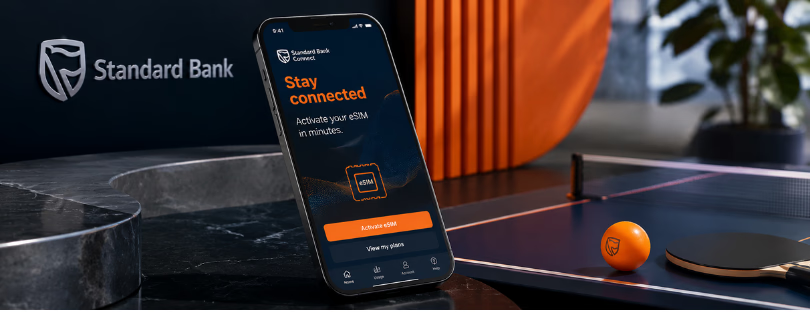
Standard Bank Connect Adds eSIM for Mobile Customers
Standard Bank Connect has added eSIM support to its mobile plans, and the timing feels deliberate. The bank-owned MVNO now serves more than 350,000 subscribers, so this is more than a small product update. It is a financial institution moving deeper into everyday connectivity, where banking, identity, payments and mobile data overlap.
For now, the feature is available on existing postpaid plans, with prepaid eSIM support expected later. That limitation matters in South Africa, where prepaid behaviour is a major part of the mobile market. But starting with postpaid is practical. It gives Standard Bank Connect a cleaner first rollout, probably among customers with compatible phones.
Benefit: no plastic SIM swap, no waiting for a card, and no store visit. For people who split work and personal numbers, chase better data prices, or want a useful backup connection.
Why banks want connectivity
The more interesting story is not eSIM. It is the bank.
Banks already sit inside the customer’s daily digital life. They verify identity, process payments, finance devices, manage rewards and bundle lifestyle services. Connectivity now fits that ecosystem naturally.
Standard Bank Connect’s executive head, Kartik Mistry, framed the launch around trust, security and integration with customers’ financial and lifestyle needs. That sounds polished, but the logic is real. A bank does not need to become a traditional mobile operator to make mobile service valuable. It needs to reduce friction, bundle relevant services and keep customers inside its digital environment.
READ MORE: eSIM Revenue Models for Airlines, Banks and OTAs
This is why bank-owned MVNOs are becoming interesting. They are not usually trying to beat Vodacom, MTN or Telkom at network ownership. They are trying to make connectivity part of a broader customer relationship.

South Africa as a testbed
South Africa has become one of the more interesting bank-MVNO markets. FNB Connect introduced eSIM support in 2024 and later pushed travel eSIM services through its banking app. Capitec Connect has taken a different route, leaning into affordable prepaid data, no-contract simplicity and app-led access. Standard Bank Connect now enters from another angle: postpaid first, banking integration and a customer base already large enough to test adoption.
That competitive mix matters. It shows that mobile connectivity is no longer only a telecom product. It can be a retention tool, a device financing companion, a travel add-on, or a way to strengthen digital identity relationships.
GSMA Intelligence has pointed to accelerating consumer eSIM adoption, with smartphone eSIM penetration expected to rise sharply through 2026 and beyond. The device base is finally catching up with the business model.
Useful, but not universal
For existing Standard Bank Connect postpaid users with compatible phones, this is a sensible upgrade. It should be especially useful for people who already use more than one SIM or prefer managing mobile services digitally.
But it is not for everyone yet. If you are prepaid-only, using an older handset, or someone who changes phones often and expects instant profile transfers, the experience may feel incomplete. eSIM is elegant when activation works smoothly. It becomes irritating when compatibility lists, QR codes, identity checks or device transfers are not explained properly.
That is where Standard Bank Connect can win or lose trust. The technology is not the differentiator anymore. The recovery experience is. What happens when a customer loses a phone? Can they move the eSIM quickly? Is support trained for real eSIM problems?
A broader fintech signal
The bigger trend is clear: banks and fintechs are realising that mobile connectivity is not just a utility. It is a channel.
For banks, eSIM can support travel products, device financing, rewards, family plans, SME mobile bundles and cross-border customer services. For fintechs, it can become part of onboarding, identity, remittances, business travel and lifestyle subscriptions.
READ MORE: ING’s New Banking Subscriptions Show Why eSIM Is Becoming a Lifestyle Perk
The most interesting future may not be a bank selling “data” as a standalone product. It may be a banking app that notices a customer is travelling, offers a relevant eSIM, applies rewards, handles payment instantly and keeps support in one place.
The real play is trust
Standard Bank Connect’s eSIM launch is not revolutionary on its own. FNB Connect has already moved in this direction, and travel eSIM providers have trained consumers to expect digital activation. What makes this move worth watching is the setting: a major bank, a growing MVNO, a multi-SIM market and a customer base that already trusts the institution with money.
The winners in bank-led connectivity will not be the ones that simply add eSIM as a feature. They will be the ones that make it feel boringly reliable: easy to activate, easy to replace, easy to understand and useful inside real customer journeys. If Standard Bank Connect can extend eSIM to prepaid without adding friction, it could turn a technical upgrade into a stronger bridge between banking and everyday connectivity.