Capitec’s eSIM Bet Reveals Where Telecom Is Headed
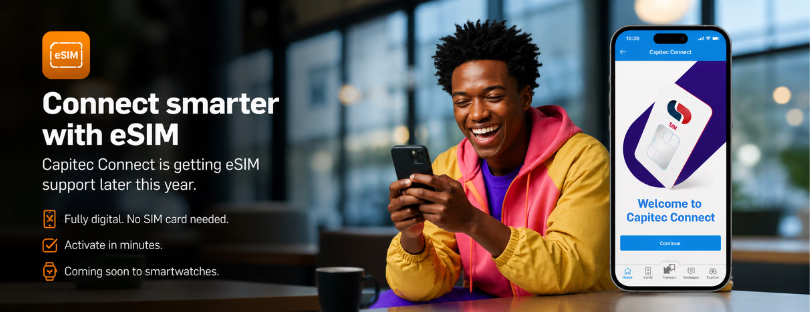
It took a while, but Capitec Connect is officially stepping into the eSIM era. The bank-backed MVNO confirmed it will introduce eSIM support in the second half of 2026, marking a significant shift not just for its own users, but for how telecom adoption is evolving in South Africa.
For a player that has built its reputation on simplicity and accessibility, this move feels less like innovation for the sake of headlines and more like a calculated response to how real users behave.
And that’s where this story actually gets interesting.
Why Capitec waited — and why it matters
On paper, Capitec is late. eSIM has been around for years. Flagship devices have supported it for almost a decade. Global travel eSIM providers like Airalo and Holafly built entire businesses on it.
So why now?
According to CEO Dalene Steyn, the answer is simple and surprisingly grounded:
“We can see exactly which phones our clients use on our network and on the Capitec app… As the adoption of eSIM is increasing in South Africa, we feel that the time is right now to also offer this to our clients.”
This isn’t about technological readiness. It’s about device penetration.
For years, eSIM has been a premium feature. If your customer base is skewed toward budget and mid-range smartphones, launching eSIM too early creates friction instead of value. Users simply can’t use it.
Capitec waited until that equation flipped.
And it has.
Affordable Android devices with eSIM support are now entering the market at scale. Apple has already removed the physical SIM tray entirely in some regions. The infrastructure didn’t change overnight. The user base did.
1.5 million users — and a clear growth lever
Capitec Connect isn’t a niche MVNO anymore. As of early 2026, it reported around 1.5 million active users.
That scale matters.
Adding eSIM is not just a feature upgrade. It’s a growth lever.
Here’s what changes immediately:
- Onboarding becomes fully digital
- SIM distribution costs drop to near zero
- Switching barriers disappear
- Multi-device connectivity becomes possible
Capitec has already confirmed that remote onboarding will be part of the rollout. That aligns perfectly with its broader strategy of simplifying financial and digital services into one ecosystem.
It also quietly turns the bank into something more than a bank.
It becomes a connectivity platform.
Beyond smartphones — wearables are next
One of the more overlooked parts of the announcement is eSIM support for wearables.
Steyn hinted at this, without going into detail:
eSIM support for wearables is in development, with more to be shared “closer to the time”.
This matters more than it sounds.
Wearables are one of the clearest use cases for eSIM because they remove dependency on the phone entirely. A smartwatch with its own data connection changes how people interact with messaging, notifications, and even payments.
For a banking-led MVNO, that opens up obvious integrations:
- Banking alerts directly on wearable devices
- Transaction approvals without a phone
- Always-on connectivity for financial services
This is where telecom starts blending into product experience.
Not a separate service. A built-in layer.
The quiet shift in South Africa’s eSIM adoption
South Africa hasn’t been a leading eSIM market globally. Adoption has been slower compared to Europe, the US, or parts of Asia.
But the signals are changing.
Operators and MVNOs are starting to move:
- Vodacom and MTN already support eSIM on select plans
- Banks are entering telecom through MVNO models
- Device compatibility is improving across price tiers
What Capitec is doing is not just adding eSIM. It’s validating that the market is ready.
And because of its positioning, it may accelerate adoption faster than traditional operators.
Why?
Trust and distribution.
Capitec already has millions of banking customers. If eSIM becomes a default option inside a financial app people use daily, adoption friction drops dramatically.
A familiar pattern — fintech meets telecom
If this feels familiar, it should.
We’ve seen this before in Europe.
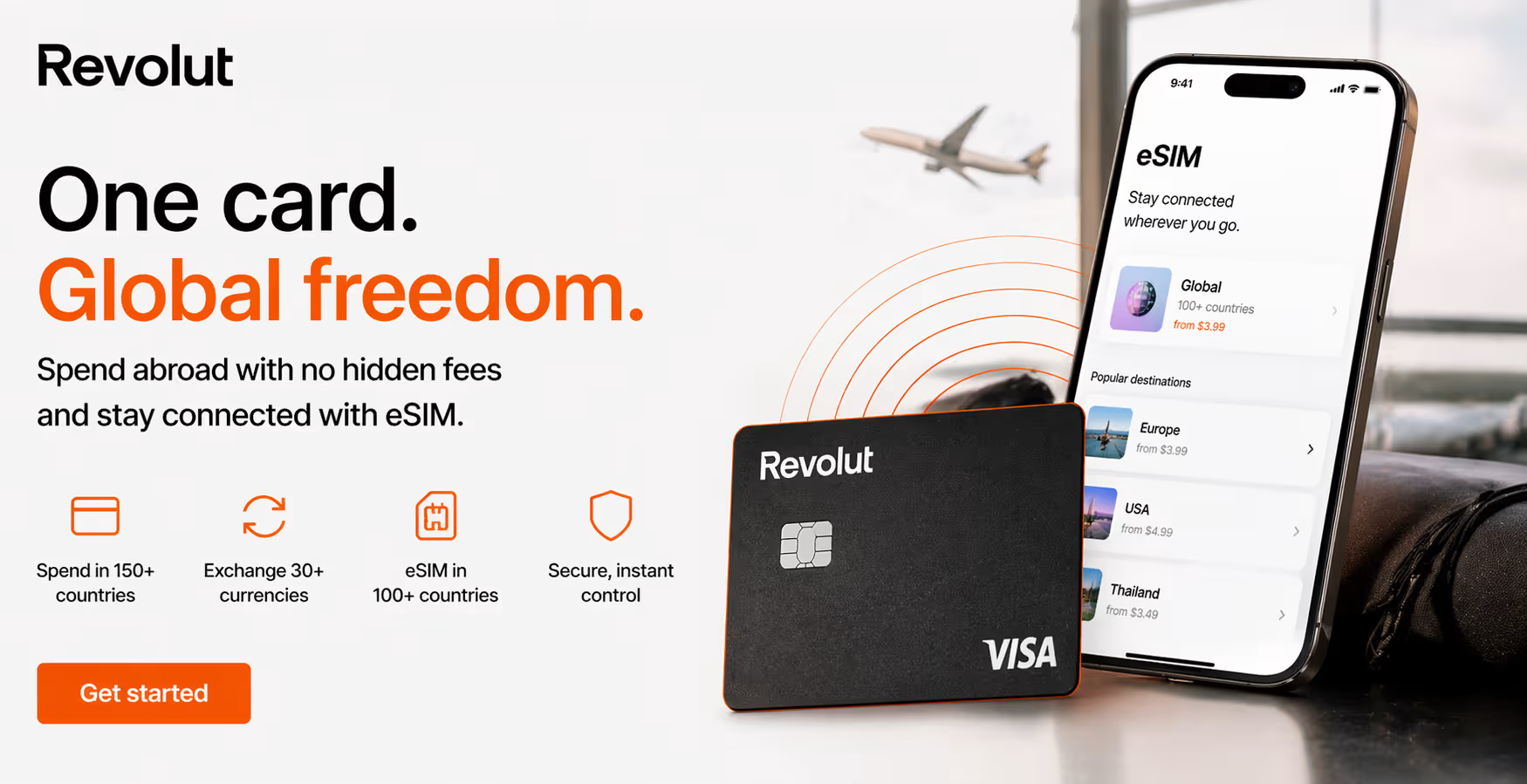
Banks like Revolut and N26 have experimented with travel connectivity and embedded telecom features. Not always successfully, but consistently enough to signal intent.
The logic is simple:
- Payments are global
- Connectivity is fragmented
- Users expect both to just work
Capitec is now moving in that same direction, but with one key difference. It controls the MVNO layer directly.
That gives it more flexibility to shape pricing, onboarding, and bundling.
What Capitec still needs to get right
Launching eSIM is one thing. Making it work commercially is another.
There are a few critical areas to watch:
- Pricing strategy: Will eSIM plans match or outperform physical SIM offers?
- UX simplicity: activation needs to be frictionless inside the app
- Device compatibility messaging: users need clarity on whether their phones support eSIM
- Real use cases: beyond convenience, why should users switch?
If Capitec treats eSIM as just another checkbox feature, it won’t move the needle.
If it integrates it into a broader digital experience, it could.

The bigger picture — telecom as a product layer
This is where the story goes beyond Capitec.
We are seeing a structural shift in telecom:
Connectivity is no longer the product. It’s becoming part of the product.
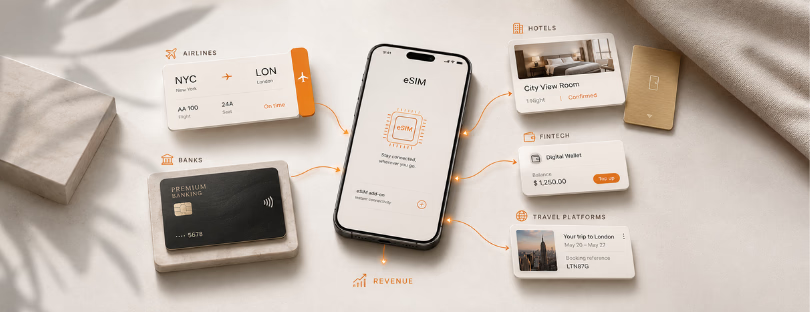
Airlines are embedding eSIM into booking flows. Travel platforms are bundling data with itineraries. Enterprise players are integrating connectivity into mobility management.
Capitec is doing it through banking.
Different vertical. Same direction.
And that direction is clear.
Conclusion
Capitec Connect’s move into eSIM isn’t late. It’s timed.
While global players like Airalo and Holafly focused on international travellers, and operators like Vodacom and MTN introduced eSIM as a technical upgrade, Capitec is approaching it from a different angle. It’s treating connectivity as an extension of everyday digital life.
That distinction matters.
Because the next phase of eSIM adoption won’t be driven by early adopters or frequent travellers. It will be driven by mass-market users who don’t think about telecom at all. They just expect it to work.
Research from organizations like GSMA has already pointed to this shift, highlighting that eSIM growth is closely tied to device availability and ecosystem integration, not just operator support.
Capitec seems to understand that.
By waiting until device compatibility reached critical mass and by embedding eSIM into an existing financial ecosystem, it is positioning itself for a different kind of adoption curve. Slower to start, but potentially broader and stickier.
The real question now is not whether eSIM will grow in South Africa.
It’s who will control how it’s experienced.
And increasingly, it doesn’t look like that will be traditional telecom players alone.