eSIM for Banks: Control the Experience or Lose It
There’s a structural shift happening inside financial products, and most banks are still treating it as a technical detail.
It isn’t.
Connectivity is becoming part of the product.
Not as a feature, and not as an add-on, but as something that directly determines whether your service works when the customer needs it most.
And the uncomfortable reality is simple.
If you don’t control that layer, you don’t fully control your product.
You are relying on something external to deliver an experience that your customer assumes is entirely yours.
That’s where the problem starts.
Because banks that ignore eSIM are not avoiding connectivity. They are accepting dependency on networks they don’t control, conditions they don’t influence, and failure points they don’t measure.
And those failure points are already affecting performance.
Where the product actually breaks
Most banks still think their product ends at the app.
It doesn’t.
It ends at the moment the customer successfully completes an action.
Now, take a very normal scenario.
A customer lands in another country. They open your app to approve a payment or verify a transaction. The connection is unstable. The OTP arrives late or not at all. The session times out.
They try again. It fails again.
At some point, they stop.
That is not a telecom issue.
That is a failed transaction.
And more importantly, it is a moment where trust quietly drops.
Not dramatically. Not visibly. But enough.
Multiply that across thousands of users, across multiple markets, and across every travel-heavy customer segment.
That is not edge-case behavior.
That is a pattern.
The dependency nobody models
Internally, this layer is rarely owned by anyone.
It sits somewhere between telecom, infrastructure, and “external factors.”
Which effectively means it is unmanaged.
But in reality, it influences:
- Transaction success rates
- Authentication reliability
- Fraud signals
- Customer support volume
- User retention over time
You are already paying for it.
Just not in a line item.
eSIM changes one thing that matters
Most people talk about eSIM in terms of convenience.
That’s not what makes it important.
What matters is control.
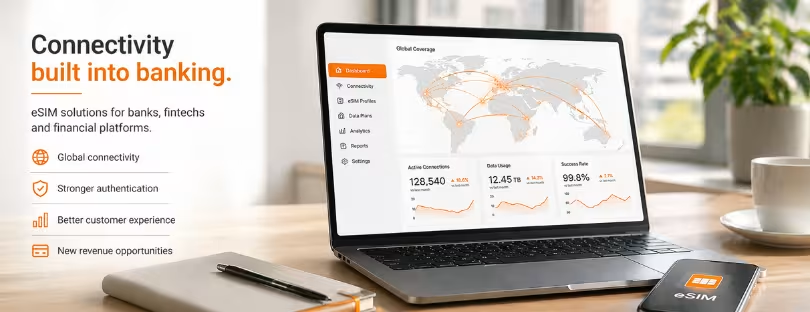
Because the moment connectivity becomes something you can integrate into your product, you remove a variable that has always been outside your reach.
You stop guessing whether your customer can connect.
You start designing for the assumption that they can.
That changes how reliable your product is across borders.
It changes how consistent your security flows are.
And it changes how much friction exists at the exact moment money is supposed to move.
Why this is moving faster than it looks
Traditional banks will not lead this shift.
It will be driven by fintech and digital-first platforms that already think in terms of full-stack experience.
For them, the logic is straightforward.
If the product depends on connectivity, then connectivity is part of the product.
Once a few players start embedding that layer, expectations will move quickly.
Not gradually. Not over the years.
Quickly.
Because customers don’t benchmark against industry standards.
They benchmark against the best experience they’ve had.
The part most banks underestimate
There is also a quieter risk here.
Ownership of the customer moment.
If your customer relies on a third-party provider to get connected when they travel, that provider becomes the gateway to everything.
Including your app.
That may seem technical, but it isn’t.
It means that in a critical moment, your product is not self-sufficient.
It depends on another layer to even be accessible.
And over time, that reduces your centrality in the user’s experience.
Not immediately. But gradually.
And those shifts are hard to reverse once they become the norm.
Waiting is not neutral
A lot of institutions are still in “wait and see” mode.
That feels rational.
It usually isn’t.
Because by the time this becomes an obvious standard, the ecosystem will already be shaped.
Key partnerships will be taken.
Best providers will be aligned.
Early movers will define what “normal” looks like.
At that point, you are not building an advantage.
You are catching up.
Your customers will buy connectivity. The question is: from you, or from someone else?
We help airlines, banks, and travel platforms turn that demand into a built-in product — not a missed opportunity.
The real challenge
This is not a technology problem.
The infrastructure already exists. Integration is not the bottleneck.
The real challenge is recognizing that connectivity is no longer external to your product.
It is part of how your product performs.
And once you see it that way, the question changes.
It is no longer:
“Should we look into eSIM?”
It becomes:
“What part of our experience are we currently leaving to chance?”
Conclusion
Banks will not ignore connectivity forever.
But they will approach it in very different ways.
Some will treat it as a technical dependency and continue to work around its limitations.
Others will recognize it as a layer they can control, integrate, and build on.
That decision will not show up in a press release.
It will show up in something much more important.
The banks that remove friction at critical moments will quietly outperform those that don’t.
And most of that difference will come from something users never think about directly.
Whether the product simply works.