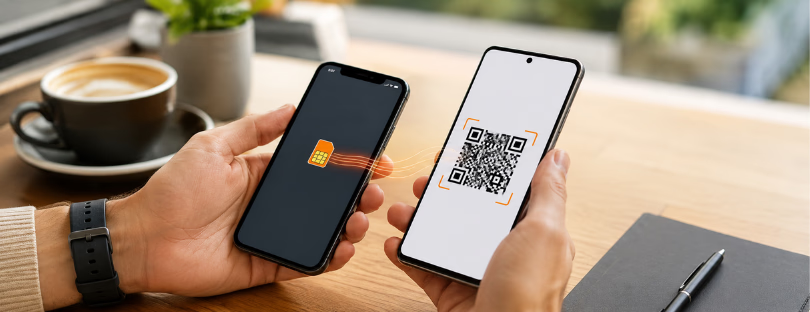
“We already use eSIM when we travel. Why can’t the company just do that for our field teams, devices, kiosks, and whatever else needs data?”
On the surface, it sounds reasonable. Consumer eSIMs feel modern. They are fast. They are app-based. They promise “global” coverage. And if you are thinking in the mindset of one person, one phone, one trip, they are genuinely convenient.
Consumer eSIMs are built around a human being who can tap, scan, troubleshoot, and accept a little chaos. Enterprises need something else: visibility, control, policy, accountability, and a clean operational story when finance asks, “Why is this bill weird?” and security asks, “What’s connected right now?”
Or, in the sentence that usually makes IT leaders exhale because it says what they actually want:
“You don’t want another SIM vendor. You want to open a dashboard and see exactly who’s connected, where, and how much it’s costing in real time without chasing reports.”
That is not a consumer product requirement. That is an enterprise requirement.
Consumer eSIMs are designed for the individual, not the fleet
Consumer eSIM remote provisioning standards are optimized for user-driven flows. The architecture behind consumer eSIM (GSMA SGP.22) is literally framed around consumer devices and their remote SIM provisioning lifecycle.
Which makes sense. The consumer world assumes:
Someone is holding the device
Someone can open an app
Someone can scan a QR code or approve a download
Someone can do a retry if activation fails
Enterprises do not operate on “someone can just do it.”
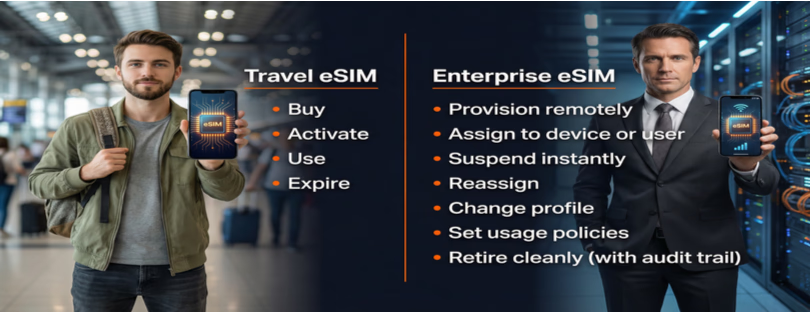
Enterprises operate on:
“This is deployed in 14 countries.”
“This is installed behind a panel.”
“This sits in a vehicle.”
“This is in a retail store and staff turnover is constant.”
“This is powering a critical workflow and downtime is a real incident, not an inconvenience.”
If you manage hundreds or thousands of endpoints, you do not want a workflow that depends on a person being available, careful, and trained.
The real gap: control layer vs connectivity purchase
Most consumer eSIM offers are a purchase-and-activate model. Great for travelers. For enterprises, buying connectivity is the easy part.
This is why “connectivity management platform” keeps showing up in enterprise IoT and enterprise mobility conversations.
Cisco’s IoT Control Center, for example, positions itself as a platform delivering “visibility and control” for enterprises, with real-time usage monitoring, automation, diagnostics, and security features designed for lifecycle management at scale.
You do not need to love any specific vendor to see the pattern. The market is telling you what the enterprise buyer actually values: not the eSIM, but the management. esim management platform enterprise
Why finance hates consumer eSIMs (and it’s not because they hate tech)
Let’s talk about the quiet enterprise killer: cost ambiguity.
Consumer eSIM products are typically optimized around a plan SKU and a user experience, not enterprise-grade cost allocation. That creates familiar pain:
“Which team used that data?”
“Why did this device burn 10GB overnight?”
“Is this roaming cost expected or a misconfiguration?”
“Why are we paying for inactive endpoints?”
Enterprise connectivity needs real-time usage visibility and the ability to connect usage to an asset, a user, a department, and a policy.
This is exactly why platforms in the connectivity management category emphasize monitoring and analytics, including programmatic control through APIs for workflows like provisioning, plan assignment, lifecycle changes, and usage checks.
A consumer eSIM can show you “remaining data.” An enterprise platform needs to show you “what is happening, right now, across the entire fleet,” and turn that into actions, not just a number.
Security is not a checkbox when identities move remotely
Consumer eSIMs are secure in the sense that the standards are built around cryptographic trust, secure elements/eUICC, and controlled profile downloads.
But enterprise security is broader than “the profile download is encrypted.”
Enterprise security is also:
Which admin can provision what
How you prevent rogue activations
How you detect anomalous usage across a fleet
How you respond fast when a device is lost, stolen, or compromised
Enterprise-focused platforms talk openly about multi-layered security and policy-based controls because the threat model is different when you are managing large deployments.
In other words, consumer eSIM security is about protecting an individual activation flow. Enterprise security is about controlling an ecosystem of endpoints over time.
SGP.32 is a big signal: the industry is building for managed fleets
If you want one clean sign that “enterprise eSIM” is not the same problem as “consumer eSIM,” look at where standards are going.
GSMA SGP.32 is explicitly framed as remote provisioning and management of eUICC for IoT, including constrained devices and fleet-style realities.
Multiple industry explainers describe SGP.32 as designed for IoT constraints like limited UI, intermittent connectivity, and long device lifecycles.
That is basically a polite standards-body way of saying: stop trying to run enterprise and IoT operations like consumer phones.
For enterprise buyers, this matters because it nudges the market toward:
More hands-off provisioning models
Better lifecycle tooling
More interoperable management approaches (over time)
A clearer separation between “consumer pull experience” and “enterprise fleet reality.”
So if your internal narrative is still “let’s just pick a travel eSIM vendor,” you are out of step with where the underlying architecture is heading.
What enterprises actually want (and how to ask for it without sounding dramatic)
Here’s the hidden desire you mentioned, translated into practical requirements:
You want power, visibility, and control without looking like you overcomplicated things.
That means you ask for capabilities that sound boring, but save your life later.
Enterprise readiness checklist
Central dashboard with real-time visibility into usage, location/context, and status across devices
Lifecycle controls: activate, suspend, reassign, retire, and audit at scale
Policy and automation: rules that prevent bill shock and reduce manual operations
Multi-operator support and the ability to manage globally without stitching together ten portals
API access so connectivity becomes a controllable layer inside IT operations, not a standalone app
Notice what is not on that list: “nice app UI” or “easy QR code.”
Those are consumer wins. Enterprises win with governance.
The uncomfortable truth: most “global” consumer eSIMs are still a black box
A consumer eSIM brand can look diverse on the outside and still funnel you into a limited set of upstream arrangements. That is not a scandal, it’s how distribution works.
But it becomes an enterprise problem when:
You cannot explain the upstream behavior to stakeholders
You cannot prove what network behavior is happening in-country
You cannot reconcile cost drivers with operational events
You cannot standardize support and troubleshooting across a fleet
Enterprises do not just buy connectivity. They buy predictability.
That is why the enterprise conversation keeps gravitating toward CMPs, orchestration layers, and managed connectivity services that explicitly promise operational control and reporting.
Conclusion esim management platform enterprise
If you zoom out, the market trend is clear: connectivity is being pulled upward into software. The “product” is no longer the SIM or even the eSIM profile. The product is the control plane.
Consumer eSIMs will keep booming because they solve a real consumer job: instant, flexible connectivity for a person. But enterprises are moving toward platforms that treat connectivity as infrastructure with governance, automation, and auditability. The standards roadmap supports this, with GSMA publishing both consumer-focused RSP (SGP.22) and IoT/fleet-focused provisioning (SGP.32).
So the smart enterprise move in 2026 is not to argue about which consumer eSIM brand is “most global.” It’s to decide whether you want to keep managing connectivity like a purchase or start managing it like a system.
And if your goal is to look calm and competent in front of finance, security, and operations, you already know the answer: you do not want another SIM vendor. You want a dashboard, a policy engine, and a fleet view that tells the truth in real time.
Driven by wanderlust and a passion for tech, Sandra is the creative force behind Alertify. Love for exploration and discovery is what sparked the idea for Alertify, a product that likely combines Sandra’s technological expertise with the desire to simplify or enhance travel experiences in some way.


 Enterprises operate on: