


China Makes Tax Refunds Easier for Foreign Travelers
China is giving its departure tax refund system a serious upgrade, and this is not just a small airport-service improvement. It is part of a much bigger attempt to turn inbound travel into inbound spending.
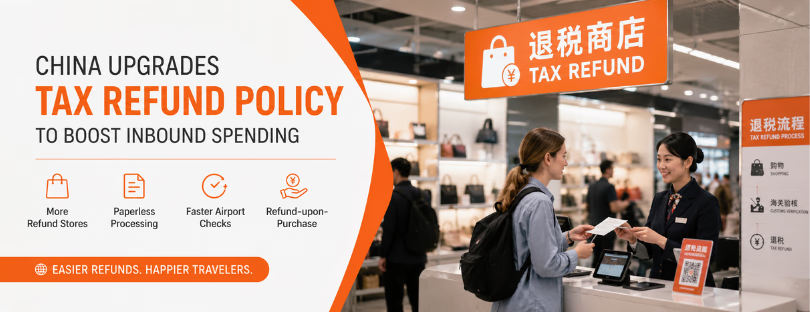
The country has rolled out what officials are calling the “2.0 version” of its departure tax refund policy, with new measures designed to make tax refunds easier, faster and more digital for overseas travelers. The package focuses on expanding the number of tax refund stores, simplifying customs checks, standardizing refund-upon-purchase services and moving refund procedures away from paper documents.
At a State Council Information Office press conference, Vice Minister of Commerce Sheng Qiuping said the aim is to make the refund system more convenient and more accessible, while improving the broader inbound consumption environment.
“The policy is designed to make tax refunds more convenient and more accessible for overseas travelers, while further enhancing the inbound consumption environment,”
Sheng said.
That sentence sounds administrative, but the logic behind it is very commercial. China not only wants more people arriving. It wants them shopping, eating, booking, paying and experiencing the country with less friction.
From tourism policy to retail strategy
China has already been trying to make itself easier to visit. In recent years, it has expanded unilateral visa-free access, promoted 240-hour transit visa exemptions, improved payment options for foreign visitors and supported campaigns such as “Shopping in China.” The tax refund upgrade fits neatly into that same strategy.
The numbers show why Beijing is paying attention. In 2025, sales under China’s departure tax refund program nearly doubled year on year, while the number of overseas travelers applying for refunds reached 270,000, around four times the figure recorded in 2024. The number of tax refund stores has also climbed to around 14,000, roughly four times the level seen at the end of 2024, according to official data reported by Chinese state media.
READ MORE: US Tourism Is Slipping — Can the World Cup Save It?
There is a simple truth here: tourists spend more when the process feels predictable. A tax refund that is difficult to claim is almost invisible. A refund that is easy, digital and available in the right shopping areas becomes part of the buying decision.
That is why the expansion of tax refund stores matters. Authorities want stronger coverage in major shopping districts, tourist attractions and ports of entry. They also plan dedicated tax refund service areas at major trade events such as the China International Import Expo and the Canton Fair. That last point is important. China is not looking only at leisure shoppers. It is also thinking about business visitors, buyers, exhibitors and international professionals who already travel with purchasing intent.
Less waiting, more spending
One of the most practical changes is the reform of customs inspections.
From July 1, 2026, refund applications involving purchases under 10,000 yuan will be subject to random checks rather than mandatory item-by-item physical inspections. Applications above that threshold will still require full verification.
For travelers, this could make a real difference. Anyone who has tried to claim a VAT refund at a busy airport knows the problem. The refund itself may be attractive, but the queue, the paperwork and the uncertainty often make it feel like a chore. If China can reduce waiting times at airports and border checkpoints, the policy becomes more than a financial incentive. It becomes part of the travel experience.
China is also moving toward paperless refunds. From July 1, customs authorities and refund agencies will be able to verify refund application forms and sales invoices online, allowing the process to be handled digitally rather than through paper documents.
That is the part travel retailers should watch carefully. The future of tourist shopping is not only about luxury malls and duty-free counters. It is about infrastructure: payments, identity checks, refund systems, customs data and airport processing all working together.

The refund-upon-purchase push
Another key change is the standardization of China’s refund-upon-purchase model. Under this system, eligible travelers can receive the refund earlier, instead of waiting until departure. The updated policy allows travelers to complete departure procedures at different ports and extends the departure period under the program to 28 days nationwide.
This may sound like a technical adjustment, but it changes behavior. If a traveler receives the refund while still in the country, there is a good chance some of that money goes straight back into the local economy. Another meal. Another museum ticket. Another suitcase item. Another domestic experience.
Li Jun, director of the Institute of International Trade in Services at the Chinese Academy of International Trade and Economic Cooperation, described this as a potential “multiplier effect,” arguing that easier refund access could support not only retail but also dining, tourism, cultural performances and sporting events.
“The expansion of the refund stores itself is a policy dividend,” Li said.
That is a useful way to frame it. Tax refund infrastructure is no longer just a back-office function. It is becoming a tourism competitiveness tool.
China is not alone
China’s move also fits a wider global pattern. Destinations are competing not only on attractions, hotels and flights, but on the smoothness of the visitor journey. Japan, South Korea, Singapore and many European countries have long used tax-free shopping as part of their tourism-retail mix. The difference now is that digital processing, instant refunds and integrated payment systems are becoming the new benchmark.
Europe still has strong tax-free shopping appeal, especially for luxury retail, but the process can remain uneven depending on the country, airport and refund operator. Singapore has built a reputation for airport efficiency and clear GST refund procedures. Japan’s tax-free shopping model is familiar to many travelers, particularly in electronics, beauty and department stores. China is now trying to make its own system feel less fragmented and more scalable.
That matters because China has a strong product story to tell. Electronics, smart devices, beauty products, cultural goods, fashion, tea, crafts and lifestyle products all give visitors a reason to spend. But product appeal alone is not enough. Travelers need payment access, refund clarity and confidence that the process will not waste their final hour at the airport.
The real signal
China’s upgraded tax refund policy is really about something bigger than shopping bags.
It shows how tourism policy, retail strategy and digital public infrastructure are starting to merge. Visa-free access brings people in. Better payment systems help them move. Tax refunds encourage them to spend. Paperless processing makes the journey feel modern. Put together, these measures turn inbound tourism into a more deliberate consumption engine.
For travelers, the benefit is obvious: easier refunds and less airport friction. For China, the prize is larger. It wants visitors to see the country not only as a place to visit, but as a place where spending feels simple, rewarding and worth repeating. That is where the real competition between destinations is heading. Not just who attracts the traveler, but who removes the most friction once they arrive.


