US Tourism Is Slipping — Can the World Cup Save It?
The United States is still the world’s largest travel and tourism market. But right now, it’s not behaving like one. global tourism market shift China vs US
Ahead of the 2026 FIFA World Cup, which should be a major tourism boost, the country is seeing a noticeable drop in international visitors. And more importantly, a shift in sentiment.
Tourists are not just staying away. Many are choosing other destinations.
The Numbers Behind the Shift
According to the World Travel & Tourism Council, global travel surged in 2025, with 80 million more international trips compared to the previous year.
But the U.S. did not benefit from that growth.
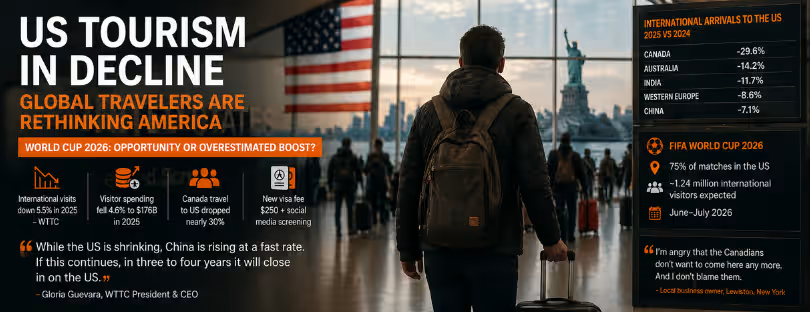
International arrivals fell by 5.5% compared to 2024, while visitor spending dropped 4.6% to $176 billion. North America was the slowest-growing region globally, with the U.S. growing just 0.9%.
That matters because it breaks a long-standing pattern. For years, the U.S. has been the default long-haul destination for global travelers.
Now, it’s being actively bypassed.
At the same time, the domestic market remains strong. Travel spending within the U.S. hit $1.54 trillion, well above pre-pandemic levels. The sector still supports over 20 million jobs and contributes $2.63 trillion to GDP.
So this is not a collapse. It is a warning sign.
China Is Closing the Gap
While the U.S. slows, China is accelerating.
Its travel and tourism sector grew 9.9% last year, contributing $1.75 trillion to GDP. Across the Asia-Pacific, growth is even stronger, with countries like Malaysia and the Philippines expanding at double-digit rates.
Gloria Guevara put it bluntly:
“While the US is shrinking, China is rising at a fast rate. If this continues, in three to four years it will close in on the US.”
This is no longer about potential. It is already happening.
Policy and Perception Are Driving Decisions
There is no single cause behind the decline, but the direction is clear.
Stricter immigration policies and geopolitical tensions under Donald Trump are playing a role. A proposed $250 visa integrity fee and expanded social media checks add friction to travel planning.
But policy alone does not explain everything. Perception matters just as much.
Canadian travel to the U.S., traditionally the largest inbound segment, dropped by nearly 30% in 2025. Visitors from Australia, India, and Western Europe also declined.
In border communities like Lewiston, New York, the impact is already visible. Local businesses report fewer visitors and reduced spending.
One resident captured the mood:
“I’m angry that the Canadians don’t want to come here any more. And I don’t blame them…”
That is not about pricing or availability. It is about how the destination feels to potential visitors.
Can the World Cup Reverse the Trend?
The World Cup should change the story, at least temporarily.
The U.S. will host the majority of matches, attracting an estimated 1.24 million international visitors during the tournament. Bookings have already increased since match schedules were announced.
Historically, events like this create short-term spikes in tourism.
But long-term impact is less certain.
There are already concerns within the industry that the boost may not translate into sustained growth. Former FIFA president Sepp Blatter even suggested fans consider avoiding travel to the U.S., with matches also taking place in Canada and Mexico.
That kind of narrative shapes behavior, whether justified or not.
The Bigger Issue: Losing Momentum
The real risk for the U.S. is not decline. It is losing momentum.
Global tourism is more competitive than ever. Travelers have more options, and many destinations are making it easier to visit, not harder.
Asia-Pacific is investing heavily in tourism infrastructure and promotion. Middle Eastern hubs are building entire travel ecosystems around stopovers and connectivity. European destinations are refining premium experiences.
Against that backdrop, even small barriers can push travelers elsewhere.
And once habits shift, they tend to stick.
What Happens Next
The World Travel & Tourism Council is clear about what needs to happen.
The U.S. must rebuild international demand, improve perception, and position itself as a welcoming destination again. That includes everything from policy adjustments to stronger global promotion.
At the same time, the opportunity is still there.
As Jason Wynn noted:
“With the U.S. set to host a series of global events through 2028, we have an extraordinary opportunity to welcome new visitors and bring travellers from around the world closer together.”
The infrastructure exists. The demand exists. But neither guarantees growth anymore.
Conclusion: A Competitive Reality Check
This is not a story about the U.S. losing its position overnight. It is a story about a market that can no longer rely on its past dominance.
Compare the U.S. with fast-growing markets like China or Southeast Asia, where tourism growth is actively engineered through policy, investment, and positioning. These destinations are not waiting for travelers. They are competing for them.
The U.S., by contrast, is at a turning point.
It still leads in scale, but scale is no longer enough. In a global travel market shaped by perception, accessibility, and experience, even the largest destination can lose ground if it becomes harder to enter or less appealing to visit.
The World Cup will bring attention. It may even bring a temporary surge.
But whether that translates into long-term recovery depends on something more fundamental: whether the U.S. adapts to how modern travelers choose where to go.
Driven by wanderlust and a passion for tech, Sandra is the creative force behind Alertify. Love for exploration and discovery is what sparked the idea for Alertify, a product that likely combines Sandra’s technological expertise with the desire to simplify or enhance travel experiences in some way.