EU Roaming Update: Where It Works and What’s Next
If you’ve traveled across Europe in the past few years, you’ve probably experienced one of the EU’s most consumer-friendly policies in action without thinking twice about it.
You land in another country, your phone connects, and… nothing happens. No panic. No “turn off data” reflex. No unexpected charges.
That’s Roam Like at Home.
But here’s what’s actually interesting right now. The story isn’t about what roaming already is. It’s about where it’s going next. And that’s where things start to matter again.
What “Roam Like at Home” really means
At its core, the concept is simple. When you travel within the EU, your mobile plan follows you.
Call minutes, texts, and data are billed exactly the same as they would be at home. No roaming fees, no separate bundles, no confusing pricing structures.
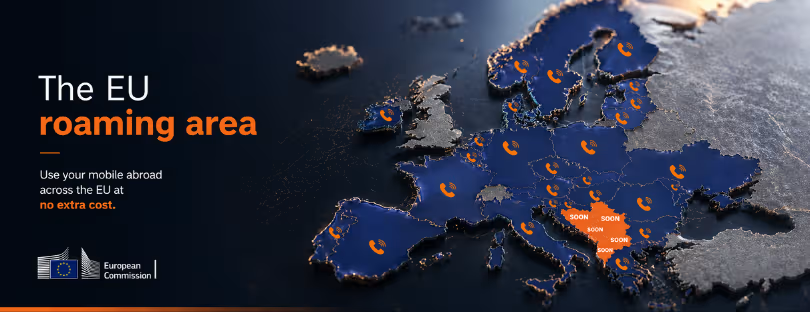
This applies across all 27 EU countries, plus Iceland, Liechtenstein, and Norway.
In practice, that means a traveler moving from Germany to Italy or from France to Croatia experiences zero friction in connectivity. It just works.
That alone reshaped traveler behavior. People stopped planning connectivity. It became invisible.
The next step: new countries entering the equation
Now comes the more important shift.
The EU roaming model is expanding toward the Western Balkans. Countries like Serbia, Montenegro, North Macedonia, Albania, Bosnia and Herzegovina, and Kosovo are moving toward integration into the EU roaming framework.
Some of these are already partially aligned through regional agreements, but the full inclusion into the EU system is the real milestone.
And it matters more than it seems.
Because right now, crossing from an EU country into one of these markets still often means:
- Data suddenly becomes expensive again
- Travelers start hunting for Wi-Fi
- Or they switch to eSIMs or local SIMs
That’s a broken experience. And it’s exactly what the EU eliminated internally years ago.
Extending roaming to these countries is not just a regulatory move. It’s a UX upgrade for millions of travelers moving across Europe’s most dynamic travel corridors.
Better roaming, but not always identical
There’s an assumption many travelers still make. If roaming is “like at home,” it must be identical.
Not quite.
Operators are required to offer the same pricing conditions, but not always identical network quality. That depends on local infrastructure.
So yes, if you have 5G at home, you should get 5G abroad where it’s available. But if the local network is weaker, your experience may vary.
That’s not a loophole. It’s just physics and infrastructure.
What has improved significantly since 2022 is transparency. Operators now have to clearly inform users about:
- Expected speeds
- Network limitations
- Differences in service quality
That alone reduces one of the biggest frustrations travelers used to face: uncertainty.
The hidden edge cases travelers still miss
Even with all these improvements, roaming in Europe isn’t completely foolproof.
There are a few situations where costs can still catch people off guard.
ROAMING WARNING
Non-terrestrial networks
If you’re on a plane or a ferry, your phone may connect to satellite-based networks.
These are not covered by EU roaming rules. And they can be extremely expensive.
The good news is that operators now warn you automatically when this happens. There’s also a built-in €50 cut-off limit to prevent bill shock.
Still, it’s one of those things most travelers don’t realize until it’s too late.
EXTRA-COST CALLS
Value-added numbers
Calling customer service lines, airline hotlines, or insurance numbers can cost extra when you’re abroad.
Even within the EU.
Operators are now required to warn users about these charges when crossing borders, but very few people actually read those messages.
Fair use isn’t a restriction; it’s a safeguard
There’s another piece that often gets misunderstood: fair use limits.
If you’re on an unlimited data plan, your operator may still apply a roaming cap. This isn’t about limiting you arbitrarily. It’s about preventing permanent roaming abuse.
The formula behind it is regulated and tied to your monthly plan price. In reality, the limits are high enough for typical travel use.
And even if you exceed them, the extra cost is minimal and capped at a regulated rate that continues to decrease each year.
So while it sounds restrictive on paper, in practice, it rarely affects normal travelers.
The UK complication
Since Brexit, the UK is no longer part of the EU roaming framework.
Some operators still offer roaming without extra charges there, but many don’t.
That means the experience becomes inconsistent again. One traveler pays nothing. Another pays significantly more for the same usage.
It’s a reminder of how much the EU framework actually standardized something that used to be chaotic.
Why this matters more than it looks
On the surface, roaming feels like a solved problem in Europe.
But it isn’t. It’s just uneven.
The expansion into the Western Balkans is the next logical step. And once that happens, a large part of Europe that still operates under fragmented connectivity rules will suddenly become seamless.
For travelers, that means fewer decisions, fewer workarounds, and fewer unexpected costs.
For the telecom industry, it’s something else entirely.
It raises the bar.
Because once users expect connectivity to “just work” everywhere, the tolerance for exceptions disappears.
Conclusion EU roaming countries
The EU’s roaming model remains one of the strongest examples of how regulation can directly improve the user experience at scale. Few regions globally have managed to eliminate roaming friction this effectively.
But the real story now is expansion.
Bringing the Western Balkans into the same framework is not just about lower costs. It’s about removing one of the last connectivity gaps in Europe’s travel experience.
At the same time, the market is shifting. Global eSIM providers have already built business models around solving exactly these gaps. In many cases, they move faster than regulation and cover regions before policy catches up.
That creates an interesting dynamic.
Regulation simplifies connectivity inside defined regions. eSIM players monetize everything outside those boundaries.
As the EU expands its roaming zone, some of that value shifts back toward traditional operators. But the expectation of instant, borderless connectivity is now global. And that expectation is being shaped just as much by private players as by policy.
According to the European Commission and BEREC, roaming usage continues to grow year over year, especially for data-heavy applications. That trend isn’t slowing down.
So the real takeaway is this.
Roaming in Europe isn’t finished. It’s evolving.
And the next phase isn’t about removing charges. It’s about removing the last remaining friction points entirely.