For years, travel marketing had a fairly predictable rhythm: inspire on social, capture demand through search, convert on the website. Simple enough. But new TravelTech Show research suggests that rhythm is starting to sound very different.
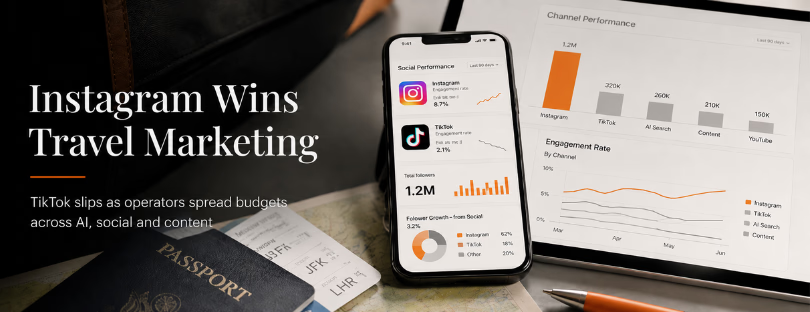
According to the survey, TikTok now delivers measurable results for just 9% of travel operators, down from 19% in 2025. Instagram, meanwhile, has moved into the lead, with 61% of operators saying it is one of their most successful social media platforms for marketing. Facebook follows at 47%, while LinkedIn, once the standout channel in the data, has dropped from 70% in 2024 to 42% in 2026.
That does not mean TikTok is suddenly irrelevant. It means the platform’s role is more complicated than the hype suggested. TikTok may still be powerful for inspiration, especially among younger travellers, but inspiration is not the same as measurable commercial impact. For travel operators, that distinction matters.
The platform gap
The most interesting part of the data is not simply that Instagram is ahead. It is that travel operators appear to be separating visibility from performance.
Instagram has become a more reliable “shop window” for travel. It works well for visual storytelling, destination mood, short-form video, creator partnerships, and brand recall. It also feels more compatible with the way many travel brands sell: polished, aspirational, and still close enough to commerce.
Facebook’s fall from 63% in 2025 to 47% in 2026 is notable, but not surprising. It remains useful for communities, older audiences, remarketing, and certain destination or tour operator segments. But it no longer feels like the obvious growth engine.
LinkedIn’s decline is more nuanced. A drop from 70% to 42% looks dramatic, but LinkedIn was probably over-indexing for B2B travel companies, technology vendors, consultants, and operators using the platform for partnerships rather than consumer bookings. It still matters, just not in the same broad way.
TikTok is the awkward one. It creates attention, but attention does not always turn into bookings. For travel brands, the problem is attribution. A traveller may discover a destination on TikTok, compare it on Google, ask ChatGPT for an itinerary, check reviews, message a friend on WhatsApp, then book through an OTA or operator website. TikTok helped, but it may not get the credit.
Search is still the money layer
Only 13% of respondents said most customer bookings and website traffic come directly from social media and influencers, compared with online search. That is the quiet reality behind the social media noise.
Travel decisions are becoming more fragmented, not less. Social starts the idea. Search validates it. AI summarises the options. Reviews reduce the risk. The website or booking platform closes the sale. This is why treating social as a standalone sales channel can lead operators to bad budget decisions.
The budget data reflects that caution. Travel operators plan to allocate 15% each to social media platforms, AI and chatbots, and website content. Booking platforms get 10%, while the customer website UX receives 8%. In other words, operators are not betting everything on one channel. They are spreading investment across discovery, assistance, content, and conversion.
That is the smart move. TravelTech Show positions its 2026 event around travel AI, software, CRM, marketing, booking systems, data analytics and mobile solutions, which fits the same bigger picture: travel marketing is becoming a technology stack problem, not just a content calendar problem.
AI enters the funnel
Commenting on the results, TravelTech Show Sales Manager Thauan “Ty” Albuquerque said, “Social media platforms have scaled significantly in the last decade to establish themselves as a valuable trading floor for travel brands as well as their shop window. It’s interesting to see Instagram leapfrog LinkedIn and Facebook in just two years. However, the most significant shift has been the decline of the impact of the Gen Z popular platform TikTok. For travel operators, this raises the question of where to invest next online to harness brand loyalty and safeguard future customers and revenue. While many are already investing in AI and chatbots as well as social media platforms and website content, alongside this is the need to maintain a sharp focus on the customer journey and booking behaviours.”
That last sentence is the key. AI is not replacing social media. It is changing what happens after the first spark of interest.
Travelers are no longer only typing “best hotels in Lisbon” into Google. They are asking AI tools to compare areas, build itineraries, explain transport options, estimate costs, and narrow choices. That makes website content more important, not less. If a travel operator’s content is thin, outdated, or generic, it will struggle in both search and AI-assisted discovery.
This aligns with wider travel technology commentary for 2026, where AI is increasingly framed as a tool for personalisation, planning, automation, and reduced friction across the trip journey.
Conclusion
The lesson for travel operators is not “leave TikTok” or “move everything to Instagram.” That would be too simplistic.
The real lesson is that travel marketing is moving from platform obsession to journey design. Instagram may currently be the strongest social performer, but search remains closer to the booking decision. AI is becoming the assistant in the middle. Website content is the credibility layer. Booking UX is where all the previous work either converts or collapses.
Compared with broader travel players such as OTAs, hotel groups, and airlines, many smaller travel operators still treat channels separately. Social team here, SEO there, chatbot somewhere else. The operators who win next will connect these pieces. A TikTok view, an Instagram save, an AI search, a Google query, a WhatsApp question, and a booking page visit are not separate stories. They are one customer journey.
That is where the real budget shift should happen: not just toward platforms, but toward systems that understand how travellers actually decide.