
eSIM Users Are Switching Providers Twice as Fast
For years, mobile operators talked about eSIM as a convenience feature. No plastic SIM. Easier activation. Cleaner device design. Nice, useful, but hardly revolutionary.
New data from Roy Morgan suggests something more interesting is happening: eSIM may be changing how loyal mobile customers actually are.
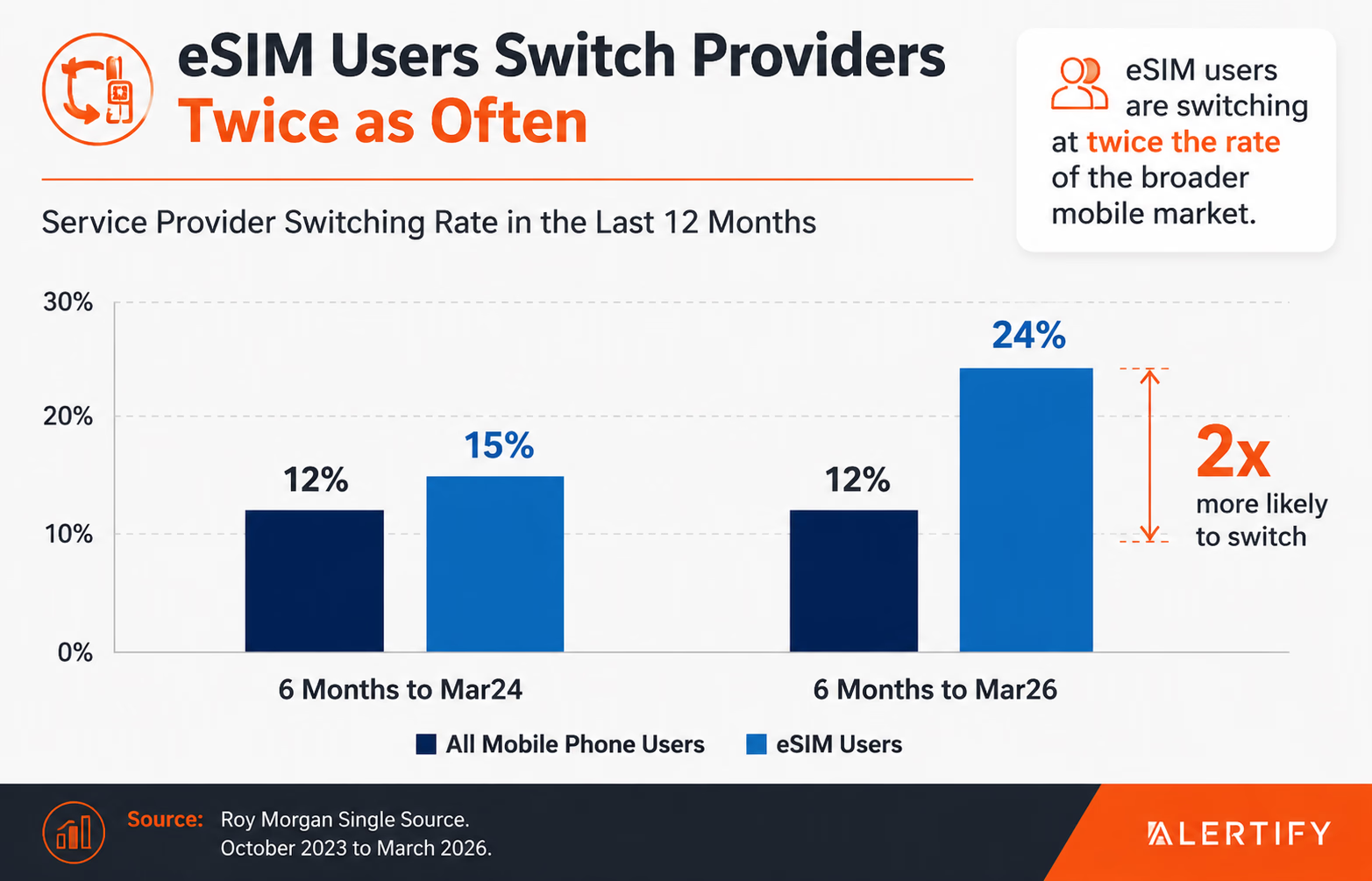
According to Roy Morgan’s latest research, 24% of Australian eSIM users switched mobile service providers in the last 12 months. Among all mobile phone users, the switching rate was just 12%. In other words, eSIM users are switching at twice the rate of the broader mobile market.
That should make operators pay attention. Because the real story is not just that more people know what eSIM is. It is that people who use it seem more willing to move.
Awareness Has Hit The Mainstream
eSIMs entered the Australian market in 2019, initially through the major mobile network operators: Telstra, Optus, and Vodafone. Since then, the technology has moved from a flagship phone novelty to something almost every serious mobile provider has to support.
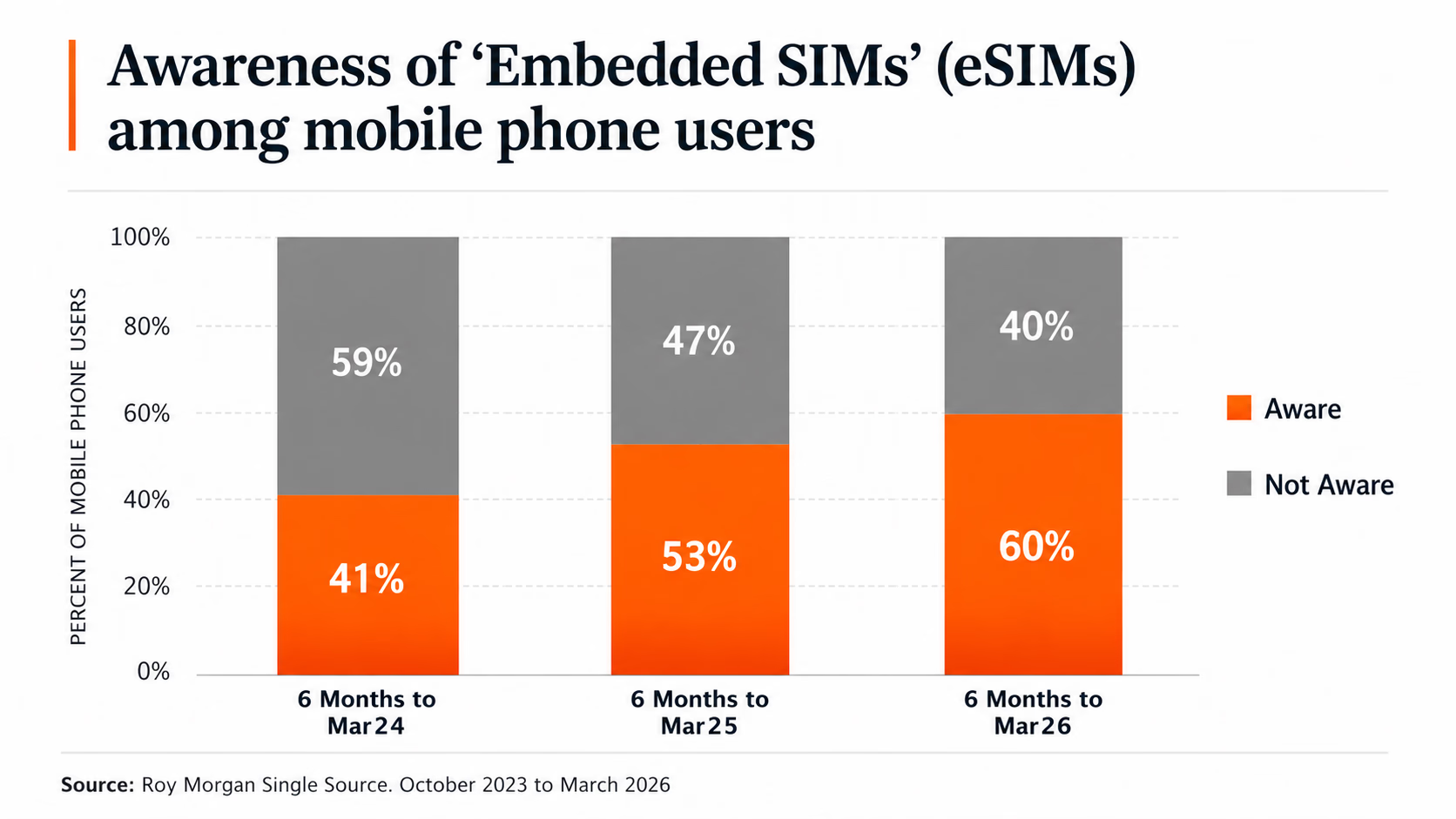
Roy Morgan says awareness of eSIM technology among Australian mobile consumers reached 60% in March 2026. That is up from 41% in the six months to March 2024, then 53% in the six months to March 2025.
READ MORE: Why Two eSIMs on One Network Feel Different?
That is not a small shift. It means eSIM has crossed from “tech people know this” into ordinary consumer awareness. The iPhone helped. So did Samsung, Google Pixel, and the wider move toward eSIM-compatible devices. GSMA also describes eSIM as allowing consumers to store multiple operator profiles on a device and switch between them remotely, which is exactly the kind of friction reduction that changes behaviour over time.
But awareness alone does not explain the switching gap. Plenty of people know about eSIM and still do nothing. The interesting group is the user who has an eSIM-enabled handset, understands the process, and suddenly realises changing providers no longer feels like a mini admin project.
The Switching Barrier Is Disappearing
Traditional SIM cards created more friction than the industry liked to admit. You had to order a new SIM, wait for delivery, visit a store, swap cards, keep the little tray tool, hope activation worked, and sometimes deal with awkward downtime. None of this was impossible. But it was enough to make many people stay put.
eSIM reduces that psychological and practical barrier. Switching starts to feel more like changing a digital service than changing a physical product.
READ MORE: Why Travel eSIMs Break at Enterprise Scale?
The ACCC saw this coming back in 2019, when it said eSIM technology had the potential to increase competition and consumer choice in mobile telecoms by letting people switch on their device rather than physically procure and change SIM cards. It also noted that eSIM could improve the competitive position of MVNOs and online-only providers.
That prediction now looks very realistic. Roy Morgan’s data shows the switching rate among eSIM users grew from 15% in March 2024 to 24% in March 2026, while the broader mobile market stayed at 12%.
So the gap is widening. eSIM users are not just slightly more flexible. They are becoming a different type of customer.
Operators Now Face A More Restless Customer
Michele Levine, CEO of Roy Morgan, put it clearly:
“This latest Roy Morgan data gives us vast insights into the impact of technology on consumer behaviour. In this case, the versatility of the eSIM technology removes a traditional barrier to mobile phone service provider switching, and this clearly influences behaviour.
“Whilst offering eSIM technology may not necessarily be a selling point for a mobile service provider, as the vast majority of providers offer eSIM activation, the data shows that having an eSIM makes it easier for customers to switch mobile service providers.
“The convenience available to those with eSIMs would have been handy for customers during the Optus national outage in late 2023 which lasted nearly 14 hours. At the very least, the Optus outage may have contributed to the substantial increase in awareness levels for eSIM during this period (+12% pts).”
READ MORE: The Rise of Always-Ready Travel eSIMs
That Optus outage point matters. Major network failures do not just create short-term anger. They teach consumers something. In this case, they may have taught many people that having a second profile, an alternative provider, or an easier switching option is not just convenient. It is resilience.
For operators, that changes the retention game. If customers can leave faster, loyalty has to be earned through network quality, pricing, service, transparency and useful bundles. “We support eSIM” is no longer a differentiator. Almost everyone does. The question is whether the customer has a reason to stay once switching becomes easy.
Why MVNOs And Digital Brands Should Care
This is where eSIM becomes more than a handset feature. It becomes a distribution shift.
MVNOs, digital-first operators and travel eSIM brands all benefit when activation is instant and remote. A customer who would never wait for a physical SIM might happily test a digital plan in minutes. That is why players like Airalo, Holafly, Nomad eSIM, Yesim, GigSky, Ubigi etc. have been able to build travel eSIM propositions around speed, simplicity, and price comparison. They do not need to own the full customer relationship forever. They need to win at the right moment.
READ MORE: eSIM Smartphones Hit 60% in Premium Market
Domestic mobile markets are now moving in a similar direction. The customer does not need to be angry enough to walk into a store. They only need to be curious enough to scan, install or activate.
This also explains why traditional operators are responding more seriously to eSIM-led competition. Recent market analysis has pointed to travel eSIM growth, operator pushback and a broader shift toward connectivity-as-a-service models, where smaller brands can launch mobile offers without owning the full telecom stack.
The old mobile model rewarded inertia. The new one rewards timing.
Final take
The Roy Morgan numbers are important because they prove something the telecom industry has discussed for years: eSIM does not just digitise the SIM card. It weakens the old glue that kept customers attached to providers.
That does not mean every eSIM user is disloyal. It means they are more empowered. And empowered customers behave differently.
For big operators, this is uncomfortable but not fatal. Strong networks, fair pricing, good roaming options and reliable service still matter. For MVNOs and digital-first brands, it is an opening. For travel eSIM players, it confirms the broader direction of the market: connectivity is becoming easier to try, easier to compare and easier to replace.
The winners will not be the providers that simply offer eSIM. That box is already ticked. The winners will be the ones who understand what eSIM really changes: not the SIM card, but the customer’s willingness to move.