Why Two eSIMs on One Network Feel Different?
Two travelers land in Paris. Both buy an eSIM. Both phones connect to the same local network, maybe Orange France. One gets smooth maps, fast uploads, and decent video calls. The other gets lag, strange IP location issues, and that familiar feeling that the phone says “5G” but behaves like hotel Wi-Fi from 2012.
That is not always the local network’s fault.
In travel eSIM, the visible network name is only the front door. What happens behind it can be completely different. The hidden part is IMSI routing, and it is one of the least explained reasons why two eSIMs on the same network can perform differently abroad.
An IMSI, or International Mobile Subscriber Identity, is the identity your SIM or eSIM uses to authenticate on a mobile network. It tells the visited network who you are, which home network or roaming partner should validate you, and how your traffic should be handled. In simple terms, your phone may be standing in Spain, but your data session might still be controlled, authenticated, rated, and routed through infrastructure in another country.
That is where the speed story gets interesting.
What IMSI routing actually changes
When you use a travel eSIM abroad, your phone usually connects to a local mobile network through roaming agreements. But your data does not automatically exit to the internet locally.
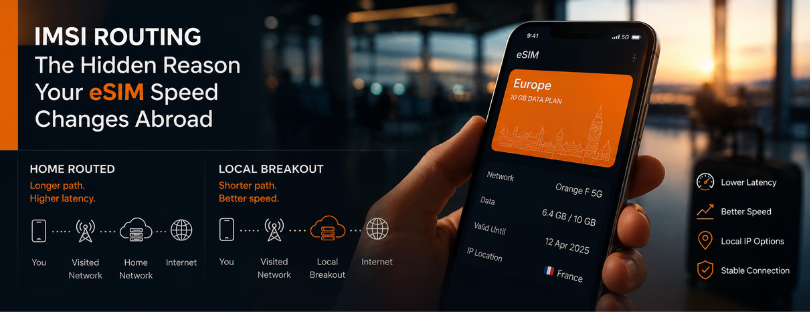
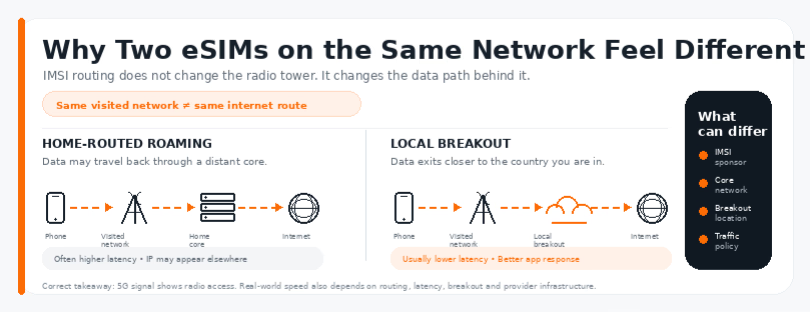
In a home-routed model, your phone connects to the visited network, then your traffic is sent back through the provider’s core network before reaching the open internet. This is common in roaming because it gives the provider more control over charging, policy, authentication, and fraud management. BEREC’s work on roaming quality makes clear that roaming performance depends not only on the visited network, but also on technical feasibility, network arrangements, and other conditions beyond the consumer’s view.
READ MORE: Best eSIM for Europe 2026 — Tested for Latency, Throttling & Multi-Network Resilience
Local breakout works differently. Instead of sending your traffic back through a distant core, data can exit closer to where you are. That usually means lower latency, better responsiveness, and fewer “why does this website think I am in another country?” moments. A CEPT report explains the basic difference clearly: with local breakout, traffic is handled locally, while with home-routed roaming, traffic is directed back to the home network.
For the traveler, this shows up in very practical ways. Google Maps feels snappier. WhatsApp calls have less delay. Banking apps are less suspicious. TikTok or Instagram uploads do not stall as often. Not because the radio signal is magically better, but because the route between your phone and the internet is shorter, cleaner, or better managed.
Why does the same local network feel different
This is the part most comparison tables miss.
When an eSIM provider says “uses Vodafone Spain” or “connects to AT&T,” that does not tell you the full experience. It tells you the visited radio network. It does not tell you the IMSI sponsor, the core network, the IP breakout location, the roaming hub, the APN configuration, traffic policy, throttling rules, or whether the provider has direct network relationships or buys access through layers of intermediaries.
That is why two eSIMs can both show the same local operator and still behave differently.
READ MORE: No Throttle eSIM vs Unlimited Plans: The Truth
One provider may have a stronger roaming profile, better traffic steering, multi-IMSI logic, regional packet gateways, or direct agreements. Another may be using the same visited network through a longer wholesale chain. The result can be higher latency, lower effective throughput, unstable switching between partner networks, or IP addresses that appear in the wrong country.
This also explains a common traveler complaint: “My phone says 5G, so why is it slow?” Because 5G on the screen mostly describes the radio access layer. It does not guarantee premium routing, low latency, high priority, or local internet breakout. A cheap plan can attach to a strong network and still deliver a weaker experience if the back-end path is poor.
The hidden premium layer
This is where infrastructure-backed providers start to separate from simple resellers.
Ubigi is a useful example because it is powered by Transatel, which says it operates its own core network, regional infrastructure, and direct network access agreements with local mobile carriers. That matters because more control over the core and routing layer can translate into a more predictable experience, especially for laptops, connected cars, business travelers, and heavy users.
Ubigi’s SmartIP feature is also a sign of where the market is going. It lets users choose a local or home-country IP in selected markets without using a traditional VPN, according to Ubigi’s own support materials and app listing. That is not just a cute app feature. It points to a deeper trend: routing, IP location, and network-layer experience are becoming part of the product itself.
READ MORE: Enterprise eSIM 101: What IT Teams Really Need
Other players approach this differently. Airalo, Holafly, Nomad, Yesim, GigSky, 1GLOBAL, and others may all sell travel eSIM connectivity, but they do not necessarily sit at the same depth in the stack. Some are more marketplace-led. Some are more operator-like. Some optimize for price and coverage breadth. Others focus on orchestration, enterprise control, or network reliability. To the average traveler, they all look like “data plans.” Technically, they are not the same product.
GSMA Intelligence has also argued that travel eSIM is shifting from a niche convenience into a real roaming alternative, especially as more operators and travel brands enter the category. That makes routing quality more important, not less. When everyone can sell a QR code, the invisible network layer becomes one of the few places left to differentiate.
What travelers should actually check
Speed abroad is not only about gigabytes. It is about routing quality.
Before buying, travelers should look beyond price and ask better questions. Does the provider mention local network partners? Does it support 5G in the destination? Does it disclose throttling or fair-use rules? Are there complaints about high latency or wrong IP location? Does the plan work well for hotspot, video calls, banking apps, or only casual browsing?
For business travelers, this matters even more. A delayed WhatsApp call is annoying. A failed banking login, unstable laptop hotspot, or corporate app flagging your session because your IP appears in another region is a real productivity problem.
The uncomfortable truth is that the best eSIM is not always the one with the most data for the lowest price. Sometimes the better option is the one with cleaner routing, stronger infrastructure, and fewer hidden compromises.
The real conclusion
The travel eSIM market is still sold like a data commodity, but performance is becoming an infrastructure story.
Airalo and Holafly helped normalize the idea that travelers can buy connectivity before they fly. Yesim and Nomad eSIM pushed convenience and app-based choice. GigSky has long played in premium travel and aviation-adjacent connectivity. Ubigi and 1GLOBAL show why deeper telecom control can matter when the product moves beyond casual browsing into laptops, cars, enterprise users, and embedded connectivity.
The next phase will not be won only by those who have the cheapest 10 GB plan in Japan or Italy. It will be won by providers that can explain, and actually control, what happens after the phone connects.
Because abroad, your speed is not just about the tower you see on your screen. It is about the route your data takes after it leaves that tower. And in eSIM, that invisible route may be the difference between “connected” and genuinely usable.