No Throttle eSIM vs Unlimited Plans: The Truth
There’s a phrase that’s quietly gaining traction in the eSIM space: no throttle eSIM.
Not flashy. Not consumer-friendly. But if you’ve ever tried to work, stream, or hotspot on a so-called “unlimited” plan, you already know why it matters.
Because most unlimited plans aren’t really unlimited. And more importantly, they’re not consistent.
That’s where things start to get interesting.
Unlimited… until it isn’t
Let’s get one thing straight. In telecom, “unlimited” rarely means what you think it does.
Most eSIM providers operate on a fair usage policy (FUP). That’s industry standard. It’s how networks protect themselves from overload. But it comes with a trade-off: once you cross a certain threshold, your speeds drop. Sometimes drastically.
And here’s the part most travelers miss:
That threshold is often not clearly communicated.
Some providers slow you down after 1–3 GB per day. Others after 5 GB. Some don’t even tell you.
The result? You’re technically “connected”… but try joining a Zoom call or uploading a file and everything falls apart.
Messaging works. Maps load. But anything heavier becomes a struggle.
That’s throttling. And it’s everywhere.
Why throttling breaks real travel use
For light travelers, throttling isn’t a big deal.
But Alertify readers are rarely “light users.”
You’re the ones:
- Running hotspot from your phone to your laptop
- Uploading content while moving between cities
- Taking calls across time zones
- Streaming, syncing, backing up… constantly
In that world, throttling isn’t a minor inconvenience. It’s a workflow killer.
The issue isn’t just speed. It’s unpredictability.
You don’t know when it will hit. You don’t know how bad it will be. And you don’t know how long it will last.
That’s a problem most providers haven’t really solved.
The rise of “no throttle” positioning
This is exactly the gap that a new wave of providers is starting to address.
And among them, FairPlay is one of the more interesting cases.
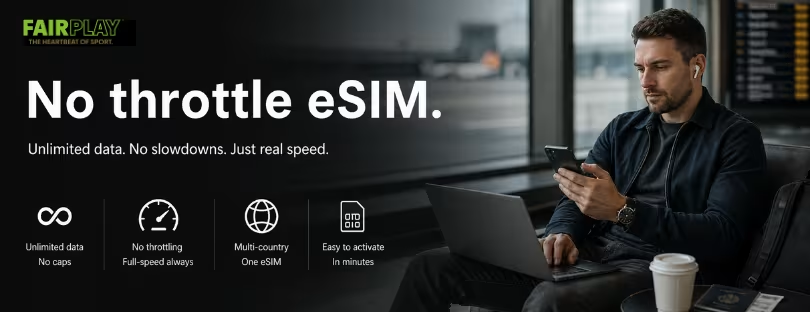
Instead of quietly managing speeds behind the scenes, their positioning is very explicit:
no caps, no hidden thresholds, no throttled data.
That’s a strong claim. And in this market, it’s a bold one.
According to their own model, the idea is simple:
- One eSIM
- Multi-destination coverage
- Predictable pricing
- And most importantly, no artificial speed reduction once you’re “in unlimited”
That last part is what differentiates them.
Because most providers don’t remove throttling. They just manage it more transparently.
FairPlay is trying to remove the concept entirely. Or at least redefine when and how it applies.
Not all “unlimited” models are built the same
To understand why this matters, you have to look at how different providers approach unlimited.
Network-led model(GigSky, some MVNOs)
|
FairPlay model(emerging category)
|
This is a fundamentally different philosophy.
Instead of saying “we’ll slow you down after X,” it says:
“we’ll let you continue at full speed, but we’ll structure pricing accordingly.”
That’s not just product design. That’s positioning.
And it’s aimed at a very specific traveler.
Who actually needs a no-throttle eSIM?
This is where things get real.
A no-throttle eSIM is not for everyone. And that’s fine.
Heavy usage
This is where throttling becomes a real problem. |
Then yes, throttling becomes the defining factor.
And this is the segment FairPlay is clearly targeting.
Not tourists. Not casual travelers.
But the people who treat connectivity as infrastructure.
The uncomfortable truth about the market
Here’s what’s rarely said out loud.
Most eSIM providers didn’t “fail” to build for heavy users.
They chose not to.
Because:
- Heavy users strain networks
- They reduce margins
- They require better infrastructure partnerships
So the market is optimized for the average traveler.
Smaller packages. Predictable usage. High turnover.
That’s why throttling became the norm. It protects the business model.
FairPlay’s approach challenges that logic.
Instead of limiting usage, they’re trying to monetize it differently.
And that’s where things get interesting from a market perspective.
Transparency vs control
One of the more subtle shifts here is how providers communicate limits.
Traditional players
|
FairPlay
|
That’s a very different user journey.
It moves the conversation from:
“Will my speed drop?”
to:
“How much am I willing to spend to keep it consistent?”
And that’s a much more honest trade-off.
The risk: can “no throttle” scale?
Now, the obvious question.
Can a no-throttle model actually scale globally?
Because let’s be realistic.
Even FairPlay plans can still be subject to network-level constraints or fair usage conditions depending on local operators.
At the end of the day, they don’t own the infrastructure. They rely on partner networks.
Which means:
- Congestion can still happen
- Local policies can still apply
- Performance can still vary
So “no throttle” doesn’t mean infinite capacity.
It means removing artificial limits where possible.
That distinction matters.
 Where is this heading?

The eSIM market is entering a more mature phase.
We’re moving from:
- “cheap data for tourists”
to:
- “connectivity as a continuous service”
And in that transition, throttling becomes a bigger issue.
Because consistency matters more than price.
You see it already:
- Subscription models are emerging
- Multi-country continuity is expected
- Power users are no longer ignored
FairPlay is not alone in this direction. But they are early in making it explicit.
Conclusion: this is not about unlimited. It’s about control.
The phrase “no throttle eSIM” sounds like a technical detail.
It’s not.
It’s a signal that the market is shifting from volume-based selling to experience-based connectivity.
Most providers still treat unlimited as a marketing layer. Something to simplify messaging while managing usage behind the scenes. And to be fair, that model works for the majority of travelers.
But it breaks down at the edges. And those edges are growing.
Digital nomads. Remote workers. multi-country professionals. The people who don’t switch off when they travel.
That’s where FairPlay’s model becomes relevant.
Not because it’s perfect. It isn’t. No provider fully escapes the realities of network dependency.
But because it reframes the problem.
Instead of asking:
“How do we limit heavy usage?”
It asks:
“How do we support it without breaking the experience?”
And that’s a much more interesting question.
If the market follows that direction, throttling won’t disappear overnight. But it will become visible. Negotiable. Structured.
And once that happens, “unlimited” might finally start meaning something closer to what users actually expect.