KuCoin Pay Partners with Yesim to Enable Crypto eSIM Purchases
There’s a quiet shift happening in travel tech right now. Payments and connectivity, two things that used to sit in completely separate lanes, are starting to merge. The latest signal comes from a new partnership between KuCoin Pay and Yesim — and it’s more meaningful than it looks at first glance.
At its core, this collaboration introduces a simple idea: you can now buy mobile data with crypto. But the real story is what that unlocks for travelers, remote workers, and increasingly, businesses operating globally.
What’s actually new here
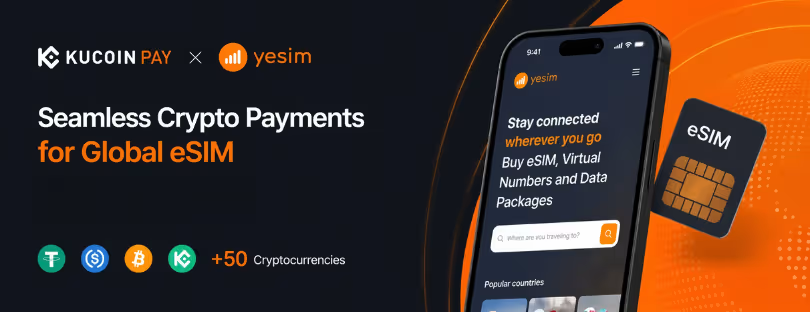
Through this integration, KuCoin Pay users can purchase Yesim’s eSIM data plans and virtual numbers using a wide range of cryptocurrencies. We’re not talking about a niche experiment either. The setup supports major assets like KCS, USDT, USDC, BTC, along with dozens of other digital currencies.
On the surface, it’s a payment option. In practice, it removes one of the last bits of friction in travel connectivity.
No currency exchange.
No card issues abroad.
No dependency on local payment systems.
You land, activate, and you’re online — paid entirely through crypto.
Why Yesim fits this model
This only works because of how Yesim is built.
Unlike traditional telecom operators, Yesim operates as a fully digital, app-first connectivity platform. Its eSIM offering already removes physical SIM cards, retail dependency, and most of the usual onboarding friction. Adding crypto payments feels like a natural extension rather than a boIt-on feature.
The core value proposition stays consistent:
- Coverage in 200+ destinations
- Instant activation via eSIM
- Flexible data plans and virtual numbers
- Strong focus on privacy and user control
That last point matters more than it sounds. Crypto users tend to be privacy-conscious by default. Pairing that mindset with a connectivity provider that emphasizes secure, self-managed access creates a very aligned product experience.
It’s not just about convenience. It’s about control.
The bigger shift: connectivity as a digital service layer
This move highlights something we’ve been seeing more of across the eSIM space.
Connectivity is no longer treated as a standalone telecom product. It’s becoming a layer inside broader digital ecosystems.
We’ve seen this with fintech apps embedding eSIMs. We’ve seen it with travel platforms bundling connectivity into bookings. And now we’re seeing it with crypto platforms turning connectivity into a purchasable utility.
KuCoin Pay is essentially doing what companies like Binance Pay and Crypto.com Pay have been exploring in adjacent verticals — pushing crypto beyond speculation and into everyday usage.
The difference here is the use case. Travel connectivity is one of the few categories where:
- The need is immediate
- The product is digital
- The user is already operating globally
That makes it a perfect fit for crypto payments.
 Real-world use cases

This is where the partnership becomes practical, not theoretical.
A digital nomad landing in Southeast Asia can activate a Yesim plan without touching local currency.
A frequent business traveler can standardize connectivity across markets without dealing with expense claims tied to local operators.
A crypto-native user can stay entirely within their digital asset ecosystem, even when moving across borders.
It’s a small shift in behavior, but a big shift in experience.
Where the market stands today
Let’s be clear: this isn’t the first time crypto and telecom have crossed paths.
Some eSIM providers have experimented with crypto payments before. But most of those integrations have been surface-level. Limited assets, clunky checkout flows, or lack of real scale.
What makes this different is the combination:
- A mature payment infrastructure (KuCoin Pay)
- A global, proven eSIM platform (Yesim)
- A use case that actually makes sense
According to data from GSMA, eSIM adoption continues to accelerate globally, especially among frequent travelers and enterprise users. At the same time, reports from Chainalysis show growing real-world usage of crypto beyond trading, particularly in cross-border scenarios.
This partnership sits right at the intersection of those two trends.
What this means for the industry
For telecom players, this is another reminder that the competitive landscape is shifting.
The battle is no longer just about coverage or pricing. It’s about distribution, integrations, and how easily your service fits into a user’s digital life.
For crypto platforms, it’s a step toward something they’ve been chasing for years: everyday utility. Not just buying and selling assets, but actually using them in meaningful ways.
And for users, it’s one less barrier.
Where Yesim stands out
From an Alertify perspective, this move reinforces something we’ve been tracking for a while.
Yesim isn’t positioning itself as just another travel eSIM provider. It’s moving toward a programmable connectivity model — one that integrates with platforms, APIs, and now payment ecosystems.
That’s a very different trajectory compared to traditional “buy a plan before your trip” competitors.
It opens the door to:
- Embedded connectivity in apps
- B2B integrations through APIs
- Flexible payment models beyond fiat
And now, crypto-native onboarding.
What to watch next
This won’t be the last partnership like this.
Expect more eSIM providers to explore crypto payments. Expect fintech platforms to bundle connectivity. And expect the line between telecom, payments, and digital services to keep blurring.
The question isn’t whether this model will grow. It’s who will execute it best.
Conclusion
What KuCoin Pay and Yesim have launched isn’t just a payment feature. It’s a signal of where the market is heading.
Connectivity is becoming borderless. Payments are becoming digital-first. And users increasingly expect both to work instantly, anywhere, without friction.
Compared to traditional eSIM players still focused purely on pricing or coverage, this kind of integration feels like a step ahead. And compared to crypto platforms still searching for real-world relevance, it’s a clear use case that actually delivers value.
If this model scales, and there’s a good chance it will, we’re looking at the early version of something bigger: connectivity that plugs directly into your digital identity, your wallet, and your way of moving through the world.
That’s where this gets interesting.