
Inside Pangea’s Bet on AI-Powered Travel Discovery
Pangea is making another move. The company, which has been quietly positioning itself as a “social operating system for travel,” just acquired Flaire, an AI-native recommendation engine built around something it calls the Places Genome. It is Pangea’s third acquisition in five months, following Overlap and Nomadago, and it signals a very specific ambition: to fix how travel discovery actually works. AI travel discovery platform
Not with another booking app. Not with another list of “top 10 things to do.” But by rebuilding the layer underneath.
At a time when travel apps are still fragmented, overly transactional, and increasingly flooded with generic AI content, this deal feels less like expansion and more like infrastructure building.
The Real Problem: Discovery Is Broken
Matt Gray, Founder and CEO of Pangea, puts it bluntly:
“People still share travel recommendations through scattered texts and messy shared docs… The result is a fragmented experience where time is wasted repeating the same surface-level research, while great recommendations slip through the cracks.”
That’s the part most platforms never solved. Travel discovery still happens across WhatsApp threads, saved Instagram posts, Google Docs, and half-forgotten bookmarks. The tools exist, but they don’t connect.
Pangea’s bet is that the future of travel isn’t just better search. It’s structured social knowledge.
What Flaire Actually Brings
This is where Flaire comes in.
At the center of the acquisition is its “Places Genome” — a system that maps destinations not by categories or star ratings, but by attributes like vibe, energy, and traveler sentiment. Think less “restaurant, Italian, 4.5 stars” and more “low-key, design-forward, local crowd, good for solo travelers.”
It’s closer to how Spotify recommends music than how traditional travel platforms rank places.
Instead of static filters, Flaire scores locations across qualitative dimensions, then matches them to users based on taste and behavior. That nuance matters. Especially as more travelers reject generic “top attractions” lists in favor of highly personal, experience-driven travel.
Julia Carter, Flaire’s founder, frames it clearly:
“AI has introduced speed and efficiency, but it hasn’t solved for trust. Flaire marries the convenience of AI with the trust of social proof to deliver actionable recommendations.”
That line cuts to the core issue in travel AI today. Speed is solved. Trust isn’t.
From Inspiration to Booking, in One Layer
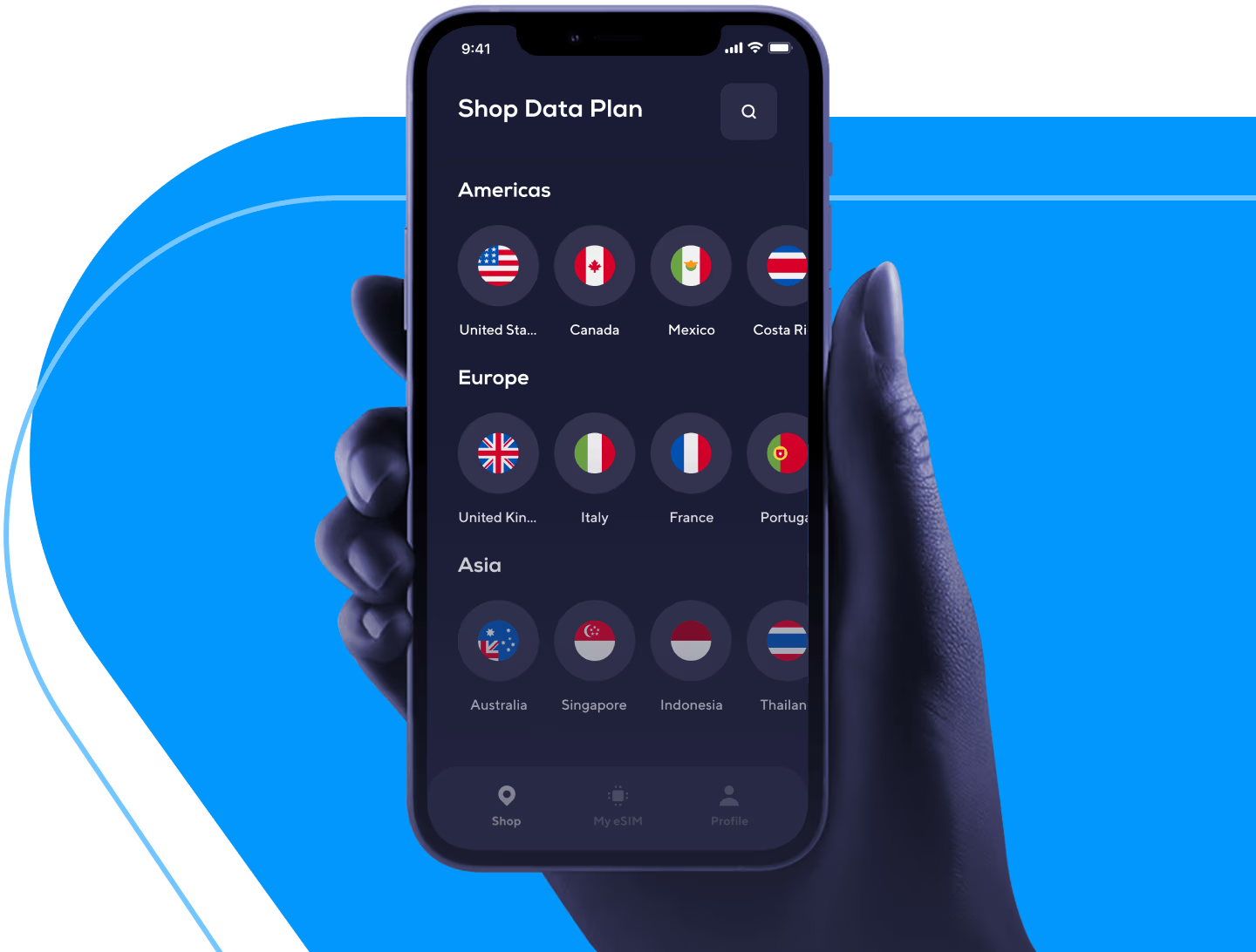
Pangea plans to integrate Flaire into a shared AI recommendation layer that sits across the entire travel journey, from inspiration to planning and eventually into booking.
This is where things get more interesting.
Most travel platforms still treat these stages separately. You discover on Instagram, plan in Google Docs, and book somewhere else. Pangea is trying to collapse that into a single environment, powered by social data and AI interpretation.
They’re calling it an “agentic booking” future. In practice, that likely means systems that don’t just recommend, but act on your behalf based on your preferences.
And importantly, this isn’t being built from scratch. Pangea is using a consolidation strategy, similar to what its leadership team previously executed at ION Group in fintech.
Different industry. Same playbook.
Why Consolidation Might Actually Work Here
Travel has a long history of failed apps. Not because the ideas were bad, but because user behavior was fragmented and expensive to capture.
Pangea is taking a different approach: instead of competing for attention with one product, it’s aggregating existing communities and tools into a single system.
Carter highlights this directly:
“After years of building in this space… I’m convinced that the winning platform will be built by founders who join forces.”
It’s a rare admission in a space usually obsessed with standalone disruption. But it reflects reality. The biggest friction in travel tech isn’t lack of features. It’s lack of integration.
The Bigger Context: AI Is Flooding Travel
There’s another layer here that isn’t explicitly stated, but clearly driving this move.
AI is already reshaping travel discovery. Tools from OpenAI, Google, and others are generating itineraries instantly. The problem is that much of this content is generic, recycled, or detached from real human experience.
That creates a paradox. More information, but less signal.
Flaire’s “Places Genome” is essentially an attempt to solve that by grounding recommendations in real-world behavior and sentiment, not just scraped data.
And that’s where Pangea’s strategy starts to make sense. If AI is commoditizing information, the differentiation shifts to data quality and context.

Where This Leaves the Market
Pangea isn’t alone in trying to fix travel discovery, but its approach is distinct.
Platforms like Tripadvisor still rely heavily on reviews and rankings. Google Maps blends search with user data but remains utility-driven. Social platforms like Instagram dominate inspiration but lack structure.
Meanwhile, newer AI-driven players are emerging, but many are still operating at the surface layer, generating recommendations rather than fundamentally rethinking how they’re built.
What Pangea is doing is deeper. It’s about building a system that unifies social behavior, AI interpretation, and product infrastructure into a single stack.
That’s harder to execute. But if it works, it’s also harder to copy.
The Road Ahead
For now, Flaire will remain a standalone platform while its capabilities are integrated into Pangea’s core system. The focus is on accelerating features around recommendation sharing and discovery, while preserving the existing community data.
That last part matters. In a space where user-generated content is often lost or buried, Pangea is positioning it as a long-term asset.
Conclusion
Pangea’s acquisition of Flaire is not just another travel tech headline. It’s a signal of where the industry is heading.
Travel discovery is shifting away from static lists and into dynamic, personalized systems. AI is accelerating that shift, but it’s also exposing the limitations of generic recommendations.
The companies that win won’t just generate better answers. They’ll build better data layers.
Compared to incumbents like Tripadvisor or Google, Pangea is betting on something more complex: that structured social knowledge, combined with AI, can outperform both search and content.
That’s a bold assumption. But it aligns with broader trends across tech, where personalization, community data, and vertical AI systems are starting to converge.
If nothing else, this move confirms one thing. The next phase of travel tech won’t be about more apps.
It will be about fewer, smarter systems that actually talk to each other.