
Virgin Voyages Launches AI Crew Assistant Rovey
There’s been a quiet problem in travel tech for years. Not a lack of innovation, but a lack of continuity.
You search. You ask questions. You get answers. Then everything resets.
So when Virgin Voyages and Google Cloud unveiled Rovey at Google Cloud Next, it didn’t feel like just another AI launch. It felt like a shift in how travel decisions might actually get made.
Rovey is positioned as the cruise industry’s first AI Crew assistant. But more importantly, it’s the first visible piece of something bigger: Project Ruby, Virgin Voyages’ long-term bet on AI shaping the entire traveler journey, from inspiration to booking to onboard experience.
And that’s where this gets interesting.
Not another chatbot
Let’s be honest about most “AI” in travel today.
You ask a question. The system pulls a pre-written answer from a database. It sounds conversational, but it’s still just search in disguise. No memory. No context. No real progression.
Rovey is trying to break that pattern.
Built using Google’s Gemini models, the Gemini Enterprise Agent Platform, and BigQuery, Rovey isn’t just retrieving answers. It’s designed to guide decisions. That sounds subtle, but it’s a completely different role.
Instead of “What are the best cruises in the Caribbean?”, you get something closer to:
Tell me how you like to travel. Slow or packed itinerary? Food-focused or adventure-heavy? Budget-sensitive or experience-first?
Then it narrows things down with you.
That’s not a query. That’s a conversation with direction.
A personality, not just a prompt box
Virgin Voyages made a deliberate choice here. Rovey isn’t just a tool. It has a name, a tone, and a role inside the brand.
That matters more than it sounds.
Most travel AI feels interchangeable. Same interface, same answers, same slightly robotic friendliness. Rovey is positioned as part of the crew, which subtly shifts expectations. You’re not interacting with “the system.” You’re interacting with someone who’s meant to guide you.
Ask about shore excursions, and it doesn’t just list options. It curates them. Cooking classes, hikes, and catamaran sails, depending on what you’ve already shown interest in.
Ask what to pack for Alaska in May, and it adapts to context. First-time cruiser? Frequent traveler? Different answers.
It starts to feel less like browsing and more like being advised.

From search to decision support
This is the real leap.
Rovey is being positioned as a decision-support system, not a Q&A interface. That means it stays with you through the process instead of restarting every time.
You explore itineraries. It remembers.
You ask about cabins. It adjusts recommendations.
You move toward booking. It guides, instead of handing you off.
That continuity is exactly where most travel platforms break today.
Virgin Voyages’ CEO, Nirmal Saverimuttu, framed it clearly:
“We built Rovey to create a sense of belonging before a Sailor (guest) ever steps on board. When someone feels connected to their voyage that early, it changes how a voyage is booked, experienced and remembered.”
That’s not just a UX improvement. That’s a commercial strategy.
Because the earlier someone feels confident, the faster they book.
Why Google Cloud matters here
This isn’t a lightweight integration.
Google Cloud isn’t just powering responses. It’s providing the infrastructure for scale, data processing, and model capabilities. Virgin Voyages brings the behavioral data, booking logic, and domain expertise.
That combination is what makes Rovey credible.
“We are excited to collaborate with Virgin Voyages and leverage Google Cloud’s leading AI technology to enhance the cruise booking process,” said Sam Sebastian, VP, North America Regions, Google Cloud. “By powering Rovey with our AI tools, Virgin Voyages is able to mitigate booking friction, deliver personalized travel recommendations at scale, and build deeper, more valuable connections with Sailors.”
Translation: this is about conversion, not just experience.
This is just the first layer
Rovey is only the beginning of Project Ruby.
Seven additional AI-driven features are planned, each targeting a specific friction point across the traveler journey. Discovery, booking, pre-trip planning, and eventually onboard interactions.
That roadmap matters more than Rovey itself.
Because one good AI assistant doesn’t change the industry. A fully integrated AI layer across the entire experience might.
And that’s clearly the direction here.
Where this fits in the broader travel AI race
Virgin Voyages isn’t alone.
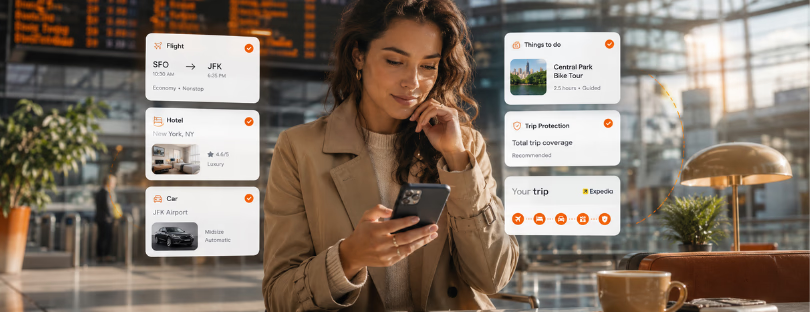
Airlines, OTAs, and fintech travel platforms are all experimenting with AI assistants. Expedia has been pushing conversational trip planning. Booking.com has integrated generative AI into search. Even Airbnb is leaning into AI-driven recommendations.
But most of these still sit at the discovery layer.
Rovey pushes deeper into decision-making and booking, which is where the real value sits.
That’s the gap.
The real takeaway
What Virgin Voyages is building with Rovey isn’t just a smarter chatbot. It’s a preview of how travel interfaces are likely to evolve.
Less search. More guidance.
Less reset. More continuity.
Less browsing. More decision-making.
And here’s the uncomfortable part for the rest of the industry.
Once users get used to this kind of experience, going back to static filters and endless comparison tables will feel outdated very quickly.
The companies that win won’t be the ones with the most destinations or the lowest prices. They’ll be the ones that reduce uncertainty fastest.
Rovey is an early attempt at exactly that.
Not perfect yet. But directionally, very clear.