SK Telecom Boosts Roaming Data Ahead of Summer Travel
South Korea’s SK Telecom is making a familiar but still telling move ahead of peak travel months. As outbound travel demand ramps up for the May holidays and summer season, the operator is expanding data allowances across its roaming portfolio and layering on aggressive discounts to capture younger travelers.
On paper, it looks like a simple promo. In reality, it reflects something bigger happening across the roaming market right now: operators are being forced to compete not just with each other, but with a new generation of eSIM-first providers that have reset user expectations on pricing, flexibility, and transparency.
More data, same price
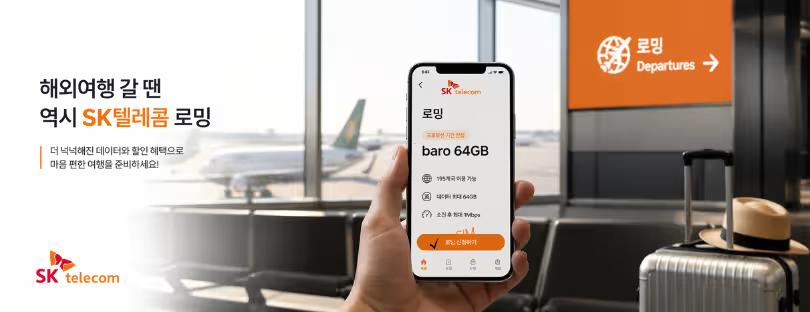
The core of SK Telecom’s campaign is straightforward. Subscribers to its “baro” roaming plans will get significantly more data without paying extra. In some cases, that uplift reaches up to 16GB, depending on the plan.
Two newly introduced high-capacity plans highlight the strategy. The “baro 48GB” and “baro YT 49GB” tiers are temporarily boosted to 64GB and 65GB during the promotional period. Priced at 99,000 won for 30 days, these plans are clearly aimed at heavier users or travelers spending extended time abroad.
There’s also a practical usability tweak that matters more than it sounds: once users exhaust their main data allowance, they can continue browsing at speeds of up to 1Mbps. That’s not fast, but it’s enough for messaging, maps, and basic browsing. In other words, no hard cut-offs. That alone reduces one of the biggest friction points in traditional roaming.
Targeting younger travelers
SK Telecom is being very deliberate about who this campaign is for.
The “baro YT” plans are specifically tailored for users aged 34 and under, and the headline promotion is a “first roaming 70% discount” for customers in their 20s and 30s who haven’t used T Roaming in the past three years. Eligible users can access one roaming plan at a steep discount, effectively removing the initial barrier to trying the service.
This is not random segmentation. Younger travelers are the exact group most likely to default to alternatives like Airalo, Nomad eSIM, or Holafly without even considering their home operator. They are also the least tolerant of unclear pricing or rigid packages.
By offering a one-time deep discount, SK Telecom is trying to get back into that consideration set.
Family and shared usage
Another layer of the offer is “Family Roaming,” which allows up to five users to share a data pool for a small additional fee. This reflects a broader trend in telecom: bundling and pooling data to create perceived value, especially for group travel.
It’s a smart move, but also a defensive one. Shared data is something eSIM providers have been experimenting with more flexibly, especially in app-based ecosystems where managing multiple users is easier than in traditional telco environments.
Scale still matters
Despite the competitive pressure, SK Telecom still has one clear advantage: scale.
The company reports that cumulative users of its baro plans have surpassed 15.67 million, with coverage spanning 195 countries. That kind of footprint is not trivial. It gives the operator reliability, established roaming agreements, and a level of trust that newer players are still building.
For many travelers, especially less tech-savvy ones, that familiarity still carries weight.
The bigger shift in roaming
Zoom out, and this move fits into a much larger pattern.
According to industry reporting from sources like Telecompaper and GSMA Intelligence, roaming demand has rebounded strongly post-pandemic, but user behavior has changed. Travelers are more cost-aware, more informed, and far more willing to switch providers.
That’s where traditional operators are under pressure.
eSIM providers have introduced:
Instant activation without visiting a store
Transparent pricing per GB or per day
Flexible validity models
Global or regional plans that often undercut roaming bundles
Operators like SK Telecom are responding by increasing allowances, softening overage penalties, and experimenting with targeted discounts. But structurally, their models are still tied to legacy roaming agreements and pricing frameworks.
Where this leaves travelers
For users, this is ultimately good news.
More data at the same price, softer speed throttling instead of hard stops, and aggressive entry discounts all point to one thing: competition is working.
But the decision is no longer obvious.
If you’re a frequent traveler who values simplicity and integration with your existing number, a telco roaming plan like SK Telecom’s can make sense, especially with promotions like this.
If you prioritize flexibility, control, and often lower costs, eSIM providers still have the edge.
Conclusion: a defensive move, but a necessary one
What SK Telecom is doing here is not groundbreaking. It’s reactive. But it’s also necessary.
The roaming market is no longer controlled by operators alone. It’s being reshaped by eSIM-native players that treat connectivity as a digital product, not a network add-on.
Compared to providers like Airalo or Yesim, SK Telecom’s plans still feel more structured and less flexible. Compared to newer models like subscription-based unlimited offerings from players such as Fairplay, they lack predictability at scale.
But they are closing the gap.
And that’s the real takeaway. Operators are no longer competing on coverage alone. They’re being pushed to rethink pricing, user experience, and even how roaming is packaged.
For travelers, that means better options across the board. For the industry, it signals something bigger: roaming is slowly turning from a legacy revenue stream into a competitive product category in its own right.
Driven by wanderlust and a passion for tech, Sandra is the creative force behind Alertify. Love for exploration and discovery is what sparked the idea for Alertify, a product that likely combines Sandra’s technological expertise with the desire to simplify or enhance travel experiences in some way.