One Hungary Faces Investigation Over Automatic Roaming Charges
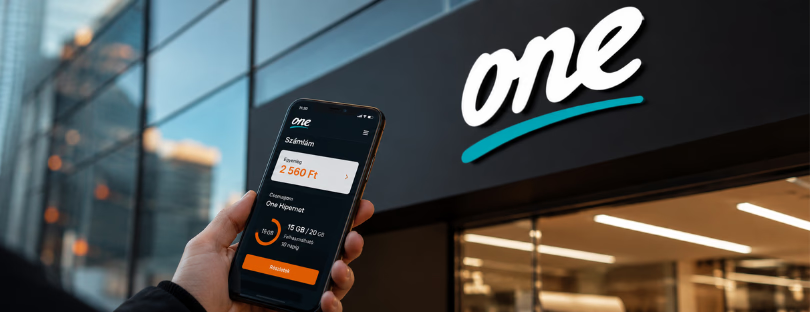
Hungary’s competition authority has opened a formal investigation into One Hungary over the way it marketed and activated its Világ Napijegy, or World Daily Ticket, roamingservice.
At first glance, this may look like another local telecom compliance case. But it touches a much bigger issue in European roaming: what happens when a roaming product is technically useful, commercially convenient, but not clearly understood by the customer before charges appear?
The Hungarian Competition Authority, GVH, said it has launched competition supervision proceedings against One Hungary because the company’s commercial communication around Világ Napijegy may have misled consumers. According to the authority, the information provided about the service may have been unclear, partly contradictory, and insufficient on key features, including the possibility that the service could activate automatically for some subscribers.
The Problem Is Not the Day Pass Itself
Roaming day passes are not unusual. In fact, they have become one of the standard answers to a difficult commercial problem: how do operators offer predictable roaming outside the EU, where “roam like at home” rules do not apply in the same way?
For customers travelling beyond the EU, a daily roaming pass can be attractive. Instead of paying unpredictable per-megabyte or per-minute rates, they get a cleaner structure: use the phone abroad, pay a daily fee, and avoid the classic roaming bill shock.
That is the theory.
The GVH investigation is focused on whether One Hungary made the activation mechanics and costs clear enough. The authority specifically says it is examining whether consumers could recognise that Világ Napijegy may automatically activate under certain subscription contracts, and whether using mobile services abroad after that activation would create a charge, including the scale of that payment obligation.
That distinction matters. A day pass that a customer deliberately turns on is one thing. A day pass that activates because the customer receives a call, uses data, sends an SMS, or connects while abroad can feel very different, especially if the customer did not understand the trigger.
Outside the EU Is Still the Danger Zone
This case also shows why non-EU roaming remains one of the most sensitive areas in telecom pricing.
Inside the EU, roaming is largely understood by consumers as “roam like at home”. The European Commission explains that travellers within the EU can use calls, SMS and data at domestic rates, subject to fair-use rules. But once a customer leaves that regulated environment, the experience changes quickly. Prices depend on operator agreements, destination zones, wholesale costs, bundles, caps and product design.
That is where communication becomes critical.
One Hungary’s own information pages says the Világ Napijegy is billed when the customer uses the phone abroad, including making or receiving calls, sending SMS or using data. It also states that once activated, the service remains active until cancelled. For a telecom expert, that may be understandable. For an ordinary traveller landing outside the EU, it may be much less obvious.
And that is exactly the grey area regulators increasingly care about: not whether a product exists, but whether the customer really knows what will happen before the cost is triggered.
A Wider Roaming Transparency Trend
The GVH also stressed that opening proceedings does not mean One Hungary has infringed. The process is meant to clarify the facts and prove, or disprove, the suspected violation. The authority said the investigation period is three months, with possible extensions.
Still, the direction of travel is clear. Roaming regulation has moved beyond headline prices. The new battlefield is transparency, consent and customer control.
BEREC, the Body of European Regulators for Electronic Communications, has long treated transparency and bill-shock prevention as central parts of roaming supervision. In EU roaming rules, operators are expected to provide information and consumption safeguards so customers are not surprised by charges they did not understand.
That pressure is not limited to Hungary. Across Europe, operators are under growing scrutiny when paid services are bundled, pre-set, automatically enabled, renewed, or triggered by behaviour the user may not recognise as chargeable. Roaming is especially exposed because customers often discover the problem only after the trip, when the bill arrives.
Conclusion One Hungary roaming
The One Hungary case is not really about whether roaming day passes are good or bad. They can be useful. In many markets, they still a better customer experience than raw pay-per-use roaming outside the EU.
The real issue is consent.
Telecom operators, travel eSIM brands and roaming providers are all trying to solve the same problem: making international connectivity predictable. But the market is splitting into two models. Traditional operators often rely on tariff zones, daily passes and automatic network behaviour. Travel eSIM providers usually push a more explicit prepaid model, where the customer buys a package before use. Neither model is perfect. Operator roaming is convenient because it works through the existing SIM. eSIMs are clearer because the purchase is usually intentional.
That is why this investigation matters beyond Hungary. The future of roaming will not only be judged by price per gigabyte. It will be judged by whether the customer understands the moment of activation, the cost trigger and the alternative before the charge happens. In 2026, “it was in the tariff details” is no longer enough. For roaming products, clarity is becoming part of the product itself.