TCA Defines First Lifecycle Framework for SIM & eSIM
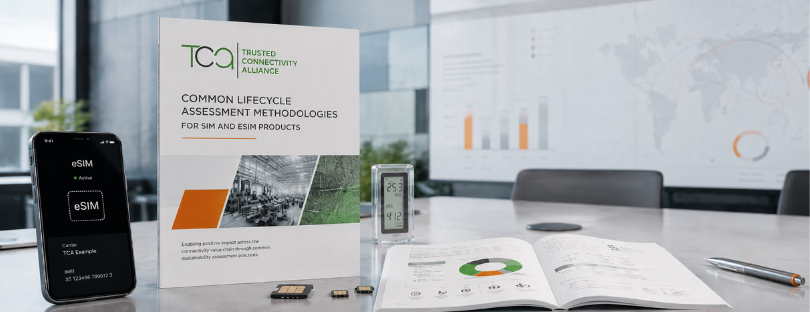
Trusted Connectivity Alliance has published common lifecycle assessment methodologies for SIM and eSIM products, a move that may sound technical at first, but actually matters quite a lot for the connectivity industry.
Why? Because sustainability claims in telecoms have a comparison problem.
For years, operators, device makers and SIM suppliers have been under pressure to reduce plastic, cut emissions and report environmental progress more clearly. But when every company measures impact slightly differently, the result is messy. One supplier talks about recycled material. Another highlights smaller packaging. Another focuses on eSIM as a digital alternative. All of that can be useful, but without a shared methodology, buyers are often left trying to compare claims that were never measured in the same way.
TCA says its new methodologies are intended to give mobile operators, connectivity providers, device manufacturers and SIM suppliers a common basis for assessing the environmental impact of SIM and eSIM products. The framework was developed with SE Advisory Services, Schneider Electric’s consulting practice, and is guided by principles from the European Union’s Product Environmental Footprint Method.
Cradle to grave
The important phrase here is “cradle to grave”.
TCA’s approach does not only look at what happens inside a factory. It covers raw material extraction, processing, distribution, storage, use, and disposal or recycling. In other words, the whole lifecycle.
That matters because the environmental footprint of a SIM product is not only about the tiny piece of plastic that reaches the customer. It also includes materials, transport, packaging, logistics, warehousing, and what happens after the product has served its purpose.
READ MORE: Travel eSIMs vs Local SIM Cards: Real Prices, Real Scenarios
For physical SIM cards, this gives the industry a more complete way to understand the impact of material choices and card formats. For eSIM, it may help bring more discipline to a space where “digital” is often automatically treated as “greener”, even though the full environmental story is more complex.
And TCA is being careful here. The methodologies are not designed to directly compare SIM and eSIM products, either from the same manufacturer or across different manufacturers. That boundary is important. This is not a ranking tool. It is a measurement framework.
“As the connectivity industry continues to advance sustainability initiatives, the release of the TCA methodologies marks an important step forward – establishing a consistent and credible framework for assessing environmental impact that stands to promote increased trust and transparency throughout global value chains,”
said Frédéric Moreira, chair of the TCA Sustainability Working Group.
Guido Abate, chair of the TCA Board, added:
“As a global industry association comprising the world’s leading SIM and eSIM providers, TCA has a proven record built over decades of promoting interoperability. Applying this expertise and experience to developing common lifecycle assessments will help to support more sustainable solutions and practices across the connectivity ecosystem.”
Why this matters now
The timing is not accidental.
Telecoms companies are now expected to show measurable climate progress, not just publish good-looking sustainability reports. The GSMA says its Climate Action Taskforce includes operators representing around 80% of mobile connections, with members working toward net zero goals across more than 150 countries and territories.
That pressure increasingly reaches suppliers. Operators cannot talk seriously about Scope 3 emissions and circularity while ignoring what happens inside their procurement chains. SIM products may be small, but the volumes are huge, and that makes standardisation meaningful.
READ MORE: From SIM Cards to Service Desks: The Hidden Battle in the eSIM Industry
TCA’s own market monitoring shows how quickly the physical SIM side is changing. According to the association, 45% of all SIM volumes reported by members were in the half-SIM format, up from 37% in 2024. In Europe, more than 40% of SIM volumes were manufactured using eco-friendly raw materials. TCA also reported movement in the Middle East and Africa, where SIMs made with eco-friendly raw materials more than doubled, while half-SIM shipments rose 40%.
That tells us something useful. The physical SIM is not disappearing quietly. It is being redesigned, reduced, and repositioned for a market where buyers increasingly ask: what is the footprint, where is the evidence, and can we trust the claim?
The eSIM angle
For the eSIM market, this is also a useful reality check.
Consumer eSIM providers often present eSIM as the obvious sustainable alternative because there is no plastic card, no shipping envelope, and no physical retail distribution. That is a fair point, especially in travel connectivity, where instant digital delivery is one of the strongest advantages.
But sustainability in eSIM should not stop at “no plastic”. There are still platforms, data centres, device processes, profile management systems, customer support flows and lifecycle operations behind the service. The environmental impact is different, not magically zero.
READ MORE: Why Smart Luxury Travelers Prefer eSIMs Over SIM Cards
This is where TCA’s move is smart. It brings the conversation away from marketing shortcuts and closer to structured assessment. That is good for operators. It is good for suppliers. And it is especially good for buyers who need credible information rather than polished sustainability language.
Conclusion
The biggest shift here is not that SIM and eSIM products now have another technical document attached to them. The real shift is that sustainability in connectivity is becoming more measurable, and therefore more accountable.
This mirrors what is already happening across the wider telecoms market. GSMA is pushing climate action at the operator level. Schneider Electric and other sustainability consultancies are pushing lifecycle-based environmental data. Operators are asking suppliers for clearer reporting. Meanwhile, eSIM companies are selling a cleaner, more digital experience, but will increasingly need to support that story with evidence, not assumptions.
For Alertify readers, the takeaway is simple: sustainability is becoming part of product credibility. In travel eSIM, enterprise eSIM, IoT connectivity and traditional SIM supply, the winners will not only be those who claim to be greener. They will be the ones who can explain how they measured it, where the boundaries are, and why the buyer should trust the data.