Xiaomi 17T Series: Big Battery, Leica, eSIM
Xiaomi’s new 17T Series arrives with the usual smartphone launch ingredients: bigger batteries, brighter screens, Leica branding, and faster chips. But for travel tech readers, the more interesting story sits in a quieter part of the spec sheet: connectivity.
The Xiaomi 17T and 17T Pro launch in Hong Kong from May 29, with local pricing listed from HK$3,999 for the 17T and up to HK$5,999 for the 17T Pro. Xiaomi’s angle is clear. It wants the 17T Series to look like a creator’s phone, last like a power user’s phone, and travel like a phone that does not need babysitting.
The eSIM angle
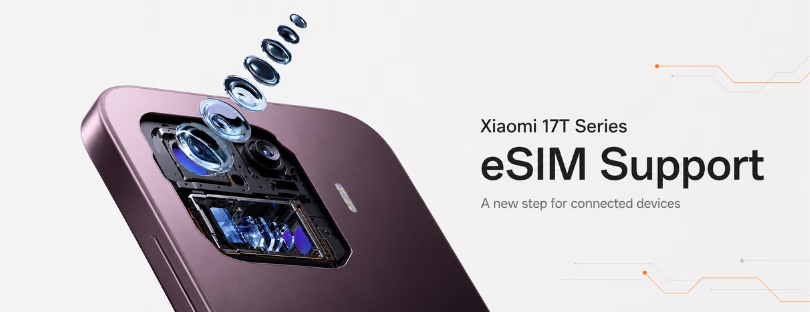
The most important travel feature here is not the Leica telephoto lens. It is the SIM setup. The Xiaomi 17T Series supports dual SIM configurations, including nano SIM plus nano SIM, nano SIM plus eSIM, or eSIM plus eSIM. That turns the phone into a more flexible connectivity tool.
A few years ago, eSIM support was a nice extra. Now it is part of the buying decision. Travellers want to land, scan, activate, and keep moving. They do not want to hunt for a kiosk or spend the first hour in a new city comparing local prepaid plans.
READ MORE: Xiaomi Watch S5 Revealed With Optional eSIM and 21-Day Battery
Dual eSIM support is especially useful. A traveller can keep one eSIM for a main line or business number and another for a temporary travel data plan. It also helps people who switch plans between countries or keep one plan active for messaging while using another for cheaper data.
There is another practical point. The 17T Series covers a wide range of 5G and 4G bands across major regions. Band support is not glamorous, but it determines whether a travel eSIM performs well or feels like a broken promise.
Built for long days
The other travel-friendly upgrade is battery life. Xiaomi says the 17T Pro carries a 7,000mAh silicon-carbon battery, the largest battery in its international smartphone lineup, while the standard 17T gets 6,500mAh. For travellers, battery is freedom: maps, boarding passes, ride-hailing, translation, mobile payments, hotspot sharing, and camera use all live on the same percentage bar.
The Pro also brings 100W wired charging and 50W wireless charging. The standard model supports 67W wired fast charging. In real travel situations, you often charge in short windows: between meetings, at an airport lounge, or before heading back out at night.
Xiaomi has paired those batteries with MediaTek chips: Dimensity 9500 on the Pro and Dimensity 8500-Ultra on the standard model. These phones are designed for heavy use, not just casual scrolling.
Leica sells the story
Camera remains the emotional hook. Both models include Leica Summilux optics, a 50MP main camera, a 50MP 5x telephoto lens with optical image stabilisation, a 12MP ultra-wide camera, and a 32MP front camera. Xiaomi is making a point by giving both models the 5x Leica telephoto lens, instead of reserving it only for the Pro.
That is smart. Travel photography is not only about wide city shots and food photos. A proper telephoto lens helps with street details, architecture, concerts, landscapes, and moments you simply cannot walk closer to. Xiaomi’s Leica Live Moment feature also follows the broader smartphone trend toward motion-based memories, bridging photo, short video, and social-ready capture.
Still, Leica branding is powerful, but not magic. Apple, Samsung, Google, Vivo, and Oppo have trained consumers to expect computational photography that works instantly. Xiaomi’s challenge is not only hardware. It has to make the full camera experience feel consistent, fast, and trustworthy.
The wider market signal
The Xiaomi 17T Series says something useful about where smartphones are going. Mid-premium phones are no longer just cheaper flagships with one or two compromises. They are becoming travel devices, creator tools, AI assistants, and connectivity hubs at the same time.
READ MORE: Airalo eSIM Integration on Xiaomi Phones Redefines Travel Connectivity
Compared with Samsung’s Galaxy S FE line, Xiaomi is pushing harder on battery and charging. Compared with Google’s Pixel A series, it leans more into hardware muscle and Leica imaging than computational simplicity. Compared with OnePlus, it looks more balanced for travel because of the camera range, battery size, and eSIM flexibility. Apple still owns one of the smoothest eSIM experiences, but Xiaomi is closing the practical gap for Android travellers.
For the eSIM industry, this matters. The more phones support flexible eSIM setups, the easier it becomes for travel eSIM providers, airlines, banks, hotels, and booking platforms to sell connectivity at the right moment.
Final thoughts
The Xiaomi 17T Series is not interesting because it has one headline feature. It is interesting because the whole package fits how people actually travel now. A big battery keeps the day alive. A strong camera turns the trip into content. Wide 5G support improves the odds of a decent connection. Dual eSIM support makes mobile data less dependent on roaming fees or airport SIM counters.
That combination is where the smartphone market is heading. The best travel phone is no longer just the one with the nicest camera. It is the one that reduces friction from the moment you land. Xiaomi seems to understand that. And for eSIM providers, that is the real signal: the phone is becoming the storefront for travel connectivity.