What happens between ‘Buy eSIM’ and ‘Connected’ (step-by-step breakdown)
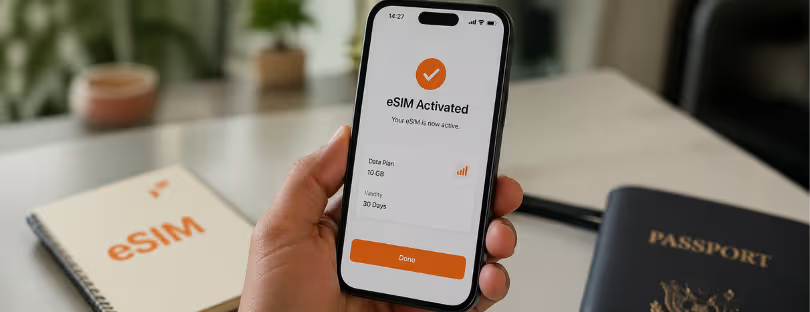
You tap “Buy eSIM.”
Two minutes later, your phone says “Connected.”
From the outside, it feels almost suspiciously simple. No SIM tray, no waiting, no friction. But behind that one tap is a surprisingly complex chain of infrastructure, protocols, and real-time decisions that most users never see. how esim activation works
And that gap — between purchase and connection — is exactly where the real eSIM industry lives.
Let’s walk through it properly.
The moment after you pay
The second your payment goes through, something important happens that most users don’t realize:
You’re not just “buying data.”
You’re being assigned a digital identity on a mobile network.
At that moment, the provider either:
- Allocates you a pre-generated eSIM profile
- Or triggers the creation of a new one tied to your device
This profile contains everything needed to connect:
- Network credentials
- Authentication keys
- Carrier routing rules
And crucially, it gets stored on something called an SM-DP+ server.
That’s where the real process begins.
The invisible infrastructure kickstarts
Before your phone even does anything, backend systems are already moving.
What’s happening in the background:
- The provider checks your plan (country, duration, data limits)
- It selects the right network partners (roaming agreements)
- It prepares your eSIM profile on a secure server
That server — the SM-DP+ (Subscription Manager Data Preparation) — is essentially the “warehouse” where your eSIM lives before installation.
Think of it like this:
You didn’t download the eSIM yet.
You just reserved it.
And your phone still has no idea it exists.

The QR code is not just a QR code
When you receive a QR code (or activation link), you’re not getting the eSIM itself.
You’re getting instructions.
Inside that QR code:
- SM-DP+ server address
- Activation code
- Sometimes confirmation credentials
When you scan it, your phone now knows where to go and what to ask for.
That’s the turning point.
Your device becomes active in the process.
Your device starts the conversation
Once you scan the QR code or tap install, your phone initiates what’s called the LPA flow (Local Profile Assistant).
In simple terms:
Your device says:
“Hey, I’ve got this activation code — give me the profile.”
Here’s what happens step by step:
The network handshake most people miss
This is the part that determines whether your experience is smooth… or frustrating.
Once the profile is installed:
Your phone still needs to authenticate with a real mobile network.
Here’s what happens:
- The device scans available networks
- It selects one based on the eSIM profile
- It sends authentication credentials
- The network verifies them
If everything aligns:
You’re connected.
If not:
You get the classic “No Service” moment.
Why some eSIMs connect instantly (and others don’t)
From the user side, this feels random.
From the industry side, it’s very predictable.
Connection speed depends on:
Better providers have stronger, direct roaming deals.
Weak ones rely on intermediaries.
Some profiles prioritize faster network selection.
Others cycle through networks slowly.
Providers with their own SM-DP+ or core integrations move faster.
Resellers depend on third-party latency.
This is why two “identical” eSIM plans can behave completely differently in the real world.
The moment you finally see “Connected”
When your phone shows signal bars, a lot has already happened:
- Profile securely delivered
- Installed into eUICC
- Authenticated with a network
- Data session established
All of that in under a minute.
And yet, most users think:
“I just scanned a QR code.”
What most providers don’t tell you
The biggest misconception in the eSIM market is this:
Providers are not all doing the same thing.
Many don’t actually control:
- The SM-DP+ infrastructure
- The network agreements
- The provisioning logic
They’re sitting on top of someone else’s stack.
Which means:
That smooth “Buy → Connected” experience is often borrowed, not built.
Why this step matters more than pricing
Here’s the uncomfortable truth:
The real product is not the data plan.
It’s the activation experience.
Because:
- If activation fails, the product doesn’t exist
- If the connection is slow, the user blames the provider
- If switching networks is unstable, trust disappears
This is where serious players differentiate.
And where most budget providers quietly fall apart.
What’s changing in this process right now
The industry is actively trying to remove friction between purchase and connection.
New activation methods are emerging:
- One-click installs (no QR)
- In-app provisioning
- Apple Universal Links
- EID-based push activation
The direction is clear:
The QR code itself is becoming outdated.
The goal is:
Zero steps between buying and being online.

Where this puts different players in the market
This is where things get interesting.
If you compare major approaches:
- Airalo-style aggregators → fast onboarding, but dependent on third-party infrastructure
- Holafly-style unlimited players → simplified UX, less transparency on backend routing
- Yesim / API-first providers → stronger control over provisioning logic
- Infrastructure-led players (MVNEs, SM-DP+ owners) → full control, but less visible to users
And then you have emerging models like:
- Subscription-based connectivity (more persistent identity)
- Always-on eSIM architectures
- Embedded connectivity inside apps, banks, and travel platforms
The activation flow is becoming the battleground.
Not the pricing page.
Bottom line how esim activation works
The gap between “Buy eSIM” and “Connected” is not a technical detail.
It’s the entire product.
What looks like a simple QR scan is actually:
A chain of infrastructure decisions, partnerships, and protocols working in real time.
And this is where the market is quietly splitting in two directions:
- Frontend brands optimizing for simplicity
- Backend players controlling the real experience
Reliable sources like GSMA architecture frameworks, Android’s eUICC documentation, and infrastructure providers all point to the same conclusion:
The value is moving deeper into the stack. how esim activation works
If you’re just comparing prices, you’re missing the point.
The real question is:
Who actually controls what happens in those 30 seconds after you click “Buy”?