And that’s exactly where things are starting to go wrong again.
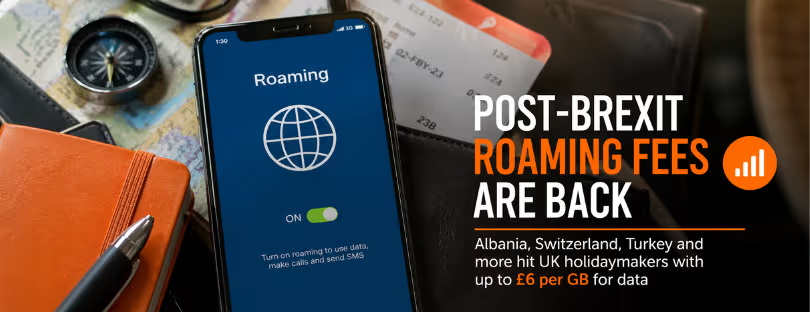
A growing number of destinations, including Albania, Switzerland, and Turkey, are quietly reintroducing the kind of bill shock many thought disappeared years ago. For UK travellers in particular, the shift is becoming more noticeable each season, with reports of data costs climbing to around £6 per GB or more in certain scenarios.
It feels like a throwback. But it isn’t. It’s the new reality of post-Brexit roaming.
The Post-Brexit Reset
Before 2021, UK travellers benefited from the EU’s “Roam Like At Home” rule. You could land in Paris or Rome and use your phone exactly as you would at home. No second thoughts.
That protection is now gone.
Since Brexit, UK users are no longer guaranteed free roaming across EU or EEA countries, and operators are free to reintroduce charges depending on their pricing strategy.
Some networks held off at first. Competitive pressure kept prices low. But gradually, the model has shifted. Daily roaming passes, fair usage caps, and hidden restrictions are now standard.
And outside the EU? It gets worse.
Why Albania Is the Perfect Trap
Albania is a textbook example of how expectations don’t match reality.
Geographically, it feels like Europe. Politically and from a telecom perspective, it’s not part of the EU roaming zone.
That means the “Roam Like At Home” policy simply doesn’t apply.
The result is predictable. Travellers arrive assuming their data works as usual, only to find themselves paying premium roaming rates. In extreme cases, operators can charge several euros per megabyte, turning casual usage into a €20–€50 daily mistake.
Turkey and Switzerland fall into a similar category. Popular destinations. Not covered. Easy to misunderstand.
This is less about pricing and more about perception.
The Real Cost of “Convenience”
On paper, roaming doesn’t always look expensive anymore. Many UK networks now offer daily passes around £2–£3 for EU usage.
That sounds reasonable.
But there are three problems:
It’s no longer universal
It often comes with data caps
And it usually excludes nearby non-EU destinations
Step outside those boundaries, and the pricing model changes fast. In some cases, standard roaming rates can still reach extreme levels, especially outside regulated zones.
So what travellers are really paying for is predictability. And increasingly, they’re not getting it.
A Fragmented Roaming Map
The European roaming landscape today is surprisingly fragmented.
Inside the EU and EEA, things still work as intended. No extra fees, same allowances, regulated pricing.
But once you cross that invisible border, everything changes.
Albania: not included
Switzerland: not included
Turkey: not included
UK users in the EU: not guaranteed coverage
That’s four different rule sets in what most people would consider “one region.”
Even within the EU, policies vary by operator. Some still offer free roaming, others charge daily access fees, and almost all apply fair usage limits.
This is no longer a unified market. It’s a patchwork.
The Industry Knows This Is a Problem
Interestingly, regulators are already trying to fix it.
The European Commission has started discussions to extend “Roam Like At Home” to Western Balkan countries, including Albania.
If implemented, it would remove one of the biggest blind spots in the current system.
But that’s not immediate. And until it happens, travellers are stuck navigating a confusing mix of rules, pricing tiers, and exceptions.
These alternatives aren’t new. What’s changed is why people are using them.
It’s no longer about saving a few euros. It’s about avoiding uncertainty.
And that’s a much stronger motivator.
The Bigger Shift: From Roaming to Direct Connectivity
If you zoom out, this isn’t just a pricing story. It’s a structural shift.
Roaming is fundamentally a legacy model. You’re paying your home operator to access someone else’s network, with multiple layers of agreements and markups in between.
That worked when there were no alternatives.
Today, there are.
eSIMs, local data plans, and regional connectivity providers are effectively bypassing the roaming system altogether. Instead of “borrowing” a network, users connect directly to it, often at a fraction of the cost and with far more transparency.
That’s why you’re seeing such rapid adoption, especially among frequent travellers and digital-first users.
Conclusion: The Illusion of Europe as One Roaming Zone
The biggest mistake travellers still make is assuming Europe is a single, unified connectivity market.
It isn’t.
What we’re seeing now is the slow unraveling of that perception. Brexit accelerated it for UK users, but the underlying fragmentation was always there, just hidden behind regulation.
Compare this with the direction of the industry. eSIM providers are building borderless, region-based plans. Tech companies are embedding connectivity directly into their platforms. Even regulators are trying to expand unified zones.
In other words, the market is moving toward simplicity.
Roaming, ironically, is moving in the opposite direction.
And that’s why stories like this keep happening.
Not because prices are shocking, but because expectations are outdated.
The real takeaway isn’t “roaming is expensive again.” It’s that roaming is becoming irrelevant for anyone who understands the new connectivity stack.
Driven by wanderlust and a passion for tech, Sandra is the creative force behind Alertify. Love for exploration and discovery is what sparked the idea for Alertify, a product that likely combines Sandra’s technological expertise with the desire to simplify or enhance travel experiences in some way.