Would Anyone Notice If Your eSIM Disappeared?
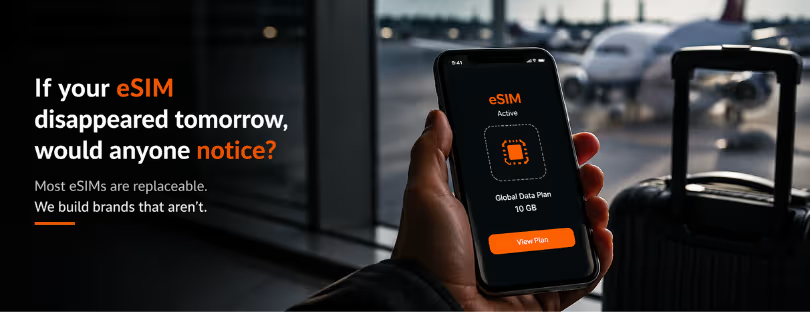
The uncomfortable question nobody in eSIM wants to ask: If your eSIM disappeared tomorrow, would anyone actually notice?
Not your team. Not your investors. Not your dashboard.
Your users.
Would they feel it?
Or would they just… download another app, buy another plan, and move on without a second thought?
That’s the question most eSIM providers avoid. Because the answer is usually brutal.
And also very fixable.
The illusion of “working product = winning product”
Let’s be honest. Most eSIMs work.
They connect.
They deliver data.
They more or less do what they promise.
From a product perspective, the industry has matured fast. Reliability is no longer the bottleneck. Coverage is no longer a differentiator. Even pricing has started to converge.
So what happens?
Everything starts to look the same.
And when everything looks the same, users don’t choose. They switch.
That’s the real problem.
Not that your product doesn’t work.
But that it doesn’t matter enough.
Nobody remembers “fine”
Think about the last time you used an eSIM while traveling.
Did you remember the brand after the trip?
Did you recommend it to a friend?
Did you feel any reason to come back?
Or was it just… fine?
That “fine” is where most providers live. And it’s dangerous.
Because “fine” doesn’t create memory.
“Fine” doesn’t create loyalty.
“Fine” doesn’t create growth.
It creates silence.
And silence is the biggest signal you’re being replaced.
The invisible churn problem
Here’s what most teams miss.
They track:
- Activations
- Data usage
- Revenue per user
What they don’t track properly is emotional connection.
Because churn in eSIM isn’t loud.
Users don’t cancel subscriptions dramatically.
They don’t complain.
They don’t write angry emails.
They just don’t come back.
And worse, they don’t even remember who they used.
That’s not churn. That’s erasure.
If your brand disappears from someone’s memory the moment their trip ends, you’re not building a business. You’re renting attention.
The commodity trap
The eSIM market is heading into a classic commodity cycle.
More providers are entering.
More aggregators are offering the same inventory.
More price competition.
So what do most companies do?
They double down on:
- More plans
- More countries
- More pricing variations
But here’s the truth:
More options don’t create differentiation.
They create confusion.
And in confusion, users default to whatever is easiest, cheapest, or most visible.
Not necessarily you.

Coverage maps don’t build brands
Look at most eSIM websites.
What do you see?
- Coverage maps
- Data bundles
- Technical explanations
- “How it works” guides
All useful. All necessary.
None of it is memorable.
Coverage maps don’t create preference.
Features don’t create attachment.
Technical clarity doesn’t create desire.
You’re explaining the product. But you’re not giving anyone a reason to care.
And if nobody cares, nobody notices when you’re gone.
What actually makes users notice
So what would make someone notice if your eSIM disappeared?
Not features.
Not pricing.
Not even performance, unless it’s dramatically better.
Its identity.
People notice when something they identify with disappears.
A brand that:
- Solves a specific anxiety
- Speaks their language
- Feels designed for them
- Becomes part of their travel routine
That’s when absence becomes noticeable.
That’s when switching feels like a downgrade, not just an alternative.
The difference between utility and preference
Most eSIMs today are utilities.
You buy them when needed.
You use them.
You forget them.
What you want is preference.
Preference means:
- “I always use this one.”
- “I trust this one.”
- “I recommend this one.”
That shift doesn’t happen at the product level alone.
It happens at the brand level.
Because preference is emotional before it’s rational.
The five-second problem
Here’s another uncomfortable reality.
Most users decide whether they trust your eSIM in under five seconds.
They land on your site or app and instantly ask:
- Do I get this?
- Is this for me?
- Can I trust this?
If the answer isn’t obvious, they leave.
Not because your product is bad.
But because your positioning is unclear.
And unclear positioning is the fastest way to become forgettable.

Standing for something (finally)
Let’s simplify this.
If your eSIM disappeared tomorrow, users would notice if:
- You removed the stress they actually feel
- You made decisions easier, not harder
- You had a clear, distinct point of view
- You owned a specific use case better than anyone else
Not “global travelers.”
Not “everyone who needs data.”
That’s not a segment. That’s everyone. Which means it’s no one.
The brands that win in this market are starting to focus:
- Heavy data users who hate throttling
- Business travelers who need predictability
- Digital nomads who want one setup, not ten
That’s where memorability starts.
Because specificity creates relevance.
The myth of “we’ll fix it with performance”
A lot of teams believe:
“If our network is better, users will stay.”
It sounds logical. It’s also incomplete.
Because users don’t benchmark networks in real time.
They don’t run speed tests across providers mid-trip.
They experience:
- Was it smooth?
- Did it work when I needed it?
- Did I feel in control?
Beyond that, performance differences are rarely strong enough to build loyalty on their own.
So if your only edge is “we’re slightly better technically,” you’re still replaceable.
The recommendation test
Here’s the simplest way to test your brand.
Would your users recommend you without being asked?
Not incentivized. Not prompted. Not reminded.
Just naturally.
If the answer is no, you don’t have a brand problem.
You have a meaning problem.
Because people recommend things that:
- Make them look smart
- Solve real problems
- Feel worth talking about
If your eSIM doesn’t do that, it stays silent.
And silence doesn’t scale.

The real growth bottleneck
This is where everything connects.
Most eSIM companies think their bottleneck is:
- Distribution
- Partnerships
- Pricing
But the real bottleneck is this:
You’re not being chosen twice.
Acquisition might work.
But retention, recall, and recommendation don’t.
And that’s why growth feels harder than it should in a growing market.
Because you’re constantly starting from zero.
What changes when you become unignorable
When you get this right, everything shifts.
Users don’t just buy. They return.
They don’t just use. They recommend.
They don’t just compare. They prefer.
Your brand becomes:
- A shortcut decision
- A trusted default
- A recognizable name in a crowded space
That’s when disappearing becomes impossible.
Because you’re no longer just an option.
You’re the option.
Where this leaves you
So go back to the question.
If your eSIM disappeared tomorrow, would anyone notice?
If the answer makes you uncomfortable, good.
That’s where real positioning starts.
Because the goal isn’t just to exist in the market.
It’s to matter in it.
And that doesn’t come from adding more features, more plans, or more countries.
It comes from building something people remember, trust, and talk about.
Something they would actually miss.
That’s the difference between a working product and a lasting brand.
And that’s exactly where most eSIM companies need help.
Not fixing the technology. eSIM brand differentiation
But building something that can’t be ignored, forgotten, or replaced.