Azercell Goes Fully Digital With eSIM Conversion
There’s a quiet but important shift happening across telecom, and Azercell Telekom just made a move that puts it firmly on the right side of it.
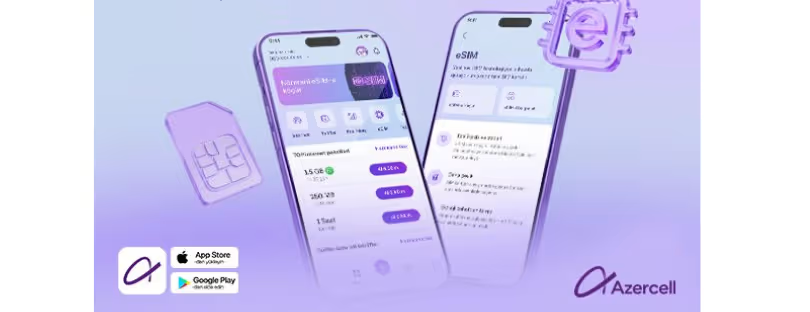
The company has introduced a fully digital way to switch from a physical SIM to eSIM, directly inside its mobile app. No store visits. No support tickets. No friction. Just a few taps and you’re done.
On paper, that might sound like a simple feature update. In reality, it’s exactly the kind of user experience upgrade the industry has been slow to deliver.
The End of the SIM Swap Ritual
Until recently, moving to eSIM often came with unnecessary steps. Even in 2025, many operators still require you to visit a store, scan a printed QR code, or go through customer support just to activate something that is, by definition, digital.
Azercell is removing that entire layer.
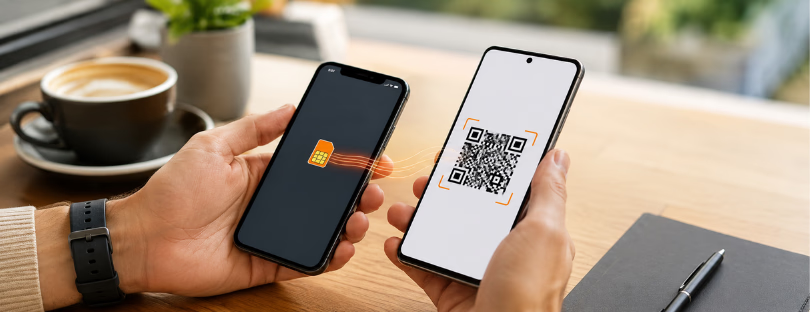
Inside the app, users can now enter their phone number and ID details, verify via OTP, and complete the transition in minutes. The eSIM can be activated either through a generated QR code or a guided in-app process. The QR code is also sent via email as a backup.
It’s simple, but that’s exactly the point.
This is what eSIM was always supposed to look like.
Why This Actually Matters
eSIM isn’t new anymore. Most modern smartphones support it. Global travel eSIM providers have built entire businesses around it. But telecom operators have lagged behind when it comes to user experience.
What Azercell is doing here is closing that gap.
By removing physical touchpoints, they’re aligning with how users already expect digital services to work. Think about banking, ride-sharing, or even airline check-ins. Everything happens in-app, instantly. Telecom has been one of the last industries to fully catch up.
This move also reinforces one of eSIM’s biggest advantages: flexibility.
Users can manage multiple numbers on a single device, switch between profiles, and move between devices without dealing with plastic cards. For frequent travelers or business users, that’s not just convenience, it’s operational efficiency.
A Broader Industry Shift
Azercell isn’t alone in this direction, but it’s still ahead of many traditional operators.
Across Europe and Asia, we’re seeing a slow but steady transition toward fully digital onboarding and eSIM management. Operators like Orange and Vodafone have introduced app-based flows, but they’re often inconsistent or still tied to legacy processes.
Meanwhile, global eSIM-first players like Airalo or Yesim built their entire experience around instant activation from day one. That’s why they’ve been able to scale so quickly with travelers.
What’s interesting now is the convergence.
Traditional telecom operators are starting to adopt the same UX principles that made eSIM startups successful. Fully digital onboarding, instant provisioning, and minimal user friction are becoming the baseline, not the differentiator.
Azercell’s update fits directly into that trend.

The Real Play: Reducing Friction
If you zoom out, this isn’t really about eSIM. It’s about friction.
Every extra step in a telecom process creates a drop-off. Store visits, paperwork, waiting times. All of it adds up. And in a market where switching providers is getting easier, those inefficiencies matter more than ever.
By enabling a complete eSIM transition inside the app, Azercell is effectively removing one of the biggest friction points in the customer lifecycle.
That has implications beyond just user experience. It impacts retention, acquisition, and even operational costs.
Fewer store visits mean lower overhead. Faster onboarding means higher conversion. Better UX means stronger customer loyalty.
Where This Leaves the Market
According to the GSMA, eSIM adoption is expected to accelerate significantly over the next few years, driven by device compatibility and operator support. But adoption alone isn’t enough.
The real competitive edge will come from how seamless the experience is.
Azercell’s move suggests they understand that.
Conclusion
What Azercell just launched isn’t groundbreaking technology. It’s something more important: a properly executed experience.
And that’s where the industry is heading.
eSIM is no longer an innovation. It’s the expectation. The real battle now is about who delivers it in the most seamless, invisible way.
Compared to many operators still stuck in semi-digital processes, Azercell is clearly moving faster. But they’re also responding to pressure from a new generation of eSIM-native players who’ve already set the standard.
The takeaway is simple. In telecom, the winners won’t be the ones who offer eSIM. They’ll be the ones who make you forget the SIM ever existed.