They know how to buy traffic. They know how to run airport-style ads. They know how to rank for “best eSIM for Japan” or “Europe eSIM data plan.” They know how to push a discount code at exactly the right moment, when someone is stressed, packing late, and trying to avoid roaming charges.
And then the customer travels.
The eSIM works.
The trip ends.
And the relationship quietly dies.
That is the uncomfortable part nobody likes to talk about in travel connectivity. A customer can have a perfectly good first experience and still never come back. Not because the product failed. Not because the price was wrong. Not because a competitor was dramatically better.
They simply had no reason to remember you.
The first-trip trap
Travel eSIM buying is often treated like a one-time emergency purchase.
The customer has a destination. They need data. They compare a few providers, buy a plan, scan a QR code, and move on. The brand is useful for a moment, but not necessarily memorable.
That creates a dangerous business model.
Every month, the company has to rebuild revenue almost from zero. New campaigns. New clicks. New affiliate traffic. New paid search spend. New “limited time” offers. New conversion pushes.
It looks like growth, but underneath, it is often just replacement.
You are not compounding customer value. You are renting attention again and again.
And in a category where many providers sell similar-looking country plans, similar data bundles, and similar “instant activation” promises, this becomes expensive very quickly.
Acquisition is not the same as loyalty
The eSIM industry loves acquisition because it is easy to measure.
Cost per click. Conversion rate. Coupon usage. Affiliate sales. App installs. First purchase revenue.
Retention is messier.
Did the customer travel again?
Did they remember the brand?
Did they open the app before the next trip?
Did they top up?
Did they switch to a regional plan?
Did they recommend it to a colleague?
Did they move from one-off tourist buyer to repeat traveler?
Most companies do not build around these questions. They build around the next campaign.
That is why so many eSIM brands are trapped in a first-purchase mindset. The customer journey ends at checkout, when in reality, that should be the beginning of the relationship.
No lifecycle, no second sale
The biggest missed opportunity is lifecycle marketing.
A customer who bought an eSIM for Spain is not just a Spanish customer. They may be a business traveler. A remote worker. A family planner. A conference attendee. A student. A frequent weekend traveler. Someone who will travel again in three weeks.
But if nobody builds the lifecycle around that behavior, the customer disappears into the database.
There is often no smart post-trip communication. No “where are you going next?” prompt. No travel pattern recognition. No loyalty logic. No seasonal nudges. No bundle recommendation. No reason to keep the app installed.
Even worse, many providers treat email and push notifications as promo channels only.
“Get 10% off your next eSIM” is not a retention strategy.
It is a discount with a subject line.
Real lifecycle marketing would look different. It would understand the traveler’s rhythm. It would separate business travelers from holiday buyers. It would know who needs multi-country coverage, who prefers unlimited plans, who only buys small data packages, and who travels to the same region repeatedly.
That is where repeat revenue starts.
The missing persistent strategy
There is a bigger shift coming in travel connectivity.
The strongest eSIM companies will not just sell data for a destination. They will become the traveler’s persistent connectivity layer.
That means the customer does not think, “I need an eSIM for Italy.”
They think, “I already have my travel connectivity sorted.”
Persistent connectivity can mean many things: wallet-style balances, reusable eSIM profiles, annual day-pass models, regional plans, business travel accounts, app-based recommendations, or subscriptions for frequent travelers.
The point is not the product format. The point is the relationship.
A one-time eSIM product starts from zero before every trip.
A persistent connectivity strategy starts from memory, trust, and previous usage.
That is the difference between a transaction and a revenue loop.
The painful revenue reality
Here is the brutal part.
Many eSIM providers are not actually growing repeat demand. They are just getting better at replacing churn with new customers.
That works while acquisition is cheap.
But acquisition never stays cheap forever.
More providers enter the market. Affiliates compare harder. Search costs rise. Customers become more price-sensitive. Big platforms move closer to the booking moment. Airlines, fintech apps, OTAs, and travel wallets start bundling connectivity into their own journeys.
Suddenly, the eSIM provider that only knows how to win the first sale is vulnerable.
Because the best customer is not always the cheapest customer to acquire.
The best customer is the one who comes back without needing to be reacquired every time.
Repeatable loops beat one-off campaigns
This is where the conversation needs to change.
The next phase of eSIM growth will not be won only by better landing pages or louder promo campaigns. It will be won by companies that understand how to create repeatable revenue loops.
That means turning first-time buyers into known travelers.
Turning repeat purchases into loyalty, referrals, and higher lifetime value.
That is not just marketing. That is commercial architecture.
And it is where many eSIM companies still have a gap.
They have campaigns, but not loops.
They have offers, but not journeys.
They have buyers, but not retained customers.
eSIM customer retention – the real opportunity
For eSIM brands, the question is no longer only: how do we get more customers?
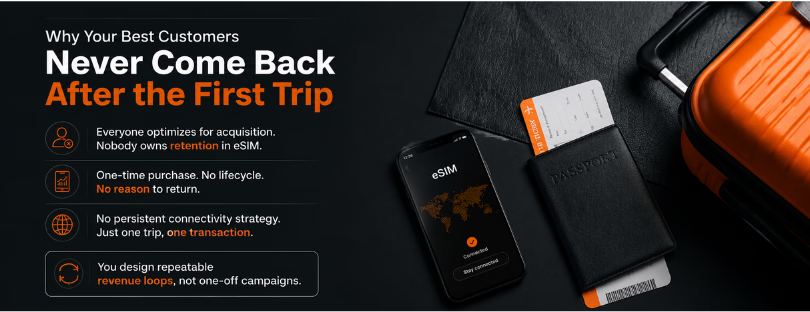
The smarter question is: why are our best customers not coming back after the first trip?
Because if the answer is “we never gave them a reason,” then the problem is not the customer.
It is the system.
The companies that fix this will stop rebuilding revenue from zero every month. They will still acquire new users, of course. But acquisition will feed something bigger: a retention engine, a travel memory, a repeatable commercial loop.
That is the difference between running one-off campaigns and building a serious eSIM business.
And it is exactly where Alertify fits.
We do not just help eSIM companies get attention for one launch, one offer, or one campaign. We help design the narrative, content, positioning, and buyer journeys that turn interest into repeatable demand.
Because in this market, the real win is not getting the first trip.
It is becoming the connectivity brand travelers remember before the next one.
Driven by wanderlust and a passion for tech, Sandra is the creative force behind Alertify. Love for exploration and discovery is what sparked the idea for Alertify, a product that likely combines Sandra’s technological expertise with the desire to simplify or enhance travel experiences in some way.