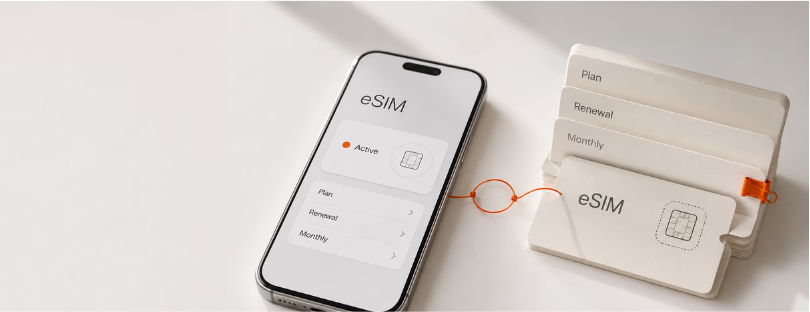
Motive Brings eSIM and Satellite D2D to LATAM
Motive used M360 LATAM in Mexico City to make a point that is easy to miss if you only look at telecom through consumer eSIM launches: the next phase of mobile growth is not just about selling more data. It is about making connectivity easier to activate, safer to trust, and available in places where traditional networks still do not reach. eSIM provisioning Latin America
The company, known for entitlement and connected device and service management, highlighted live deployments with Claro, Vivo, and Entel. These are not soft pilots. They sit in three areas that matter deeply for Latin America: satellite direct-to-device connectivity, large-scale eSIM provisioning, and SIM-based silent authentication as a replacement for fraud-exposed SMS one-time passwords.
The old model was built around SIM cards, stores, call centres, and coverage maps. The new one is being shaped by software layers that decide how quickly a device can be activated, how securely a user can be verified, and whether a customer can still connect beyond tower coverage.
Why entitlement matters now
The most interesting part of Motive’s announcement is that entitlement is becoming commercial infrastructure.
For Claro Brazil, Motive says the launch of iOS eSIM Quick Transfer helped drive 63% year-over-year growth in eSIM downloads, with 15% average month-on-month adoption growth. That matters because eSIM has often been framed as a consumer convenience. In reality, for operators, poor provisioning is a revenue leak. If activation feels confusing, customers delay, abandon, or keep using physical SIMs longer than they need to.
READ MORE: Best eSIM for South America 2026 — Tested for Consistency Across Carriers & Cities
Vivo Brazil brings a different angle. As Brazil’s largest operator, with more than 117 million subscribers, Vivo became the first in Latin America to launch SIM-based silent authentication via the GSMA Open Gateway framework, according to Motive. Instead of asking users to type SMS codes, the system uses invisible SIM verification. For banks, fintechs, marketplaces, and travel platforms, that is not a small change. SMS OTP is familiar, but also exposed to interception, SIM swap fraud, and user fatigue.
Silent authentication will not fit every use case. Some businesses will still need layered checks, especially for high-risk transactions. But as a baseline identity signal, network-level verification is becoming harder to ignore.

Satellite moves from promise to service
The Entel Chile deployment is the most strategically important part of the story. Motive says Entel became the first mobile operator in Latin America to deliver commercial mobile service via Low-Earth Orbit satellites, reaching more than 450,000 unique users across Patagonia and remote coastal communities.
That is where direct-to-device moves beyond keynote language. In regions with mountains, coastlines, rural routes, mining sites, islands, and emergency-risk zones, connectivity is not just a nice upgrade. It is a public service layer, a business continuity layer, and sometimes a safety layer.
Latin America may become a more serious proving ground than some mature markets. In dense urban economies, satellite-to-phone can look like a premium backup. In remote parts of Chile, Peru, Brazil, Mexico, Colombia, and Argentina, it can solve a more visible problem: there are still places where towers are not economically easy to build.
The competitive signal
Motive is not alone in this infrastructure race. G+D and NetLync have pushed Entitlements-as-a-Service for operators, Thales remains one of the strongest names in eSIM and remote SIM provisioning, and mobile identity players such as Sinch, Vonage, and Infobip are competing around verification, messaging, and authentication. On the satellite side, Starlink Direct to Cell, AST SpaceMobile, Lynk, and operator partnerships are all trying to define what “coverage everywhere” actually means in practice.
That is why Motive’s Latin America examples are useful. They connect three market movements that are too often discussed separately: eSIM activation, satellite reach, and telco-grade identity. Together, they show operators looking for new revenue beyond classic connectivity bundles.
Jay McMullan, VP Sales, Americas at Motive, put it directly:
“Latin America has some of the world’s most demanding connectivity challenges: remote geographies, fraud ecosystems exploiting legacy authentication, and eSIM adoption curves outpacing operator infrastructure. Claro, Vivo, and Entel aren’t running pilots. They’re in production, generating results, and already expanding.”
What this really tells us
For Alertify readers, the bigger story is not Motive alone. It is the changing role of the operator. They are becoming activation platforms, identity providers, satellite access partners, and digital service enablers.
That does not mean every operator should rush into every new layer. Smaller carriers may be better served by partnering, using managed entitlement solutions, or focusing on one priority first, such as eSIM transfer or fraud reduction. But the direction is clear. In markets where customers expect instant digital activation, secure login, and coverage in previously unreachable places, telecom infrastructure has to become more programmable.
Latin America is not waiting for a perfect future network. It is already testing the commercial version of it.