The Future of eSIM Is One Unified Connectivity Layer
For years, the eSIM industry loved complexity.
There was always another layer. Another platform. Another dashboard. Another acronym sitting quietly in the background, doing something “critical” that most users never saw and most executives pretended to fully understand.
You had provisioning vendors. Entitlement servers. Subscription managers. Connectivity orchestrators. Analytics layers. Policy engines. Device lifecycle platforms. Customer experience tools. Billing mediation. API gateways.
Every part of the stack had its own specialist.
That structure made sense when eSIM was still emerging. The ecosystem was fragmented, standards were evolving, and telecom companies were trying to fit a software-native technology into infrastructure originally designed decades ago.
But something is changing now.
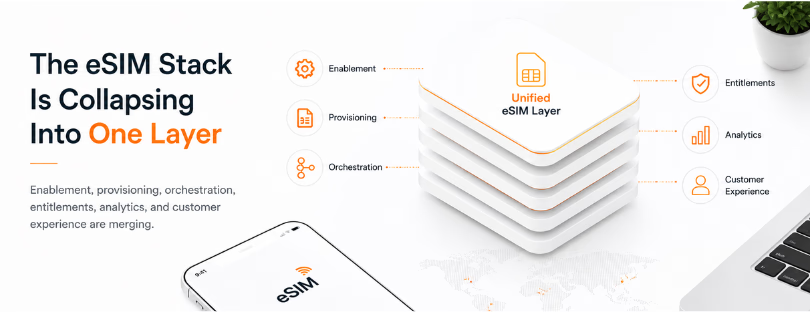
Quietly, and faster than many people realize, the eSIM stack is collapsing into a single operational layer.
Not literally one company. Not literally one platform. But functionally, the boundaries between enablement, provisioning, orchestration, entitlements, analytics, and customer experience are disappearing.
And that shift may become one of the most important structural changes in the entire eSIM market.
The old telecom model
Traditional telecom stacks were built like a bureaucracy.
Each system had one narrow job. One vendor controlled onboarding. Another handled SIM provisioning. Another managed billing. Another monitored usage. Another owned CRM. Another owned policy control.
Integration was painful but tolerated because operators themselves moved slowly.
The problem is that eSIM changes the pace of connectivity.
READ MORE: APIs Are No Longer a Differentiator in eSIM
When activation becomes digital, customer expectations change immediately.
Users do not care which layer failed.
They do not distinguish between entitlement logic, provisioning latency, authentication conflicts, roaming steering policies, or analytics synchronization.
They only see this:
“My eSIM doesn’t work.”
That single sentence forced the industry to rethink architecture.
Because once connectivity becomes software, the customer experience becomes inseparable from the infrastructure stack itself.
 Provisioning stopped being enough
 Provisioning stopped being enough
A few years ago, simply being able to provision an eSIM remotely was already impressive.
Now it is table stakes.
Most travel eSIM apps can generate QR codes. Most orchestration platforms can deploy profiles globally. Multi-IMSI capabilities are no longer rare. APIs are everywhere.
The real competition moved somewhere else.
Can the platform recover a failed installation automatically?
Can it detect device compatibility issues before purchase?
Can it optimize network selection dynamically?
Can it synchronize billing and usage visibility in real time?
Can customer support see orchestration-level diagnostics instantly?
Can the experience feel native instead of telecom-heavy?
That is why the stack is compressing.
Because modern connectivity products are no longer isolated telecom functions. They are operational experiences.
Operational experiences cannot survive across ten disconnected systems forever.

Apple accelerated this faster than expected
The industry still underestimates how much device manufacturers have changed the balance of power.
Once Apple normalized eSIM-only iPhones in markets like the United States, the customer relationship shifted dramatically.
The operating system suddenly became part of the telecom onboarding flow itself.
That matters enormously.
Device-native activation experiences changed customer expectations from “telecom setup” into “app onboarding.”
This is why entitlement infrastructure suddenly became strategic instead of invisible.
READ MORE: Provisioning Is Becoming the Boring Part of eSIM
Apple, Samsung, and Google are increasingly shaping how connectivity is surfaced, installed, recovered, and managed on the device layer itself.
That creates pressure for eSIM providers to simplify their internal architecture.
Because if the front-end experience becomes seamless, the back-end cannot remain fragmented chaos.
The companies winning right now are not necessarily the ones with the most infrastructure.
They are often the ones with the smoothest orchestration between layers.
APIs are becoming operating systems
One of the most interesting shifts in the market is that APIs are no longer just integration tools.
They are becoming telecom operating environments.
Look at what companies like 1GLOBAL, Gigs, Truphone for Finance and IoT services, eSIM Go, or even infrastructure-focused players like Telna are doing.
They are not simply exposing telecom functions anymore.
They are abstracting telecom complexity entirely.
That is a major difference.
The goal is no longer “here is connectivity.”
The goal is:
“Here is programmable connectivity embedded into your product.”
That changes the stack architecture completely.
Because once APIs become the primary product layer, orchestration, provisioning, analytics, customer management, entitlements, and lifecycle control all need to operate together in real time.
The old silo model becomes operationally inefficient.
Travel eSIM brands feel this pressure the most
Consumer-facing travel eSIM companies are entering a difficult middle phase.
On one side, they need increasingly polished customer experiences to compete with device-native flows and embedded connectivity ecosystems.
On the other side, they often still depend on fragmented enablement structures underneath.
That creates tension.
A travel eSIM brand may look beautifully simple on the surface while relying on multiple providers for provisioning, roaming agreements, analytics, fraud controls, customer support tooling, and entitlement management underneath.
The issue is not that this model is bad.
The issue is that margins shrink when too many operational layers remain disconnected.
READ MORE: The Entitlement Server Power Shift Behind Travel eSIM
Every additional dependency increases latency, support complexity, troubleshooting costs, and coordination overhead.
This is why the industry is moving toward tighter stack integration.
Not because integration sounds innovative.
Because operational economics eventually force it.

Analytics is no longer “reporting”
One of the biggest underreported shifts is the role analytics now plays inside connectivity itself.
Analytics used to mean dashboards after the fact.
Now analytics actively shapes orchestration decisions in real time.
That changes everything.
Platforms increasingly analyze:
- Network performance
- Device behavior
- Failed activation patterns
- Usage anomalies
- Roaming quality
- Fraud indicators
- Churn probability
- Customer support escalation risk
And those insights feed directly back into provisioning logic, entitlement handling, and customer experience flows.
This is where telecom starts looking more like cloud software than carrier infrastructure.
The stack is becoming self-adjusting.
Not perfectly. Not fully automated. But directionally, that is where things are heading.
The invisible winners
Ironically, the companies gaining the most strategic power may become less visible to consumers.
The market spent years obsessing over retail eSIM apps.
But the real leverage increasingly sits with whoever controls orchestration and lifecycle intelligence underneath.
This is why enablement players suddenly matter far more than they did three years ago.
READ MORE: Cerqle Showcases eSIM Orchestration Platform at MWC
The infrastructure layer is no longer passive.
It is becoming the actual operating core of digital connectivity experiences.
And once orchestration, entitlement logic, analytics, provisioning, and lifecycle management merge together, differentiation moves deeper into the stack.
Not higher.
eSIM orchestration platform – Final Thoughts
The eSIM industry is entering a phase where “connectivity provider” stops being a sufficient description.
The companies shaping the next decade are becoming connectivity operating systems.
That is an important distinction.
Some players are pushing toward vertical integration. Others are building orchestration layers that unify fragmented infrastructure through APIs and automation. Both models are trying to solve the same problem: telecom stacks became too operationally heavy for software-speed customer expectations.
You can already see the divergence.
Travel-first brands like continue competing heavily on customer acquisition and front-end simplicity. Infrastructure-focused players like 1GLOBAL, Gigs, and enablement ecosystems around orchestration and APIs are competing for something deeper: control of the operational layer itself.
That battle matters more long-term.
Because once provisioning becomes invisible, whoever controls lifecycle intelligence controls the experience.
And whoever controls the experience eventually controls distribution.
The irony is that the eSIM market spent years talking about digital SIMs when the real story was always software orchestration.
The SIM was just the entry point.