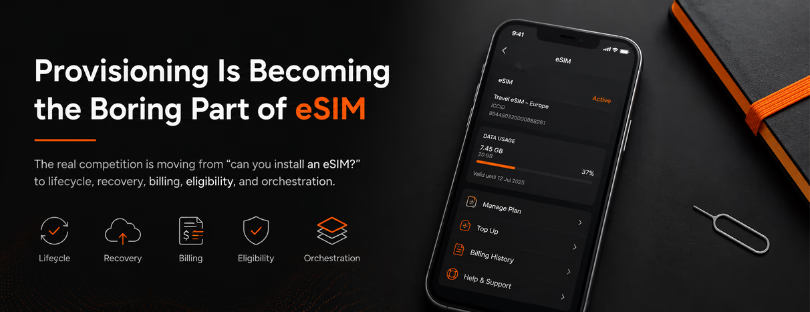
Provisioning Is Becoming the Boring Part of eSIM
For years, the eSIM industry treated provisioning as the headline feature.
Could you install an eSIM in under two minutes?
Did the QR code work?
How fast was activation?
Could the app automate setup?
That made sense in the beginning. The technology itself was still unfamiliar to most consumers, and even operators were learning how to handle remote SIM provisioning without breaking customer support systems in the process.
But somewhere over the last two years, provisioning quietly stopped being the hard part.
Today, most decent eSIM providers can activate a profile successfully. Apple normalized the experience. Android has improved significantly. QR flows became cleaner. Device compatibility lists became standardized. Even smaller providers can now plug into mature SM-DP+ infrastructure and launch globally without building everything themselves.
The install itself is no longer the differentiator.
What matters now is everything that happens after the installation.
That shift is subtle, but it is probably one of the biggest structural changes happening in the eSIM market right now.
The New Bottleneck
The consumer sees activation as the product.
The industry increasingly sees it as infrastructure.
That distinction matters.
Because once provisioning becomes relatively commoditized, the competitive advantage moves elsewhere: lifecycle management, entitlement, billing orchestration, recovery flows, fraud handling, network switching, account portability, and policy control.
This is why some travel eSIM providers feel polished while others still feel strangely fragile, even if both technically “support eSIM.”
READ MORE: Who Controls eSIM? The Entitlement Battle Begins
The difference is no longer whether they can issue a profile. The difference is whether the entire connectivity lifecycle behaves predictably after that moment.
What happens if a user changes devices mid-trip?
What happens if the app is deleted?
What happens when a customer accidentally removes the profile?
Can the provider recover the session without support tickets and manual intervention?
Can billing continue across multiple countries and network changes without confusing usage calculations?
Can the customer keep identity continuity across plans, regions, or subscription layers?
Those questions are becoming more commercially important than the original installation flow itself.
And interestingly, this is where many consumer-focused travel eSIM brands start colliding with telecom reality.
The Industry Is Quietly Moving Up the Stack
A few years ago, many eSIM brands competed primarily on coverage maps and gigabyte pricing.
Now the smarter players are talking about orchestration layers.
Not publicly, at least not always. But internally, absolutely.
You can see it in how companies position APIs, multi-IMSI logic, entitlement management, smart network selection, identity persistence, and embedded telecom services.
The conversation is slowly moving away from “we sell data” toward “we manage connectivity states.”
That sounds abstract until you realize how much complexity exists behind a seemingly simple travel connection.
A modern connectivity session now includes:
- Device eligibility
- OS entitlement logic
- Network steering
- Policy enforcement
- Billing reconciliation
- Identity mapping
- Fraud checks
- Recovery handling
- Subscription synchronization
- Cross-border compliance
The eSIM profile itself is increasingly just one component inside a much larger orchestration system.
This is also why infrastructure companies are becoming disproportionately influential in the ecosystem.
Consumers may recognize retail brands like Airalo or Holafly, but behind many consumer experiences sits a deeper infrastructure layer involving entitlement servers, provisioning platforms, roaming brokers, core networks, and API management systems.
And that layer is where some of the most important power shifts are now happening.

Provisioning Became Expected
There is a useful comparison here with payments.
Consumers no longer get excited because a card transaction works. That is expected.
The competition moved toward fraud prevention, embedded finance, identity continuity, subscription handling, instant settlement, loyalty orchestration, and platform integration.
eSIM is starting to follow the same path.
Provisioning still matters technically, but commercially, it is becoming table stakes.
Nobody markets “our QR code usually works” anymore.
Instead, providers increasingly compete on things like:
- Seamless recovery
- One-tap renewals
- Cross-device continuity
- Subscription flexibility
- Real-time spend visibility
- Embedded partner experiences
- Enterprise governance
- Smart activation timing
- Integrated billing logic
This is particularly visible in enterprise eSIM.
Companies like 1GLOBAL, Gigs, Truphone for Things (1GLOBAL IoT), and enterprise-focused platforms such as SureSIM by Utelize Mobile increasingly position themselves around control, visibility, orchestration, APIs, and lifecycle management rather than simple activation.
That is not accidental.
Enterprise buyers do not care whether a QR code scans in 20 seconds or 45 seconds.
They care whether 3,000 devices can be managed globally without operational chaos.
Recovery Is Becoming the Real UX
One of the least discussed areas in travel eSIM is recovery.
And honestly, this is where many providers still look immature.
The industry spent years optimizing onboarding while underinvesting in what happens when things go wrong.
But real telecom systems are defined by exception handling.
Lost devices. Reset phones. SIM deletion. App migration. Failed provisioning retries. Suspended accounts. Duplicate installs. Authentication mismatches.
Those are the moments where telecom stops looking like a clean software demo and starts revealing its operational depth.
READ MORE: What Is LPA in eSIM and Why It Matters
Apple’s device-native eSIM transfer capabilities changed user expectations significantly. Consumers increasingly expect eSIM to behave like cloud software, not like old telecom infrastructure.
If a customer loses access during a trip, they do not care which provisioning server failed. They blame the brand.
That means lifecycle resilience is becoming a brand issue, not merely a technical issue.
And this is exactly why orchestration layers matter more than ever.
Billing Is Still a Mess
Another uncomfortable truth inside the eSIM industry: billing remains surprisingly fragmented.
Many travel eSIM experiences still operate like disconnected prepaid wallets stitched together with APIs.
Usage synchronization delays, inconsistent expiry handling, top-up confusion, overlapping packages, unclear throttling policies, and unpredictable network switching still appear across the market.
The irony is that consumers increasingly expect SaaS-style subscription simplicity while much of telecom billing infrastructure still behaves like legacy roaming architecture wearing a modern UI.
That tension is becoming harder to hide.

Some providers are responding with annual plans, pooled usage, PAYG balances, or “always-on” connectivity models that abstract away destination-based complexity.
Others are pushing embedded telecom experiences directly into fintech apps, airlines, travel platforms, and enterprise software.
Again, the important point is not provisioning itself.
The important point is orchestration after provisioning.
The Quiet Rise of Telecom-as-a-Service
One reason this shift matters is because telecom is slowly becoming programmable.
That changes who can participate in the market.
A bank may not want to become an operator. An airline may not want to manage roaming agreements. A travel app may not want to build a telecom stack from scratch.
But they increasingly want connectivity embedded inside their customer experience.
That requires orchestration layers more than provisioning flows.
The winners in this environment may not necessarily be the loudest consumer brands. They may be the companies controlling lifecycle logic, entitlement infrastructure, identity continuity, billing abstraction, and partner APIs underneath the experience.
In other words: the invisible layers are becoming more valuable than the visible activation screen.
Conclusion
The eSIM industry spent years treating provisioning as innovation.
Now, provisioning is becoming plumbing.
And that is actually a sign of maturity.
The market is entering a phase where the most important questions are no longer “Can you install an eSIM?” but rather:
Can the experience survive complexity?
Can it scale operationally?
Can it recover gracefully?
Can it integrate into larger digital ecosystems?
Can connectivity behave like software instead of telecom bureaucracy?
That is a very different competitive landscape.
The companies still optimizing only activation flows risk becoming interchangeable. The companies investing in orchestration, lifecycle resilience, entitlement logic, and embedded connectivity infrastructure are positioning themselves much higher in the value chain.
You can already see this divergence forming between simple travel eSIM retailers and infrastructure-driven players building telecom-as-a-service ecosystems.
And historically, technology markets tend to reward the layer that controls continuity, not merely access.
Provisioning opened the door for eSIM.
Lifecycle orchestration may ultimately decide who owns the room.